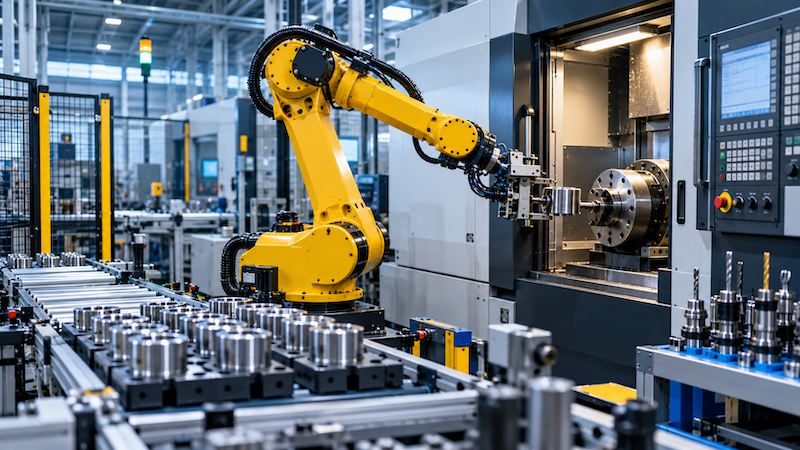
An automated production cell is a connected manufacturing system in which machines, robots, controls, sensors, and material-handling equipment work together with limited manual intervention.
What once required an operator to load every blank, start every cycle, remove every finished component, and carry parts onward can now happen as one coordinated sequence.
This shift does not mean every factory is becoming fully autonomous. In many plants, automation is happening one production cell at a time.
CNC machines are being connected to industrial robots, servo systems, machine vision, inspection equipment, automated storage, and manufacturing software.
Labor availability, machine utilization, production consistency, and the need to handle more varied production runs are accelerating the change.
What is an Automated Production Cell?
An automated production cell is a group of manufacturing machines and automation equipment arranged to complete one or more production operations as a coordinated system.
The equipment communicates through controllers, sensors, industrial networks, and software so that parts move through production with less manual intervention.
A simple cell might contain one CNC machining center and a collaborative robot. The robot retrieves a raw part, positions it in the machine, waits for machining to finish, removes the completed component, and places it onto a pallet.
More advanced cells can contain several CNC machines, industrial robots, measuring stations, conveyors, washing systems, and automated storage.
Automation exists on a spectrum. Common configurations include CNC machines with automatic loading, robot-assisted machining cells, multi-machine robotic cells, flexible manufacturing cells, and automated cells with integrated inspection.
A conventional CNC workstation can therefore evolve gradually rather than being replaced all at once.
Why Are Manufacturers Automating CNC Production Cells?
Manufacturers automate CNC production cells mainly to increase machine utilisation, reduce repetitive handling, improve consistency, and make production easier to scale.
CNC equipment represents a major capital investment, so every period in which a machine waits for an operator reduces productive capacity.
Automation can also reduce variation in loading and handling. Skilled machinists remain essential, but robotic systems can take over repetitive movements while operators focus on setup, programming, troubleshooting, process improvement, and inspection.
There are six major advantages:
- Increase machine utilisation: Keep CNC equipment producing for more of the available shift.
- Reduce manual handling: Automate repetitive loading, unloading, and transfer tasks.
- Improve production consistency: Repeat defined movements with less variation between cycles.
- Extend production hours: Suitable cells can continue operating during breaks or lightly staffed periods.
- Improve worker safety: Reduce interaction with sharp parts, heavy workpieces, chips, coolant, and moving equipment.
- Support flexible manufacturing: Reprogram cells for different products instead of building dedicated automation for each one.
The best automation projects usually start with a measurable production problem, not the robot itself.
How Does a CNC Machine Become Part of a Robotic Production Cell?
Turning a stand-alone CNC machine into a robotic cell requires the machining process, workholding, part presentation, motion system, controls, safety equipment, and process verification to work together.
Repeatability matters. The robot must find each component where expected, the fixture must locate it correctly, and the CNC must clearly communicate when each stage of the cycle is complete.
There are six main steps:
- Choose the process to automate: Identify repetitive loading, unloading, or transfer tasks.
- Standardize the workpiece: Ensure components can be located and gripped consistently.
- Add robotic handling: Select a robot or cobot with suitable payload, reach, and speed.
- Connect the controls: Coordinate machine doors, cycle starts, completion signals, and alarms.
- Add part storage: Use pallets, conveyors, drawers, bins, or feeders.
- Verify the process: Add sensing or measurement where required.
Motion control is particularly important because robotic joints, linear axes, indexing systems, and handling devices must move accurately and repeatedly.
What Equipment Makes Up an Automated CNC Production Cell?
An automated CNC production cell is a coordinated manufacturing system, not simply a machine tool with an attached robot. Every component has a specific role, and poor integration between otherwise capable equipment can limit the entire cell.
The exact architecture depends on machine type, component geometry, takt time, payload, floor space, accuracy requirements, and expected product changes.
Typical equipment includes:
- CNC machine tools
- Industrial robots or collaborative robots
- End-of-arm tooling and grippers
- Servo motors and servo controls
- Part feeders, pallets, and conveyors
- Machine vision and sensors
- Safety guarding and interlocks
- Inspection equipment
- PLCs and cell controllers
- Production monitoring software
Industrial Robots and Robotic Machine Tending
Robotic machine tending uses an industrial robot to load, unload, or transfer workpieces between manufacturing equipment.
In a CNC application, the robot may collect a blank, move it into the machine, position it in a fixture, and return after machining to remove the finished component.
Six-axis industrial robots are widely used because they can approach machines from several directions. Collaborative robots can also perform tending tasks when payload, speed, reach, and safety requirements allow.
Gripper design is equally important. A capable robot cannot compensate for tooling that fails to hold parts securely or consistently.
Servo Drives and Motion Control
Motion control is the technology used to regulate the position, velocity, and torque of moving machine components. In an automated cell, it may govern robot axes, rotary tables, linear slides, feeders, grippers, and indexing mechanisms.
A controller issues a command, a servo drive regulates electrical power to the motor, and feedback devices report actual motion so the system can correct errors.
This is why servo motor drives are important in robotic and automated machinery. They control motor motion based on the commanded position, speed, or torque.
Servo motor types, feedback systems, mechanical transmission, and control architecture all affect final performance. Accurate motion is especially important where equipment must repeat the same positioning task thousands of times.
How Do Robots Work With CNC Machines?
Robots work with CNC machines by exchanging control signals and performing programmed movements at defined stages of the machining cycle. The CNC controller manages machining, while the robot controller manages part handling.
A normal cycle begins when the robot collects a raw component from a pallet, drawer, conveyor, or feeder. It then positions the workpiece inside the machine.
Sensors can confirm correct placement before the robot leaves the machining area and the CNC cycle begins.
A typical sequence is:
- Retrieve the workpiece.
- Verify its orientation.
- Open the machine door or wait for it to open.
- Insert the part into the fixture.
- Confirm correct positioning.
- Move outside the protected area.
- Start machining.
- Wait for completion.
- Remove the finished component.
- Move it to inspection, storage, or the next process.
Reliable machine tending depends on predictable parts, repeatable fixtures, suitable grippers, accurate signaling, and collision-free robot paths.
How Can CNC Machining and Robotics Support Flexible Manufacturing?
CNC machining and robotics support flexible manufacturing by allowing one production cell to handle multiple parts or batches through programming, tooling, and workholding changes rather than major mechanical rebuilding.
CNC machines can store multiple machining programs, while robots can store matching handling routines. Automatic tool changers, adaptable grippers, quick-change fixtures, and pallet systems can reduce switchover time between products.
This approach is valuable for high-mix production where manufacturers handle several component families instead of one part in very high volume.
The same principle can extend beyond milling and turning. Waterjet cutting can also become part of automated production environments.
For example, electric servo pumps can provide the high-pressure water used in waterjet cutting systems. Electric waterjet pumps and servo waterjet pumps show how different manufacturing technologies can be incorporated into connected production cells when their processes are controllable and repeatable.
Where Does Quality Inspection Fit into an Automated Production Cell?
Quality inspection fits into an automated production cell by checking whether the process continues producing components within defined specifications. Detecting a problem early reduces the risk of producing an entire batch of defective parts.
Inspection can happen inside the CNC machine, between operations, or after production. In-machine probes can check position and selected dimensions, while robots can present components to vision systems, gauges, or automated measuring stations.
Common methods include machine vision, dimensional gauges, coordinate measuring machines, statistical process monitoring, and final inspection.
Automated inspection is particularly useful for identifying process drift. However, internal process monitoring is different from independent supplier quality control.
Companies outsourcing production may have less visibility into the supplier’s manufacturing process. In such cases, inspection services can check products during production while manufacturing is still underway.
This allows defects to be identified before an entire order is completed and adds an extra layer of verification when production is handled externally.
What Are the Main Challenges When Automating a Production Cell?
Production cell automation can increase capital requirements, introduce integration complexity, and create additional maintenance and safety responsibilities.
Automation also tends to expose inconsistencies that experienced operators previously corrected without documenting them.
A robot performs the sequence it has been programmed to perform. If incoming components vary unpredictably or fixtures collect chips, the cell needs sensors, error-handling routines, or process changes to cope with those conditions.
Six important challenges include:
- Increase initial investment: Robots, controls, tooling, integration, and safety systems require capital.
- Require integration expertise: CNC machines, robots, PLCs, sensors, and software must communicate reliably.
- Limit reliability when parts vary: Inconsistent components can cause gripping and positioning failures.
- Create more complex maintenance: More connected equipment adds more potential failure points.
- Demand careful safety engineering: Automated motion requires suitable guarding, interlocks, scanners, and risk assessment.
- Reduce efficiency when poorly matched: Highly unpredictable processes may be difficult to automate economically.
The best automation candidates are normally processes that are already stable and repeatable.
How Should Manufacturers Approach Production Cell Automation?
Manufacturers should start with one stable, measurable bottleneck, automate it carefully, and expand only after the new process performs reliably. This approach reduces risk and provides useful operating data before further investment.
Cycle time alone should not determine where automation starts. Machine waiting time, operator travel, changeovers, inspection delays, work-in-progress inventory, and maintenance history can all reveal where production capacity is being lost.
There are seven practical steps:
- Identify repetitive production tasks.
- Measure cycle time and downtime.
- Standardize components and fixtures.
- Select appropriate CNC, robotic, and motion-control equipment.
- Design predictable material flow through the cell.
- Add process monitoring and quality checks.
- Measure results before expanding automation.
Scalability also matters. A cell that begins with one robot and one CNC machine may later add another machine, automated inspection, material handling, or factory-level monitoring.
What is the Next Step Beyond a Robotic CNC Cell?
The next step beyond a robotic CNC cell is connecting multiple automated processes so materials, production instructions, machine status, and quality data move through the factory with less manual coordination.
Autonomous mobile robots can move pallets between cells. Automated storage can release materials based on production schedules, while inspection equipment can send measurements directly to quality or manufacturing systems.
Machine monitoring can identify downtime as it occurs. Predictive maintenance can use operating data to detect developing problems, while automated tool management can track tool usage across multiple machines.
Not every manufacturer needs a fully lights-out factory. Several reliable semi-autonomous cells connected by effective production planning may provide more value than one extremely complex system.
The goal is not maximum automation. It is useful automation where it improves manufacturing performance.
Conclusion
Modern manufacturing automation increasingly focuses on connecting proven technologies rather than replacing an entire factory in one project.
A CNC machine can gain automated loading, become part of a robotic cell, and later connect to inspection, material handling, and factory-level systems.
The progression is straightforward: CNC machine, robotic machine tending, connected production cell, integrated inspection, and increasingly autonomous manufacturing.
Reliable execution is more demanding. Robots, servo systems, fixtures, sensors, software, safety equipment, and quality processes must all support the same production sequence.
Manufacturers can therefore start with one clearly defined bottleneck, prove that automation improves it, and expand from there as production requirements and technical experience grow.
