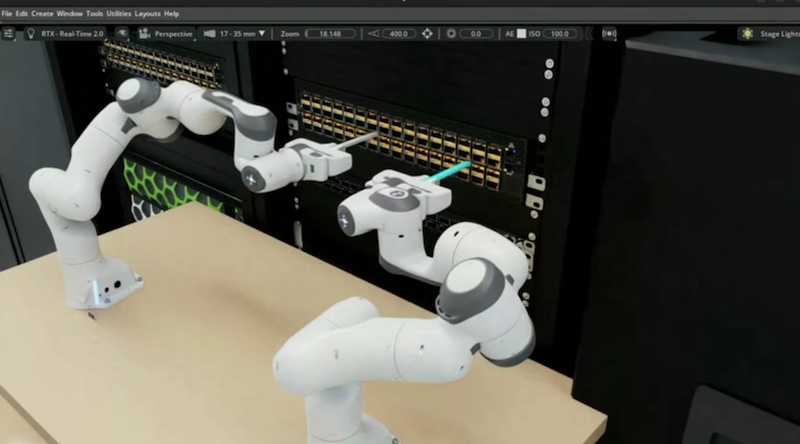
DataraAI is developing robotic automation technology designed to enable industrial robot arms to connect cables and other components during the assembly of AI servers and racks – a task that is still largely performed manually. (See video below.)
The California-based company is targeting operations including routing cables, seating connectors and handling wiring harnesses, where conventional industrial automation can struggle because cables change shape as they are manipulated and successful connections can be difficult to verify visually.
DataraAI says cabling can become a bottleneck in server and rack production because thousands of connections may need to be routed and terminated manually even when other parts of the manufacturing process have been automated.
The company is attempting to overcome the problem by combining robotic manipulation with simulations calibrated using data collected from real manufacturing operations.
Rather than generating a simulated environment first and attempting to transfer a robot’s learned behavior to the physical production line, DataraAI uses RGB-D vision, force and torque measurements, tactile sensing and motion data from real operations to calibrate its simulations.
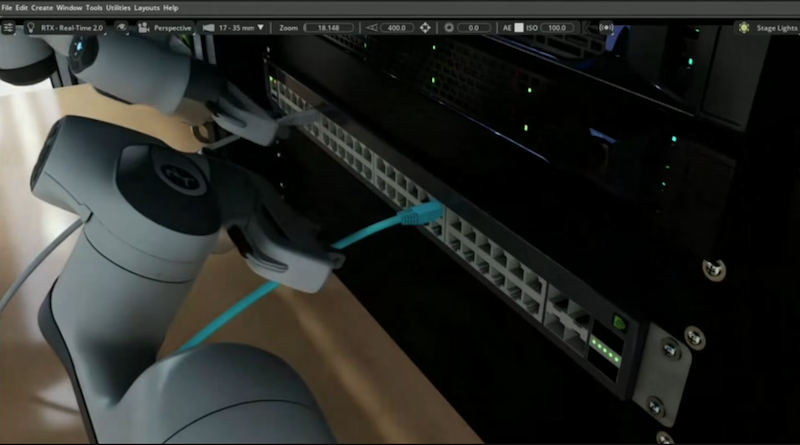
The approach is intended to address the so-called “Sim2Real gap”, where robotic systems that successfully perform tasks in simulation encounter problems when faced with the physical variability of real components and environments.
For cable insertion, for example, vision can determine the position of a cable and connector, while force and tactile information can help establish whether the connector has actually been seated correctly.
Durgesh Srivastava, CEO and founder of DataraAI, says: “Self-driving technology for industrial manufacturing did not reach autonomy by simulating more miles. It reached autonomy by driving real miles, building the simulator from them, and scaling from there. Industrial manufacturing needs that same order of operations.
“Rack output is gated at the cabling station, and manufacturers are asked to commit capital to automate a task no vendor has proven on their hardware. We calibrate against their rack and their connectors first, then show what holds before anything is purchased.”
DataraAI has also joined Arm Total Design for Physical AI, an ecosystem bringing together companies working across AI models, software, sensors, silicon and development tools for physical AI systems.
The company is also working with Arm on its Robotics Capability Framework, an initiative intended to establish a common way of describing and comparing the capabilities of different robotic systems.
Dermot O’Driscoll, vice president of go-to-market, physical AI at Arm, says: “Scaling physical AI from innovation to production requires systems that can operate reliably in the complexity and variability of the real world, where critical conditions can be difficult to reproduce accurately in simulation.
“DataraAI brings expertise in simulation accuracy to help close that gap, strengthening Arm Total Design for Physical AI and helping accelerate the path to production-ready physical AI systems.”
DataraAI specializes in simulation and training data for manufacturing automation, particularly AI server and rack assembly and other tasks involving deformable components and physical contact.
