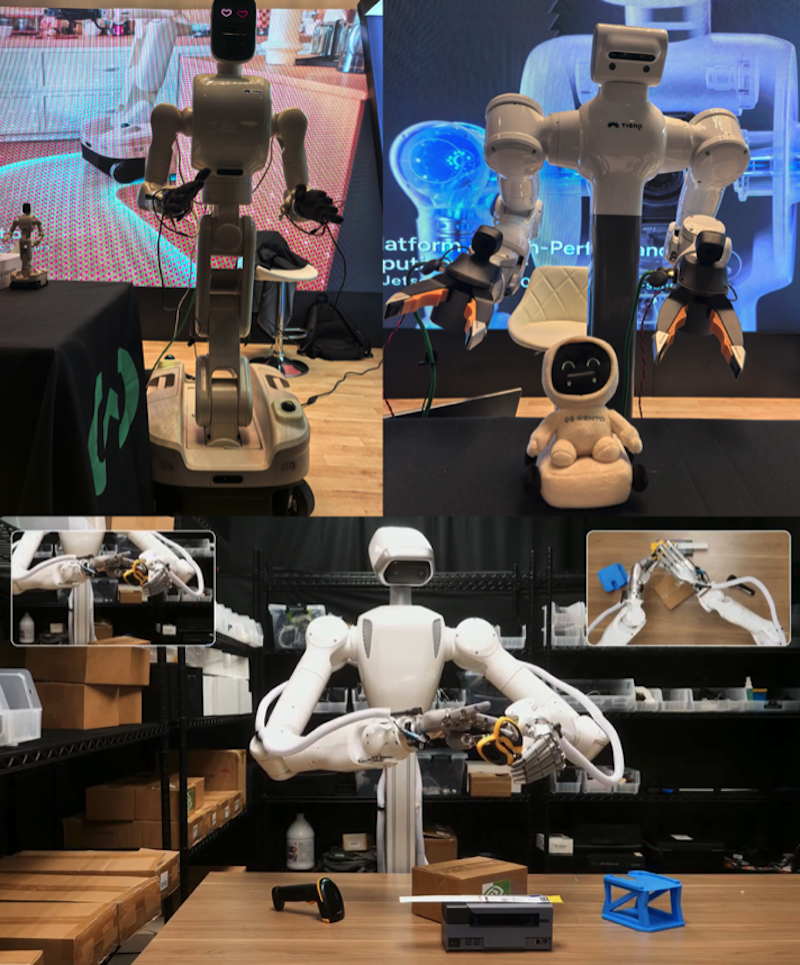
At CoRL 2026 in Austin, GENTO showed humanoid robots and a new dexterous hand that sit on top of a stack Tianji Intelligence has been building since 2015, starting with a single component most people never see.
Most conversations about humanoid robots start with the AI model. Far fewer start with the torque sensor inside each joint, even though that part decides how a robot reacts when it pushes against something. For GENTO, that is exactly where the story begins.
GENTO, an independent humanoid robot brand incubated by Tianji Intelligence, develops humanoid robot systems, dexterous hands and teleoperation and data-collection platforms. Its humanoid systems incorporate Tianji Intelligence’s TIANJI-branded force-controlled arms.
At CoRL 2026, one result of that approach appeared on a bigger stage. A TIANJI Marvin Pro platform, built for NVIDIA by Tianji Intelligence, was used in demonstrations accompanying NVIDIA’s GR00T 2 launch on Nov. 9. GR00T 2 is an open world action model built on NVIDIA Cosmos, and NVIDIA’s published research demonstrations show the platform assembling a toy truck and scooping granola with two hands.
A model like GR00T 2 needs a physical body to execute and evaluate what it has learned. Behind that body is a chain of components that starts inside each joint.
Starting With the Sensor
Tianji Intelligence was founded in Shenzhen in 2015 as an industrial robotics and motion-control company, incubated by Yaskawa Electric and Everwin Precision. In-house development of MEMS torque sensors began the same year. The company reports that these sensors offer 10 times the sensitivity of conventional strain-gauge designs without frequent recalibration.
When Tianji Intelligence moved into force-controlled humanoid arms in 2023 and 2024, it already had the sensing layer in house, along with four-loop closed-loop control and compliant impedance control, which regulates how a robot responds to contact.
Five Layers, One Chain
The company describes its products as a five-tier stack, with each tier building on the one below. MEMS joint torque sensors handle perception. Integrated joint modules, which combine motor, reducer, driver, encoder and brake in one unit and weigh about 25% less than comparable modules, handle actuation. TIANJI dual arms come next, followed by GENTO whole-body systems and, at the top, the GENTO 21-degree-of-freedom dexterous hand.
The arms are matched to different jobs. The TIANJI M6-Lite, rated for 3 kg, is aimed at data collection and light tasks, the M6 at data collection and workstation tasks, and the 20 kg M20 at heavy handling. All three have seven degrees of freedom and MEMS torque sensing at every joint. On the core arm platforms, Tianji Intelligence reports a minimum detectable torque of 0.02 N·m and absolute force-control accuracy within 0.3 N·m.
The Hand at the Top
The dexterous hand, which made its global debut as a prototype at CoRL 2026 in Austin, is where the stack comes together. It has five active degrees of freedom in the thumb and four in each of the other fingers. Its linkage-driven design is meant to tackle four mechanical problems together, namely backlash, damage from impacts and overloads, limited joint backdrivability, and fingertip force within a constrained finger size.
Some of its specifications point to practical use rather than lab display. According to the company, the hand has a maximum grasp diameter of 100 mm, a minimum opening and closing time of 0.5 seconds, a specified no-load grasping life of one million cycles and an industrial Ethernet interface.
A Supplier as Well as a Brand
Building the lower layers in house also lets Tianji Intelligence supply other companies. It reports more than 30,000 industrial robots delivered to more than 1,000 industrial customers, more than 2,000 force-controlled humanoid arms delivered within four months in 2025, and production or supply relationships with more than 45 robot manufacturers and embodied-AI companies.
The NVIDIA demonstrations are one example of that work showing up in other companies’ research. Tianji Intelligence also reports that the GENTO Luna platform serves as a real-robot testbed for Shengshu Technology’s self-evolving world model, Motus2.
Where it Goes Next
CoRL 2026 was GENTO’s first time at the conference, following its global debut at ICRA 2026 in Vienna. GENTO robots also arrived at the APEC China 2026 venue in Shenzhen to provide services during the meetings. Behind that activity, Tianji Intelligence closed a RMB 1 billion Series B and B+ round in May 2026 and a strategic Series B++ round in September.
GENTO’s tagline is “Touching the World Gently.” In practice, that idea starts with a torque reading of 0.02 N·m inside a single joint, and the company has spent more than a decade building everything else on top of it.
