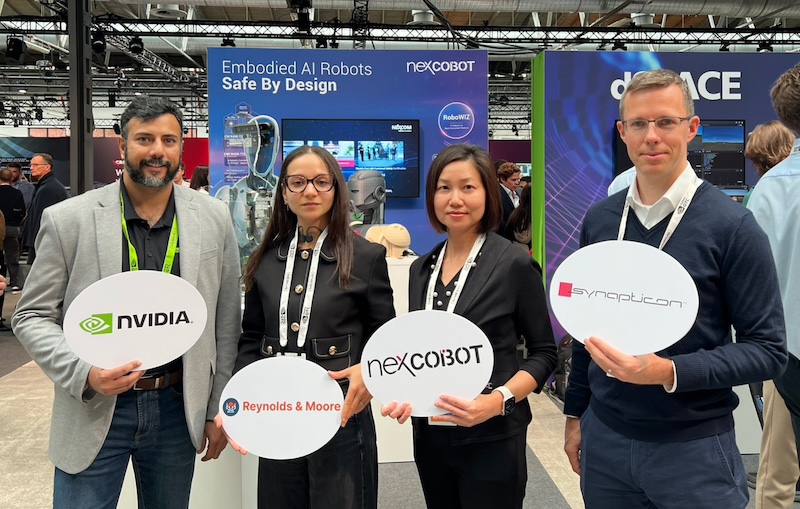
NEXCOM and its robotics subsidiary NexCOBOT have showcased their RoboWIZ AI Robotics Platform at Nvidia GTC Berlin, highlighting an open development ecosystem designed to simplify the integration of artificial intelligence, motion control, perception and safety technologies into robotic systems.
The presentation, held during the October 21–22 event in Berlin, brought together technology partners RealSense, Stereolabs, Synapticon and Reynolds & Moore, alongside NEXCOM’s robotics computing platform based on Nvidia IGX Thor.
RoboWIZ is intended to address one of the challenges facing robotics developers: bringing together the many different hardware and software technologies required to build an intelligent robot.
Rather than providing a complete robot with a fixed configuration, the platform allows developers to combine components, control systems and engineering services from different suppliers.
The approach is designed to support a range of applications, including humanoid robots, quadrupeds, mobile manipulators, collaborative robots and autonomous mobile robots.
Building an open robotics ecosystem
NEXCOM first introduced RoboWIZ at Automation Taipei in August 2026, where it demonstrated humanoid, quadruped and dual-arm robotic applications developed with technology partners.
Its appearance at GTC Berlin marked a further step in the development of the platform, with NEXCOM emphasizing its international partner ecosystem and the integration of additional robotics technologies.
RoboWIZ brings together five main areas of robot development: AI core control, functional safety and cybersecurity, visual perception, real-time control, and actuation and robot systems.
The AI computing layer supports technologies from Nvidia, Intel and Qualcomm, while other elements include cameras, sensors, servo drives, joints, grippers, dexterous hands and robotics software.
Developers can select components according to the requirements of their particular robot rather than being restricted to a single hardware architecture.
Through its RoboWIZ partner program, NEXCOM also provides a framework for technology suppliers to integrate their products with NexCOBOT controllers.
The company says this modular approach can help developers reduce the complexity of combining technologies from different suppliers, potentially shortening development and integration times.
Partners contribute perception, motion and safety technologies
Four technology partners featured prominently in NEXCOM’s presentation at GTC Berlin, each addressing a different part of the robotics development process.
RealSense contributes depth-sensing cameras and computer-vision technology that enable robots to perceive their surroundings. Such systems support navigation, obstacle detection, spatial awareness and object manipulation.
Stereolabs provides its ZED stereo-vision cameras and 3D perception software. The companies have previously collaborated on integrating Stereolabs’ vision technology with NEXCOM edge AI computing systems for robotics and industrial applications.
Synapticon specializes in motion-control and functional-safety technologies for robotic joints and actuators. Its EtherCAT-based SOMANET servo-drive technology combines motor control, communication and safety functions within compact modules.
Reynolds & Moore provides functional-safety engineering services, including risk assessments, safety-system design, validation and certification support.
Together, the four companies illustrate the different technologies and specialist services needed to turn AI software and robotic hardware into functioning machines.
Why functional safety matters for AI robots
One of the central challenges in developing advanced robots is ensuring that increasingly sophisticated AI systems can operate alongside reliable motion-control and safety mechanisms.
This becomes particularly important for humanoid robots and mobile manipulators, which may operate in environments shared with people.
Unlike conventional industrial robots working within fenced production cells, these machines may encounter unpredictable obstacles, changing surroundings and direct physical interaction with human operators.
Paul Schmitt, CTO of Reynolds & Moore, says there is no universal solution to these challenges.
Schmitt says: “There is no one-size-fits-all safety architecture for robotics. The right approach depends on the robot, its intended use, operating environment, hazards, and required risk reduction.
“As one of the early adopters of IGX Thor, NexCOBOT addresses this challenge with the MARS400 T20. It combines AI, motion control, and functional safety into one platform with T5000 specs and 8 GMSL camera inputs, providing developers high-performance processing power and a flexible, practical foundation for safety by design, system integration, and validation.”
The inclusion of functional-safety engineering within the RoboWIZ ecosystem reflects the need to consider safety throughout robot development rather than treating it as an additional feature once a machine has been built.
Nvidia IGX Thor provides computing foundation
Alongside its partner ecosystem, NEXCOM highlighted its MARS400 T20 robotics computing system, based on Nvidia IGX Thor.
The company originally introduced the system at Nvidia GTC in San Jose in March 2026.
The MARS400 T20 combines Nvidia Blackwell AI computing technology with NEXCOM’s capabilities in real-time motion control, functional safety and cybersecurity.
Its architecture is intended to support robotics applications that require substantial AI processing power while maintaining predictable control of physical movements.
This distinction is important because AI inference and robot motion control have different operational requirements.
AI models may process visual information, interpret instructions and generate actions, while the robot’s control systems must execute movements within precise timing constraints and respond appropriately to safety-critical conditions.
Bringing these capabilities together is one of the technical challenges RoboWIZ is designed to address.
The platform also provides eight GMSL camera inputs, allowing developers to connect multiple cameras for robotic perception applications.
From individual components to complete robotic systems
The broader significance of RoboWIZ lies in NEXCOM’s attempt to make robotics development less dependent on custom integration work.
Building a humanoid robot, for example, involves much more than selecting an AI model and installing it on a computing platform.
Developers must also integrate perception systems, communication networks, motor drives, actuators, safety functions and real-time control software.
These technologies frequently come from different suppliers, creating engineering challenges around compatibility, performance and system validation.
By bringing technology providers together within a common development ecosystem, NEXCOM aims to make it easier for robot manufacturers and research teams to assemble systems suited to their applications.
The company has not presented RoboWIZ as a single standardized robot design. Instead, it is positioning the platform as a flexible foundation for different robotic architectures.
Following its initial introduction in Taiwan in August and its European showcase in October, RoboWIZ represents NEXCOM’s expanding involvement in the development infrastructure for physical AI.
As robotics companies move from experimental systems toward commercial applications, the ability to integrate AI computing, sensing, motion control and safety technologies may become as important as the capabilities of the AI models themselves.
Main image, from left to right: Thejas Gupta Shivashankar, head of BD and partner ecosystem at Nvidia; Ferdaousse Ziari, director of engineering (Europe) at Reynolds and Moore; Jenny Shern, general manager of NEXCOM robotic solutions (NexCOBOT); Dr. Florian Weisshardt, head of Synapticon Intelligence
