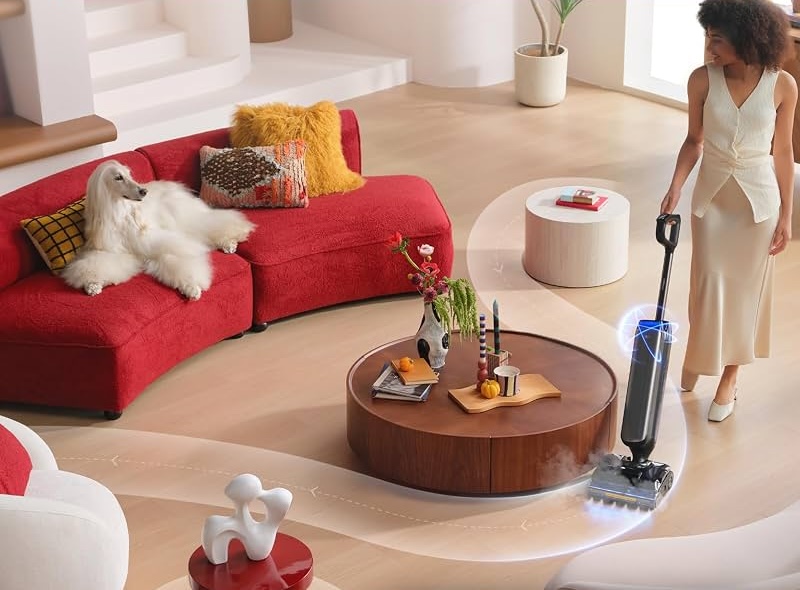
Most conversations about consumer robotics still gravitate toward humanoids.
Bipedal machines walking through a kitchen, manipulating household objects and eventually performing a broad range of domestic tasks remain one of the industry’s most visible long-term ambitions.
But another form of robotics is already entering homes in a much quieter way.
It does not have arms.
It does not walk.
And in many cases, consumers would not describe it as a robot at all.
Modern floor-care appliances are increasingly incorporating principles familiar from robotics and automation:
- sensing;
- closed-loop control;
- adaptive behavior;
- automated servicing;
- docking infrastructure; and
- reduced human intervention.
That does not make every smart vacuum cleaner a robot.
But it does make home cleaning a useful case study in how robotic principles are migrating into ordinary consumer products long before general-purpose domestic robots become commonplace.
Consumer robotics may arrive through specialization first
The distinction between specialized and general-purpose robotics is becoming increasingly important.
A humanoid is designed, in principle, to perform many different tasks.
A floor-cleaning system is designed to perform one task exceptionally well.
The trade-off is obvious.
A general-purpose machine offers flexibility.
A specialized machine can be optimized around:
- one environment;
- one class of sensors;
- one type of actuator;
- one maintenance routine; and
- one measurable outcome.
Cleaning is therefore a particularly strong early use case for consumer automation.
The task is repetitive.
The environment is constrained.
The outcome is relatively easy to observe.
And the value of reducing human labor is immediately understandable.
That is one reason robotic vacuum cleaners have become one of the most mature consumer-robot categories.
The same engineering philosophy is now appearing in manually guided floor-care systems as well.
Not every intelligent appliance is a robot
Terminology matters.
There is a meaningful difference between four categories.
Traditional appliance
A person selects a setting and the machine runs a largely fixed process.
Smart appliance
The machine adds sensing, connectivity or automatic adjustment.
Adaptive appliance
The system continually reads conditions and modifies its behavior in response.
Autonomous robot
The system perceives its environment, makes decisions, plans or executes tasks with substantially less direct human control.
Most current manually guided wet-dry floor washers sit in the middle of this spectrum.
They are not autonomous mobile robots.
A person still provides locomotion and decides where the machine goes.
But the cleaning process itself is increasingly adaptive.
That is the part worth examining.
Sensors are replacing fixed settings
Traditional floor-cleaning appliances typically operate at a preset level.
The user selects a mode.
The machine maintains that setting until told otherwise.
Newer systems increasingly use onboard sensing to modify cleaning behavior as conditions change.
Tineco’s iLoop sensor platform is one example of this broader trend.
Rather than requiring the user to judge dirt levels continuously, supported models use real-time dirt detection as an input to automatic cleaning control.
The Tineco STATION S9 Scientist Pro Wet Dry Vacuum Cleaner combines iLoop sensing with a broader automated floor-care system that includes a Smart Refresh Station, 5-liter water storage, automatic hot-water refill, 180-degree Lay-Flat operation and up to 100 minutes of stated runtime.
What matters from a robotics perspective is not the product specification by itself.
It is the control loop.
sense → interpret → adjust → continue monitoring
That is fundamentally different from a fixed appliance cycle.
Adaptive automation is more interesting than simple automation
Traditional automation is deterministic.
A button starts a predefined sequence.
The machine runs that sequence.
Adaptive automation adds feedback.
The device monitors changing conditions while the task is taking place and alters its response accordingly.
This is a basic principle across industrial automation, robotics and autonomous systems.
In consumer floor care, that may mean the system responds differently when it encounters a dirtier area rather than maintaining one constant level throughout the entire room.
The degree of adaptation remains far below that of an autonomous mobile robot with mapping, localization and path planning.
But the underlying architectural shift is similar:
- control is moving from fixed settings toward feedback-driven behavior.
The next frontier may be maintenance rather than cleaning
The more significant automation story may actually begin after the floor has been cleaned.
A wet-dry cleaner finishes a task with:
- dirty water;
- a damp roller;
- residue inside the cleaning path; and
- possible hair or debris around the brush system.
Traditionally, all of that becomes the user’s problem.
Increasingly, manufacturers are automating portions of the maintenance cycle.
Modern systems may:
- rinse the roller;
- flush parts of the internal pathway;
- dry the roller with heated airflow; and
- recharge automatically.
This moves automation from task execution toward system upkeep.
From an engineering perspective, that is important.
A useful machine does not only need to perform its primary task.
It also needs to remain ready for the next task.
The dock is becoming part of the robotic system
In industrial robotics, support infrastructure is rarely treated as an afterthought.
Charging.
Tool changing.
Material replenishment.
Calibration.
Servicing.
All of these can be part of the broader system architecture.
The same idea is emerging in domestic cleaning.
A docking station is no longer necessarily just a charger.
It can become a service node.
The Station S9 Scientist Pro demonstrates this clearly.
Its Smart Refresh Station stores 5 liters of water and can automatically replenish the cleaner with hot fresh water, while the system also supports hot-water self-cleaning and FlashDry.
This means the station is performing a role closer to robotic infrastructure:
- it provisions, services and prepares the device between tasks.
That is a more interesting automation story than simply adding another cleaning mode.
The machine and station should increasingly be evaluated as one system
Consumer electronics are often evaluated device by device.
Robotics is usually more system-oriented.
That may become the better way to think about advanced home cleaning too.
The relevant questions become:
- What does the handheld device sense?
- What does it adjust automatically?
- What maintenance can the station perform?
- Which resources must the user replenish?
- Which dirty components still require manual handling?
- How much human intervention remains across the full cycle?
A highly automated cleaning pass followed by ten minutes of manual servicing is less autonomous than the marketing may suggest.
The useful metric is not how many automated features exist.
It is how much total intervention remains.
The Tineco FLOOR ONE S9 Artist Steam Wet Dry Vacuum Cleaner shows another path
Not every advance in this category depends on a large station.
The S9 Artist Steam combines onboard sensing, wet-dry floor washing, HyperSteam, 180-degree Lay-Flat operation and automated self-cleaning.
Tineco currently lists up to 75 minutes of runtime, a 1-liter clean-water tank, 0.72-liter dirty-water tank and iLoop sensing on the US version.
From a robotics perspective, the interesting point is that several previously separate decisions are becoming embedded in the product:
- how intensely to clean;
- when to apply a specialist cleaning mode; and
- how to maintain the roller afterwards.
The user still steers the machine.
But the amount of low-level process management shifts toward the appliance.
Specialized robotics may remain competitive with humanoids for a long time
The current enthusiasm around humanoids often assumes that one sufficiently capable platform will eventually absorb many domestic tasks.
That may happen.
But specialized machines have structural advantages.
A dedicated floor-care system can be optimized around:
- floor-level geometry;
- fluid handling;
- roller design;
- edge cleaning;
- dirty-water separation;
- docking; and
- low-clearance access.
A humanoid performing the same job would need to manipulate a separate cleaning tool or develop an entirely different end-effector strategy.
That introduces more perception, grasping and motion-planning complexity.
For many household tasks, specialized automation may therefore remain competitive even after general-purpose domestic robots improve significantly.
Robotics & Automation News recently highlighted this same argument in a broader consumer-robotics context: specialized machines can reach useful reliability sooner because they solve a much narrower problem.
Mechanical engineering still matters as much as software
Consumer robotics discussions increasingly focus on AI.
But physical design remains a hard constraint.
A sensor can detect dirt beneath a sofa.
That does not mean the machine can reach it.
The Tineco S7 Stretch Ultra Wet Dry Vacuum Cleaner illustrates the mechanical side of the problem.
Its 180-degree Lay-Flat design is intended to let the body reach beneath low furniture, while DualBlock Anti-Tangle reduces hair wrapping around the roller. Tineco lists up to 50 minutes of runtime on the current US model.
None of those capabilities require AI.
They are mechanical solutions to physical constraints.
That distinction matters.
Good consumer robotics will always require both:
intelligence about the environment and a body capable of acting within it.
Steam is automation, not autonomy
The same caution applies to specialist cleaning features.
The Tineco S7 Stretch Steam Wet Dry Vacuum Cleaner adds HyperSteam and Lay-Flat capability.
That can automate more of the response to sticky or dried residue.
But steam itself should not be confused with intelligence.
It is an actuator.
The intelligent part lies in:
- when it is used;
- how the cleaning process is controlled; and
- how the machine responds to changing conditions.
This distinction becomes increasingly important as appliance marketing adopts words such as “AI,” “intelligent” and “smart.”
Not every advanced function is artificial intelligence.
What still separates these products from autonomous robots?
Three major capabilities remain limited.
1. Navigation
A manually guided floor washer does not independently decide where to travel.
The user controls the route.
2. Task planning
The appliance does not typically create a whole-home plan and sequence rooms autonomously.
3. Manipulation
It cannot move furniture, open doors, climb stairs or interact broadly with household objects.
That makes it fundamentally different from an autonomous mobile robot or humanoid.
The more accurate description is:
robotic principles embedded in a manually operated appliance.
That is less dramatic.
It is also more technically honest.
Human intervention is shrinking, not disappearing
The realistic trajectory is not zero human involvement.
Users still need to:
- fill or replenish consumables;
- empty dirty-water tanks;
- inspect filters;
- check rollers;
- confirm flooring compatibility;
- move the machine between levels;
- decide where cleaning is required.
Even an advanced station cannot make dirty water disappear from the home entirely.
The direction is therefore better described as:
fewer interventions per cleaning cycle.
That is a useful metric for comparing automation.
Privacy may become more important as consumer robotics gets smarter
One advantage of many manually guided floor washers is that they generally require less environmental mapping than autonomous robot vacuums.
That means they may not need to create the same detailed spatial model of the home.
As consumer robotics becomes more capable, buyers are likely to ask increasingly important questions:
- What sensors are collecting data?
- Is any mapping data stored?
- Does the device require cloud connectivity?
- What happens if the manufacturer’s servers are unavailable?
- Can core functions operate locally?
- How long is software support expected to last?
These issues become more important as appliances move further from electromechanical tools toward software-defined systems.
Maintenance automation may matter more than AI branding
The robotics industry often focuses on increasingly sophisticated perception models.
For home users, the most valuable advance may be much less glamorous.
Consider the tasks people dislike:
- handling dirty rollers;
- emptying small tanks repeatedly;
- removing wrapped hair;
- waiting for wet components to dry.
Automation that removes those tasks can create immediate value without requiring advanced generative AI or general-purpose reasoning.
That is why self-maintenance deserves more attention in consumer robotics.
It solves a real deployment problem:
how to keep an automated system operational without creating a new maintenance burden for the user.
What home-cleaning robotics may look like next
Several developments appear plausible.
More autonomous resource management
Stations may increasingly handle:
- water replenishment;
- cleaning solution;
- drying; and
- diagnostics.
Better condition sensing
Future systems may distinguish more precisely between:
- different levels of dirt;
- moisture conditions; and
- surface characteristics.
Predictive maintenance
Rather than waiting for a filter or roller to degrade, systems may increasingly estimate wear and alert the user before performance falls significantly.
Multi-device coordination
Robot vacuums, handheld wet-dry systems and other home devices may eventually share more information rather than operating as isolated products.
More local processing
As privacy becomes a larger concern, more sensor interpretation may happen on the device rather than in the cloud.
These are trends, not capabilities that should be assumed to exist universally today.
FAQ: What US, UK and European buyers are likely to ask about home-cleaning automation
Is a wet-dry floor washer actually a robot?
Usually not in the full autonomous sense. A manually guided wet-dry washer may use sensors and adaptive control, but the user still handles navigation. It is more accurate to describe it as a smart or adaptive appliance incorporating robotic principles.
What is the difference between a robot vacuum and a wet-dry floor washer?
A robot vacuum typically navigates autonomously using mapping and localization. A manually guided wet-dry washer is steered by the user but may automate cleaning intensity, water management and maintenance.
Will humanoid robots eventually replace specialist floor-cleaning devices?
Possibly for some tasks, but specialized cleaning machines have major advantages in cost, reliability and task-specific engineering today. General-purpose robots must solve much harder perception, manipulation and navigation problems.
Do smart floor cleaners require Wi-Fi or cloud connectivity?
Not necessarily. Many core cleaning and sensing functions can operate onboard. App and cloud requirements vary by model and should be checked before purchase.
Do these devices map the inside of the home?
Manually guided floor washers generally do not require the same whole-home mapping used by autonomous robot vacuums. Specific data collection depends on the model and app.
Are smart cleaning appliances a privacy risk?
Any connected device can create privacy considerations. Buyers should check what sensors are used, what information is stored, whether cloud services are required and whether core functions continue to work locally.
Can a wet-dry cleaner handle stairs?
The appliance may clean suitable hard-floor stair surfaces only if it can be safely operated there, but it cannot autonomously climb stairs. For many staircases, a lightweight dry vacuum remains more practical.
Can it replace a traditional vacuum in a carpeted US or UK home?
Usually not. Wet-dry floor washers are primarily designed for compatible hard floors. Carpet, rugs, stairs and upholstery generally still require a dry vacuum.
Are these machines suitable for pet households?
They can be useful for pet hair, muddy paw prints and food or water spills on hard floors. Anti-tangle systems can reduce hair wrapping, but they do not eliminate periodic maintenance.
Is steam safe on hardwood floors?
Not universally. The flooring manufacturer’s care guidance should take priority. Steam should only be used when the specific flooring product permits it.
What happens if the docking station is large?
This is increasingly important in US apartments, UK homes and European urban housing where floor space may be limited. Buyers should consider the station footprint, power access and water-management requirements before purchase.
Do self-cleaning systems mean zero maintenance?
No. They can rinse and dry rollers and automate parts of the cleaning path, but users still need to empty dirty-water tanks, check filters and perform periodic inspection.
How important is local servicing and spare-part availability?
Very important. A highly automated appliance is still a physical system with rollers, filters, batteries and seals that wear over time. Availability of replacement parts and service support can matter more than adding another software feature.
Is battery runtime the most important specification?
Not by itself. Tank capacity, floor area, cleaning mode, docking support and refill requirements all affect whether a machine can complete a useful cleaning session without interruption.
What is the most important automation feature?
For many users, automated maintenance may provide more day-to-day value than advanced app functions because it reduces the unpleasant work that follows wet cleaning.
The broader robotics lesson
None of this makes a wet dry vacuum mop equivalent to an industrial robotic arm, an autonomous mobile robot or a humanoid.
That distinction should remain clear.
But floor care is still a useful window into the direction of consumer automation.
Fixed settings are giving way to sensing.
Open-loop operation is giving way to feedback.
Passive docks are becoming service infrastructure.
Manual upkeep is becoming partially automated.
Physical design is being optimized around the environment.
Companies such as Tineco therefore offer an interesting consumer-scale case study for a much broader engineering trend.
Robotics may enter everyday life not through one dramatic machine capable of doing everything, but through dozens of increasingly specialized systems that quietly adopt the same principles:
sense, adapt, act, maintain and ask the human to intervene less often.
