By Tristan Harrison, MD, BearJam
Every business experimenting with AI-powered automation eventually asks the same question: how far do we take this? Get it wrong in one direction and you move slowly, while competitors don’t. Get it wrong in the other and you scale problems as fast as you scale output.
At BearJam, an AI-powered video production company, we’ve spent the past two years finding the point in between. And here’s what we’ve learned.
Start by deciding what should be automated, not whether it can be
We selectively use AI across the production process, including storyboarding, script development and selected voiceovers. While some projects can now be delivered almost entirely using AI, we’ve found it often works best when combined with live-action shooting, traditional post-production and human creative judgement.
The question that matters isn’t simply “can AI do this?” It’s “where in this workflow will AI genuinely make the work better?”
Highly specific branded assets, human performances and culturally sensitive details are usually still better handled by people.
AI lawyer Kelsey Farish explains an important ownership aspect: “Liability for AI (automation) output largely sits with whoever deploys it, not the platform that built the tool, so brands can’t outsource the thinking to their AI vendor’s terms and conditions.
“Instead, get ahead of it, decide, and say out loud, how and why you’re using AI, rather than hoping nobody asks.”
Build human checkpoints into the process, not around it
Responsible automation doesn’t mean moving fast and checking for problems at the end. On our projects, clients approve static AI-generated frames before we move into animation.
That means creative, brand and accuracy issues get caught while they’re still easier to fix, rather than after a full sequence has been rendered.
The principle generalises beyond AI video production: put oversight at defined points inside the workflow, not as a final sign-off bolted on afterwards.
Businesses should be thinking about the necessary approvals, audit trails and accountability when automation is involved and baking that into their processes uniformly.
Automation scales your errors as fast as your output
More concepts, more versions, more assets, in less time: yes, that’s the upfront pitch of automation, and it’s somewhat true. But the same speed that multiplies your output also multiplies mistakes: a wrong logo, an inaccurate detail, a cultural misstep, reproduced across every version before anyone notices.
Our experience is straightforward: the more specific the output needs to be, the more important human review becomes. Quality control has to scale alongside production volume and certainly not lag behind it.
Hybrid isn’t a compromise, it’s the model
Our approach is deliberately hybrid. AI accelerates the repetitive, time-intensive parts of production; people retain responsibility for judgement, editing, craft and quality control.
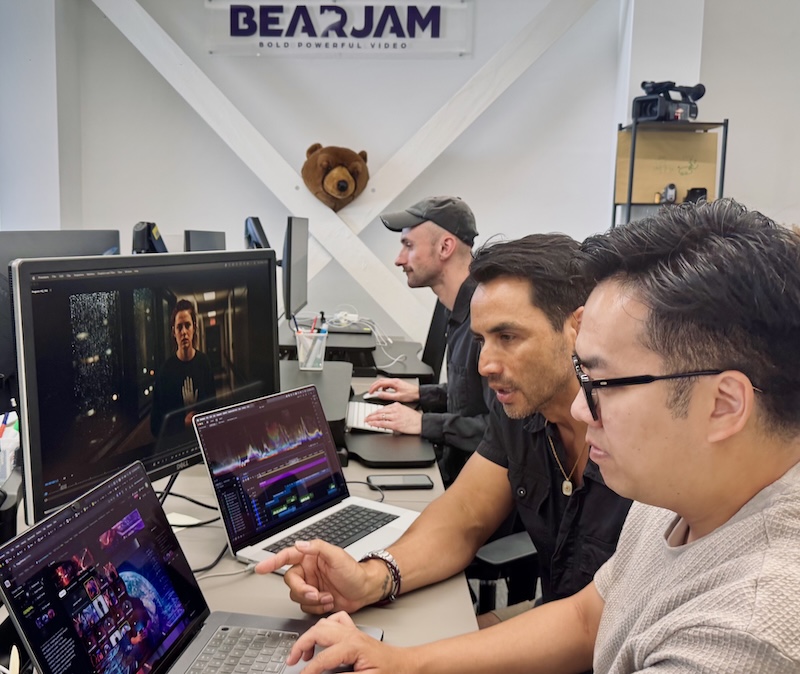
That split is also changing what “human expertise” looks like. We hired Brick Ng as an AI Artist for example, a role that didn’t exist before demand for AI production created it.
His background in graphic design lets him translate lighting, composition, lens choice and visual taste into AI workflows. Responsible automation isn’t just a process question, it’s also an investment in the people who operate, oversee and optimise the technological output.
Judge the whole workflow, not the automated step
Automating one stage doesn’t automatically make the whole process faster or cheaper. Consistent characters, precise human performances and complex scenes can still need heavy iteration and post-production, and in some cases traditional filming is simpler and no more expensive.
The goal should be a better overall process, not the highest possible number of automated tasks. That means being willing to switch between automated, traditional and hybrid approaches depending on the brief, rather than defaulting to whichever one is fashionable.
Clear limits make it easier to innovate, not harder
Knowing where you won’t use the technology is as much a part of responsible automation as knowing where you will. We’ve turned down projects we could technically deliver, including misleading before-and-after product imagery.
Having that line drawn in advance means the team can experiment freely within it, instead of re-litigating the same risk every time a new brief comes in.
Most importantly, businesses may need firmer red lines than “grey area but technically fine” because the legal or reputational downside outweighs the efficiency gain.
The goal is better-designed automation, not more of it
None of this requires slowing every process down with extra layers of sign-off. It means automating the right tasks, keeping human judgement where it adds value, and building checks into the workflow from day one rather than adding them after something goes wrong.
Our experience suggests the strongest model isn’t human versus AI. It’s a hybrid process that uses automation for speed and scale without designing expertise out of the system. Businesses can move quickly with automation, as long as responsibility is built into how the workflow operates, not bolted on after the fact.
About BearJam
London’s award-winning video production agency. Bold content for Netflix, Red Bull, Revolut and more. Corporate video, AI video, animation.
BearJam is the first hybrid AI UK video production company to commit 1% of revenue from AI-intensive projects to nature restoration, supporting the long-term restoration of a 69-acre habitat site in Kent.
