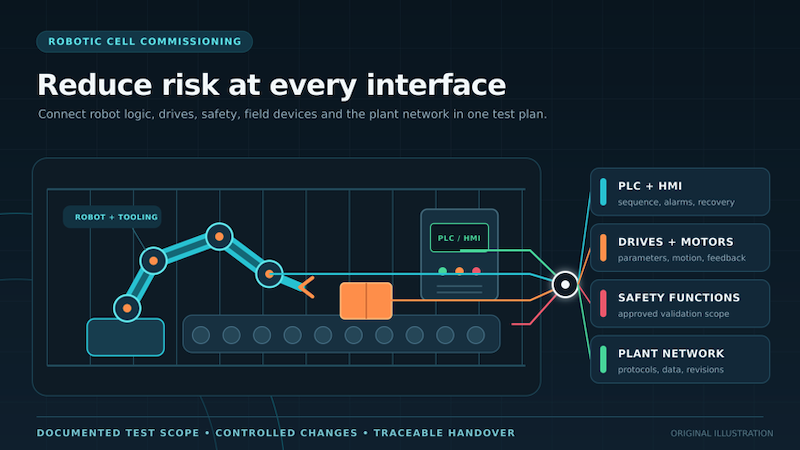
Commissioning a robotic production cell requires coordinated testing across robot controls, drives, safety functions, field devices, and plant networks.
A robotic cell can run cleanly during a shop demonstration and still lose hours when it reaches the plant. The robot may be ready while a drive uses the wrong parameter set.
A sensor can change state at a point the PLC sequence did not expect. Network traffic, field wiring, tooling, and upstream equipment add conditions that were absent from the original test setup.
Commissioning risk sits largely at those boundaries. A qualified systems integrator reduces it by treating the robot, controls, motion equipment, safety functions, and plant interfaces as one system with documented acceptance criteria.
Define the interfaces before the build
The commissioning plan should begin while the cell is still being designed. The team needs an approved controls narrative, I/O list, network map, equipment revisions, and clear ownership of each interface. It should also define what will be demonstrated at the integrator’s facility and what must wait for the installed site.
This turns a vague requirement such as “the cell runs correctly” into observable results. Each mode, alarm, permissive, handoff, and recovery state can then be tied to an agreed test and record.
Test behavior before site work
Factory testing gives the team a controlled place to expose logic and interface problems before production is waiting. Tests can cover ordinary operation along with approved fault and recovery cases, such as a missing part, a sensor timeout, a drive fault, or a lost communication path.
The principle is reflected in IEC 62381:2024, which describes factory and site acceptance tests as demonstrations against an applicable specification. Although the standard addresses process-industry automation, its planning lesson applies more widely: the owner, buyer, and vendor should agree on scope, responsibilities, and project-specific test procedures.
Connect robot logic with motion and controls expertise
Drives and motors sit at the boundary between a robot command and physical movement elsewhere in the cell. A commissioning problem may begin in parameter settings, fieldbus mapping, electrical installation, or the sequence between a conveyor and the robot rather than in the robot program itself.
For example, Riverside Drives describes its ABB integrator scope as including electrical installation, drive commissioning, application and drive selection, programming, troubleshooting, and Ethernet protocol enablement. Bringing those disciplines into the same test plan helps the team investigate the complete motion chain instead of isolating each device too early.
Recheck the cell in its final environment
Shop testing cannot reproduce every site condition. Site commissioning must account for the installed wiring, utilities, grounding, plant network, connected machinery, and real operating loads. The team should close factory punch-list items, confirm software and parameter revisions, and then execute the approved site procedure under the plant’s safety controls.
Electrical work also needs an appropriate safety boundary. Where it applies, OSHA 29 CFR 1910.333 requires safety-related work practices that match the electrical hazards and assigns specified verification and energized-work tasks to qualified people. A commissioning checklist does not replace the employer’s electrical-safety program or task-specific procedure.
Leave the plant with a recoverable system
Commissioning is easier to defend when the final record shows what was tested, which revisions were used, what changed at the site, and who accepted each result. The handover package should preserve approved software backups, drive parameters, drawings, open-item dispositions, and retest evidence.
A certified integrator cannot remove every startup variable. The practical gain is a commissioning process that finds interface problems earlier, controls changes, and leaves the plant with evidence it can use when the cell needs service months later.
