Blow-off is the compressed air use nobody has to think about. A valve opens, the part comes clean, the line moves on.
The electricity bill lands in a different department, with no note about which nozzle caused it.
Blow-off is an energy decision
Compressed air is one of the most expensive utilities in a plant.
According to the US Department of Energy’s compressed air sourcebook (DOE, Improving Compressed Air System Performance), as much as 80 to 93 percent of the electrical energy an industrial air compressor uses is converted into heat, which leaves very little for the air doing work.
Blow-off and drying are among the heaviest users. They run for long hours, at full line pressure, and often with the valve open longer than the part needs.
The sourcebook also lists open blowing among the potentially inappropriate uses of compressed air, meaning any application that can be done more effectively or more efficiently by another method.
Drying and clean-up are on its open blowing list, and blowers and blowers with knives are among the alternatives it names. That is not a ban. It is a prompt to find out what the job costs.
The arithmetic takes five inputs
You need the horsepower of the compressor feeding the blow-off, the hours per day it runs, the days per week, your electricity rate, and the number of identical lines.
Take one line as an example: a 50 horsepower compressor supplying blow-off around the clock, at $0.10 per kWh.
- 50 hp x 0.746 = 37.3 kW
- 24 hours x 7 days x 52 weeks = 8,736 hours a year
- 37.3 kW x 8,736 hours = about 325,900 kWh
- 325,900 kWh x $0.10 = about $32,600 a year
The example treats nameplate horsepower as the electrical load, a common shortcut. DOE’s own formula also divides by motor efficiency, which it takes as 90 percent, so the figure would rise by about 11 percent.
In the other direction, the example assumes the compressor sits at full load for every hour. Real machines cycle, unload and idle, so the true number is usually lower, sometimes much lower.
Where the energy goes
Two losses sit inside the blow-off number. The first is leakage. DOE says leaks can waste 20 to 30 percent of a compressor’s output, and that a typical plant that has not been well maintained loses about 20 percent.
On blow-off headers the usual culprits are quick-connects, hose splices, and nozzles left open between parts.
The second loss is pressure. A compressor delivers air at 100 psi or so, and a regulator at the station drops it to what the job needs.
Many blow-off and drying tasks need a lot of air at low pressure rather than a little air at high pressure, and the energy spent compressing to 100 psi is spent either way.
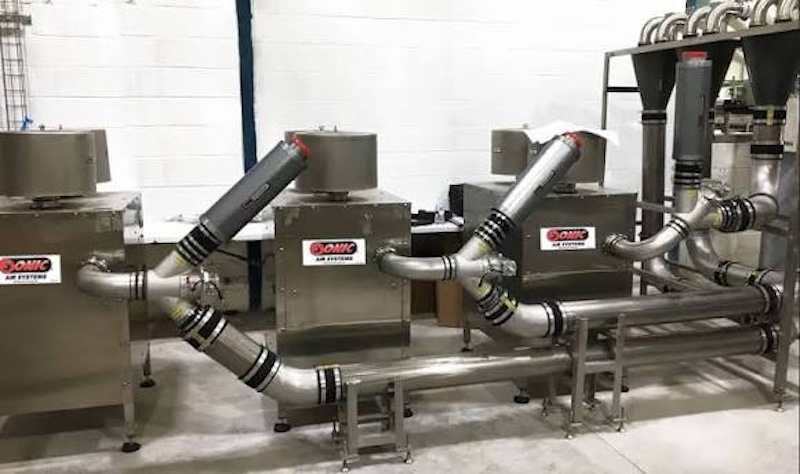
Air knife systems take the other route: a centrifugal blower feeds a full-width slot, so the low-pressure air is made directly instead of being throttled down from 100 psi.
Three ways to bring the figure down
Start with the existing system. Survey and fix the leaks, and put a solenoid valve on each station so air flows only while a part is present.
On lines with gaps between parts, the air is then off during the gaps instead of running through them.
Next, replace open pipes and drilled tubes with engineered nozzles, which pull in surrounding air and use less compressed air for the same effect.
Last, move the job off compressed air. Where a task needs volume at a few psi, as drying, debris removal and cooling often do, a blower-driven system can replace the compressed air outright.
What a blower will not do
Blowers are not a drop-in for everything. They move a lot of air at low pressure, so they suit drying, debris removal and cooling.
They do not suit cleaning blind holes, clearing fine passages or driving pneumatic actuators, which need real pressure.
A blower also brings its own noise, floor space and ductwork, and the saving depends on the motor you replace. Running the numbers first shows which blow-off stations are candidates and which should stay on compressed air.
Start with the line that runs the most hours
Pick the blow-off station with the longest runtime and put a logger on the compressor feeding it for one production week.
Compare the measured kWh with the arithmetic above. If they agree, you have the real cost of that line and a number to take to whoever owns the budget.
If they do not, the gap is usually a leak or an idle load nobody knew about, and that is worth fixing before anything else.
