Automation engineers spend most of their effort on PLC logic, motion control, robot cells and the integration between line equipment and higher-level systems.
The human-machine interface is often treated as the final layer, something configured once the control system works. In GMP production that order of priorities can backfire.
On a pharmaceutical filling line, in a biologics suite or in a sterile packaging area, the HMI is where operators start batches, acknowledge alarms, confirm line clearance and sign off critical steps. It shapes how the automation is used, how deviations are handled and how much of the process is documented reliably.
Why the HMI is a GMP-critical component
In regulated production, the HMI is usually much more than a display of tags. It is the place where electronic signatures are applied, where recipe parameters are selected and where audit trail entries are created.
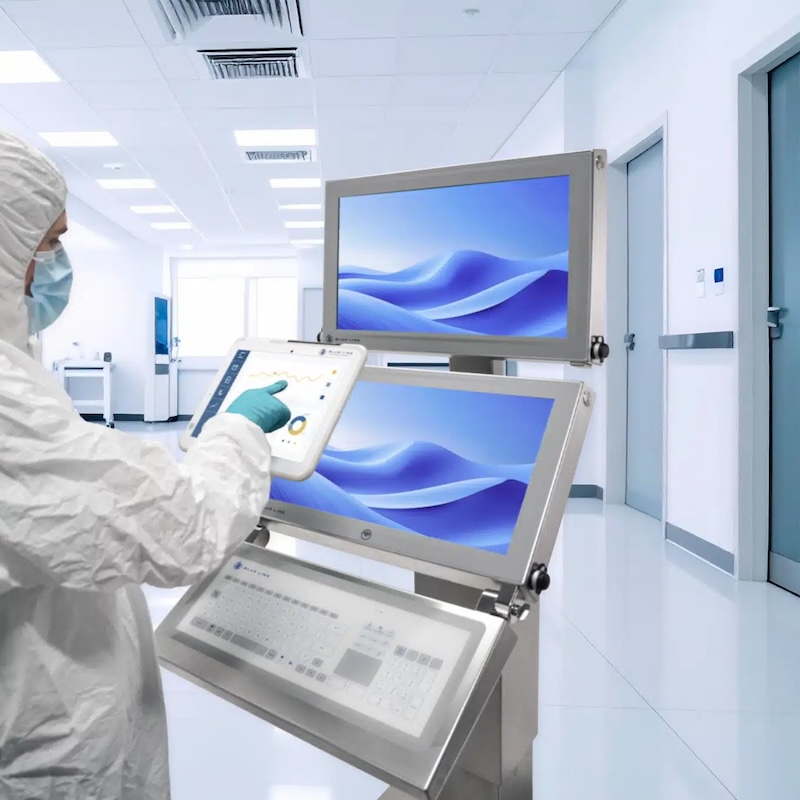
When the line runs inside a classified area, the interface is also physical equipment in the cleanroom, which is why many projects specify fixed cleanroom computers as dedicated operator panels rather than reusing industrial panels designed for general factory floors.
A general-purpose industrial panel PC is built to survive dust, vibration and temperature swings. A cleanroom HMI has a different job. It must not shed particles, must not disturb airflow, and must withstand repeated wipe-downs with 70 percent IPA and sporicidal agents.
In isolator and RABS environments it may also be exposed to vaporized hydrogen peroxide during bio-decontamination cycles. These requirements push the design toward fanless electronics, sealed stainless steel enclosures, flush-mounted glass and IP65 or IP69K protection on the front, and sometimes on all sides.
The consequence for the automation team is that the choice of HMI hardware is not purely an electrical or software decision. It belongs in the same discussion as the room classification, the cleaning regime and the contamination control strategy that EU GMP Annex 1 requires.
An HMI chosen late, after the line layout and the cleaning procedures are fixed, often ends up as a compromise that the quality team has to justify for the rest of the line’s life.
Interface design for gloved hands and validated workflows
Operators in Grade A and B areas wear sterile gloves, often two pairs, and sometimes work through isolator glove ports. That changes what a good interface looks like. Touch targets need to be larger than in an office application.
Projected capacitive touchscreens need to be tuned to register gloved input reliably without false touches from cleaning wipes or liquid on the glass.
Some sites prefer resistive touch or sealed membrane keyboards for specific tasks, and many add a dedicated cleaning mode that locks the screen while it is being wiped.
Screen layout also has a GMP dimension. An alarm summary that hides critical information behind several menus slows the response and increases the risk of an incorrect acknowledgement. An electronic signature dialogue that requires a long password typed on an on-screen keyboard with gloves invites shortcuts.
Many automation teams now pair the HMI with RFID badge readers or barcode scanners so that operators can authenticate quickly while preserving the attributability required by EU GMP Annex 11 and data integrity guidance.
Good practice is to prototype screens with real operators wearing their actual gowning before the design is frozen. Small decisions, such as button spacing, font size and colour contrast under cleanroom lighting, have a real effect on errors and training time, even if nobody tracks them formally.
A half-day session with a mock-up and a gowned operator usually reveals more than weeks of reviewing screenshots at a desk.
Mounting, integration and the line layout
Where an HMI sits is as important as what it shows. Wall-mounted terminals built flush into the cleanroom panel system leave the floor free and reduce horizontal surfaces. Pole or ceiling mounts keep the screen close to the machine and allow adjustment between operators of different heights.
Machine-mounted panels move the interface onto the equipment itself, which simplifies cabling but makes the HMI part of the machine’s own cleaning and qualification scope.
Each choice affects the automation architecture. A wall-integrated terminal may run a thin client connected to a SCADA server outside the cleanroom, which keeps most of the computing and its heat outside the classified area. A machine-mounted panel may connect directly to the PLC over an industrial Ethernet network.
Cable penetrations through the cleanroom wall need sealing that is compatible with the room’s pressure cascade, and connectors need to be cleanable or protected behind sealed covers.
Integration with line equipment is also a validation matter. Every interface between the HMI, the PLC and the MES needs defined data flows, tested during OQ and documented as part of the computerized system validation.
Treating the HMI hardware as a standardized, documented component makes that work repeatable across lines and sites, instead of a new exercise for each project. It also simplifies training, because operators who move between lines meet the same hardware and the same interaction patterns.
Lifecycle thinking: what happens after commissioning
A production line in a pharmaceutical plant may run for fifteen or twenty years. Operating systems, however, change on a much shorter cycle, and security patches are a continuous requirement. Automation teams therefore need a plan for keeping HMIs secure and supported without triggering endless requalification.
That includes locked-down operating system images, controlled patch procedures and hardware platforms with long availability, so that a replacement unit is functionally identical to the original.
Spare parts strategy deserves the same attention. A failed HMI on a filling line can stop production, and a replacement that must first be sourced, configured and qualified can extend that stop by days.
Keeping qualified spares on site, with documented images ready to deploy, is a modest investment compared with the cost of an idle line. Backup and restore procedures should be tested, not just written, so that the time to recover is known before it is needed.
The HMI rarely gets the attention given to robots or vision systems, yet it is the component operators interact with every minute of every shift.
In GMP production, designing it with the same care as the rest of the automation pays back in fewer deviations, faster training and a line that is easier to defend during inspection.
