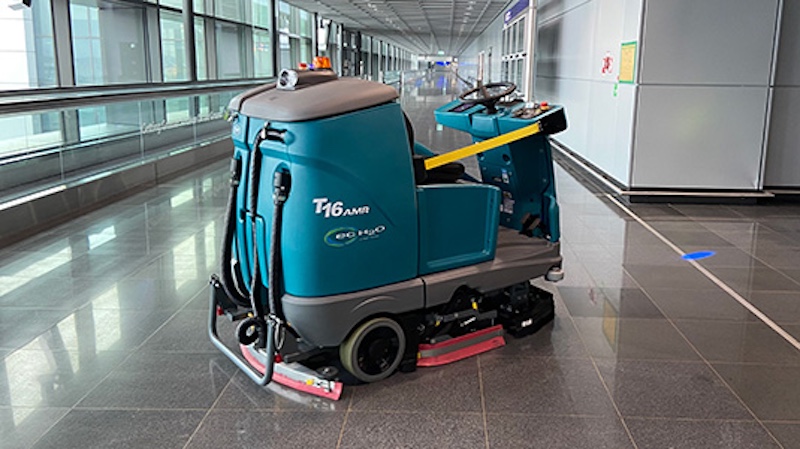
Tennant’s 2026 Sustainability Report details progress on renewable electricity, product emissions and technologies designed to reduce water, energy and chemical use
Commercial cleaning could be one of the most overlooked opportunities for businesses to reduce their environmental footprint, according to new data released by Tennant Company.
Publishing its 2026 Sustainability Report, the global cleaning technology company revealed that greenhouse gas emissions generated when customers use Tennant’s machines have fallen by 30 percent compared with its 2021 baseline.
Key findings include:
- Carbon emissions from operating Tennant cleaning equipment reduced by 30 percent since 2021
- 99 percent of global electricity sourced from renewable sources
- More than 8.2 trillion square feet of shared spaces cleaned using Tennant technologies during 2025
- In excess of $2 million donated to communities worldwide
- First Double Materiality Assessment completed to inform future priorities
This illustrates how even routine business operations such as commercial cleaning can play an important role in reducing emissions. Tennant also sourced 99 percent of the electricity used across its global operations from renewable sources during 2025.
Cleaning is a routine but resource-intensive activity across factories, hospitals, airports, warehouses, schools and retail environments.
Tennant’s results show that advances in battery-powered equipment, autonomous cleaning, detergent-free technologies and equipment remanufacturing are giving organisations more options to reduce water, energy and chemical consumption while maintaining cleaning performance and operational efficiency.
Alongside reporting progress, Tennant said 2025 marked an important year in strengthening the foundations of its sustainability strategy.
The company completed its first Double Materiality Assessment, bringing together insights from customers, employees, investors, suppliers and industry experts to help identify the environmental and business priorities that will shape future investment, innovation and sustainability targets.
Megan Wickmann, sustainability director at Tennant Company, says: “Organisations are increasingly looking at the environmental impact of everyday operational activities, including the energy, water and chemicals required to keep facilities clean and safe.
“During 2025, Tennant technologies were used to clean more than 8.2 trillion square feet of shared spaces worldwide in partnership with our customers. That scale means cleaning technology has a practical role to play.
“By improving efficiency, reducing resource consumption and extending the useful life of equipment, it can support customers’ wider sustainability objectives without compromising cleaning performance.
“Our results show meaningful progress, particularly in renewable electricity and emissions associated with product use. We are also transparent about where progress needs to accelerate.
“The work we completed during 2025 will help us focus our future targets and investment on the areas where Tennant and its technologies can make the greatest difference.”
With organisations facing increasing pressure to improve operational efficiency while meeting sustainability targets, Tennant believes commercial cleaning will play a growing role in helping facilities reduce resource consumption without compromising hygiene, safety or productivity.
