• Skip to primary navigation
  • Skip to main content
  • Skip to primary sidebar
  • Skip to secondary sidebar
  • About
    • Contact
    • Privacy
    • Terms of use
  • Shop
    • Cart
    • Checkout
    • My Account
  • Advertise
    • Advertising
      • Buy ad space
    • Case studies
    • Design
    • Email marketing
    • Features list
    • Lead generation
    • Magazine
    • Press releases
    • Publishing
    • Sponsor an article
    • Webcasting
    • Webinars
    • White papers
    • Writing
  • Subscribe to Newsletter

Robotics & Automation News

Where Innovation Meets Imagination

  • Home
  • News
  • Features
  • Editorial Sections A-Z
    • Agriculture
    • Aircraft
    • Artificial Intelligence
    • Automation
    • Autonomous Vehicles
    • Business
    • Computing
    • Construction
    • Culture
    • Design
    • Drones
    • Economy
    • Energy
    • Engineering
    • Environment
    • Health
    • Humanoids
    • Industrial robots
    • Industry
    • Infrastructure
    • Investments
    • Logistics
    • Manufacturing
    • Marine
    • Material handling
    • Materials
    • Mining
    • Promoted
    • Research
    • Robotics
    • Science
    • Sensors
    • Service robots
    • Software
    • Space
    • Technology
    • Transportation
    • Warehouse robots
    • Wearables
  • Press releases
  • Events

Opinion: Why robot dogs are leading the pack in factory floor efficiency

July 8, 2026 by Sam Francis

By Andrew Hamilton, head of the Digital Process Manufacturing Centre (DPMC) at the National Manufacturing Institute Scotland (NMIS)

Manufacturing facilities today are sprawling, interconnected environments where equipment operates continuously and processes stretch across large physical footprints.

From factory floors and plant rooms to service corridors and external assets, engineering teams need clear visibility across areas that are not always easy, or safe, to access.

Maintaining performance in these conditions depends on accurate, timely information and the ability to respond before issues escalate.

Achieving that level of insight, however, is not straightforward. Manual inspections remain common, requiring engineers to walk sites, take readings, and feed information back into separate systems.

The process is labour-intensive, varies from person to person, and becomes harder to sustain as facilities grow in scale and complexity.

Against this backdrop, robot dogs are increasingly being explored to support inspections, monitoring, and data collection without disrupting daily operations.

The broader growth in industrial robotics helps explain this shift. More than 542,000 robots were deployed in factories globally in 2024 – more than double the number a decade ago – and annual installations have now exceeded 500,000 units for four consecutive years.

While most remain fixed to production lines, manufacturers are increasingly exploring the use of mobile robots capable of moving through operational environments in ways humans cannot safely or efficiently reach.

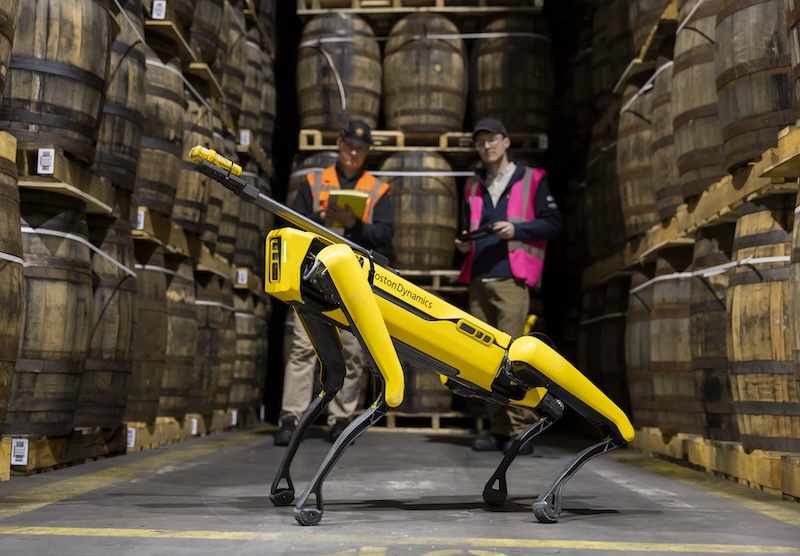
Robot dogs, in particular, are opening up new possibilities. Quadruped platforms such as Boston Dynamics’ Spot are designed to navigate spaces built for human movement rather than machinery.

Able to averse stairs, uneven surfaces, and confined areas, they are ideal for inspection and monitoring in parts of a facility that are otherwise difficult or hazardous to access.

Equipped with cameras, thermal sensors, or environmental monitoring tools, robot dogs follow predefined routes and collect time-stamped, location-linked data, providing a consistent, high-quality view of conditions across a site.

Beyond improving operational insight, robot dogs also enhance worker safety and efficiency. By taking on tasks in areas that would be risky for humans, they allow engineers and technicians to concentrate on analysis, decision-making, and process optimisation.

Far from replacing human teams, these autonomous platforms complement them, extending reach while reducing exposure to potentially dangerous environments.

Large and complex manufacturing sites are where this approach proves especially valuable. In maritime and shipbuilding settings, facilities often span multiple compartments, with work carried out by several contractors in parallel.

Robot dogs fitted with imaging or 3D scanning equipment can move through these spaces to verify installations, identify discrepancies, and reduce the need for repeated walkthroughs, helping teams maintain oversight as work progresses.

Process manufacturing presents a different, but equally practical, application. In drink manufacturing, where utilities such as carbon dioxide are central to day-to-day operations, close monitoring is essential.

Robot dogs can carry out routine checks, take meter and gauge readings, and monitor equipment condition using thermal or infrared sensing.

Where abnormalities are detected, alerts can be passed directly to maintenance teams, supporting planned interventions rather than unplanned downtime.

Deploying robot dogs also prompts manufacturers to think more critically about digital readiness. Once mobile robots are operating on the shop floor, questions around network coverage, data integration, sensor selection, and ownership of information come into focus.

For many organisations, this provides a practical way to explore digitalisation without the cost or disruption associated with retrofitting permanent sensing infrastructure.

The shift in digital readiness is shaping the direction of the technology itself. As payload capacities increase and software interfaces become more intuitive, integrating third-party sensors or analytics platforms now requires far less bespoke development than before.

Quadruped robots already provide tangible value for inspection and data collection, and manufacturers are exploring how these platforms can be tailored to address specific operational challenges.

As these capabilities advance, robot dogs are helping teams work more efficiently and respond proactively, giving early adopters a competitive edge and positioning UK manufacturing to take the lead in building safer and more resilient operations for the future.

About the author: Andrew Hamilton is head of the Digital Process Manufacturing Centre (DPMC) at the National Manufacturing Institute Scotland, operated by the University of Strathclyde. He leads research into digital manufacturing technologies, including robotics, AI, autonomous systems, sensing and data-driven industrial innovation, helping manufacturers adopt advanced technologies to improve productivity, safety and operational performance.

NMIS is operated by the University of Strathclyde and part of the High Value Manufacturing (HVM) Catapult.

Print Friendly, PDF & Email

Share this:

  • Print (Opens in new window) Print
  • Share on Facebook (Opens in new window) Facebook
  • Share on LinkedIn (Opens in new window) LinkedIn
  • Share on Reddit (Opens in new window) Reddit
  • Share on X (Opens in new window) X
  • Share on Tumblr (Opens in new window) Tumblr
  • Share on Pinterest (Opens in new window) Pinterest
  • Share on WhatsApp (Opens in new window) WhatsApp
  • Share on Telegram (Opens in new window) Telegram

Related stories you might also like…

Filed Under: Features, Industry Tagged With: Autonomous robots, boston dynamics spot, digital manufacturing, factory inspections, High Value Manufacturing Catapult, industrial automation, industrial robotics, manufacturing, mobile robots, National Manufacturing Institute Scotland, NMIS, predictive maintenance, process manufacturing, quadruped robots, robot dogs, University of Strathclyde

Primary Sidebar

Search this website

Latest articles

  • Opinion: Why robot dogs are leading the pack in factory floor efficiency
  • ABB Robotics completes Visual SLAM AMR range with autonomous forklift launch
  • A3’s Automate 2026 breaks records as demand for robotics, AI and automation grows
  • How to Build a Strong Insurance Strategy for Large Construction Firms
  • ExRobotics launches UL-certified inspection robot for hazardous industrial sites in North America
  • HelloFresh expands chilled warehouse capacity fivefold with Locus Robotics automation
  • RLWRLD launches open platform to benchmark dexterous robotic hands
  • Flytrex scales shared drone traffic system with thousands of coordinated flights
  • Robust.AI selects Aptiv’s AI-powered perception system for next-generation Carter warehouse robot
  • Agility Robotics to go public through $2.5 billion SPAC merger

Secondary Sidebar

Latest news

  • Opinion: Why robot dogs are leading the pack in factory floor efficiency
  • ABB Robotics completes Visual SLAM AMR range with autonomous forklift launch
  • A3’s Automate 2026 breaks records as demand for robotics, AI and automation grows
  • How to Build a Strong Insurance Strategy for Large Construction Firms
  • ExRobotics launches UL-certified inspection robot for hazardous industrial sites in North America
  • HelloFresh expands chilled warehouse capacity fivefold with Locus Robotics automation
  • RLWRLD launches open platform to benchmark dexterous robotic hands
  • Flytrex scales shared drone traffic system with thousands of coordinated flights
  • Robust.AI selects Aptiv’s AI-powered perception system for next-generation Carter warehouse robot
  • Agility Robotics to go public through $2.5 billion SPAC merger

Copyright © 2026 · News Pro on Genesis Framework · WordPress · Log in

We use cookies on our website to give you the most relevant experience by remembering your preferences and repeat visits. By clicking “Accept”, you consent to the use of ALL the cookies.
Do not sell my personal information.
Cookie SettingsAccept
Manage consent

Privacy Overview

This website uses cookies to improve your experience while you navigate through the website. Out of these, the cookies that are categorized as necessary are stored on your browser as they are essential for the working of basic functionalities of the website. We also use third-party cookies that help us analyze and understand how you use this website. These cookies will be stored in your browser only with your consent. You also have the option to opt-out of these cookies. But opting out of some of these cookies may affect your browsing experience.
Necessary
Always Enabled
Necessary cookies are absolutely essential for the website to function properly. These cookies ensure basic functionalities and security features of the website, anonymously.
CookieDurationDescription
cookielawinfo-checkbox-analytics11 monthsThis cookie is set by GDPR Cookie Consent plugin. The cookie is used to store the user consent for the cookies in the category "Analytics".
cookielawinfo-checkbox-functional11 monthsThe cookie is set by GDPR cookie consent to record the user consent for the cookies in the category "Functional".
cookielawinfo-checkbox-necessary11 monthsThis cookie is set by GDPR Cookie Consent plugin. The cookies is used to store the user consent for the cookies in the category "Necessary".
cookielawinfo-checkbox-others11 monthsThis cookie is set by GDPR Cookie Consent plugin. The cookie is used to store the user consent for the cookies in the category "Other.
cookielawinfo-checkbox-performance11 monthsThis cookie is set by GDPR Cookie Consent plugin. The cookie is used to store the user consent for the cookies in the category "Performance".
viewed_cookie_policy11 monthsThe cookie is set by the GDPR Cookie Consent plugin and is used to store whether or not user has consented to the use of cookies. It does not store any personal data.
Functional
Functional cookies help to perform certain functionalities like sharing the content of the website on social media platforms, collect feedbacks, and other third-party features.
Performance
Performance cookies are used to understand and analyze the key performance indexes of the website which helps in delivering a better user experience for the visitors.
Analytics
Analytical cookies are used to understand how visitors interact with the website. These cookies help provide information on metrics the number of visitors, bounce rate, traffic source, etc.
Advertisement
Advertisement cookies are used to provide visitors with relevant ads and marketing campaigns. These cookies track visitors across websites and collect information to provide customized ads.
Others
Other uncategorized cookies are those that are being analyzed and have not been classified into a category as yet.
SAVE & ACCEPT