Manufacturers have spent decades automating physical production. Robots assemble components, sensors monitor equipment, and control systems coordinate increasingly complex operations.
Yet many of the processes surrounding production still depend on manual data entry and communication. Information generated on the factory floor may need to reach maintenance, procurement, finance, logistics, or customer service. These handoffs are often managed through spreadsheets, emails, and disconnected business applications.
The next stage of automation is not limited to installing more machinery. It involves connecting operational systems with the software used throughout the rest of the organisation.
The divide between OT and business systems
Operational technology controls or monitors physical equipment. Business systems manage areas such as inventory, purchasing, finance, sales, service, and workforce planning.
These environments were designed for different purposes. Industrial systems prioritise reliability, safety, and real-time operation. Enterprise applications focus on transactions, records, and coordination.
As a result, important information may remain isolated. A machine can report deteriorating performance, but creating a maintenance ticket and checking spare-part availability may still require a person. A production delay may be visible to plant personnel before sales or logistics teams learn about it.
End-to-end automation requires a controlled method for transferring relevant events across this boundary.
From machine event to business action
Consider a packaging line reporting repeated temperature anomalies. The event should not automatically result in unrestricted changes to the machine.
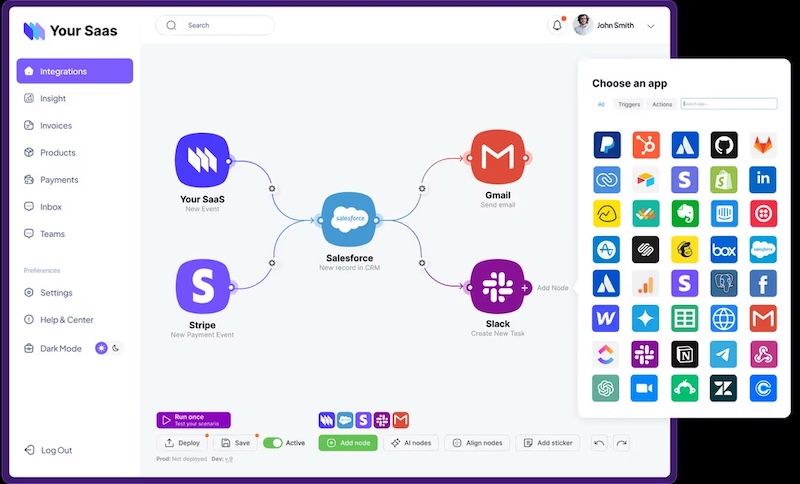
Instead, an integration layer can receive the approved event, enrich it with contextual information, and begin a business workflow.
The process might:
- verify the equipment and event type;
- retrieve recent maintenance information;
- create a ticket in the maintenance system;
- check whether a required component is available;
- notify the responsible engineer;
- update production planning if downtime is confirmed;
- inform customer-facing teams when delivery dates may be affected.
The industrial control decision remains within the appropriate operational environment. The workflow coordinates the administrative and informational consequences.
The role of integration platforms
Point-to-point integrations can solve individual problems, but they become difficult to manage as the number of systems grows. Each custom connection has its own authentication, mapping, error handling, and maintenance requirements.
An embedded integration platform can connect operational data with ERP, CRM, support, and analytics systems without rebuilding every integration independently.
This platform acts as an orchestration layer. It receives data through an API, webhook, message queue, or another approved interface and then applies business logic.
Validation is crucial. The workflow should confirm that incoming data follows the expected structure and originates from an authorised source. It should also prevent duplicate events from creating multiple orders or maintenance tickets.
Where AI agents can help
Industrial environments produce large volumes of logs, alarms, reports, and technical documentation. AI can help interpret this information before it enters a business process.
An agent might summarise a maintenance report, classify an incident, retrieve the relevant manual, or prepare a briefing for an engineer. It can also translate technical findings into a concise update for non-technical departments.
AI should not be allowed to issue arbitrary control commands. Any action affecting equipment, safety, production parameters, or access rights requires deterministic safeguards and, in many cases, qualified human approval.
The most useful architecture separates interpretation from execution. AI proposes or summarises; validated workflow rules determine which approved action may follow.
Connecting production to customer service
End-to-end automation can also improve communication after a product leaves the factory.
When a support case identifies a possible manufacturing defect, the information can be linked with the batch, component supplier, inspection records, and previous incidents. Quality teams receive a more complete picture without manually searching several databases.
If the investigation confirms a broader issue, an approved workflow can notify affected teams and create the necessary follow-up tasks. This shortens the distance between field information and production improvement.
Manufacturers can also use service data to identify recurring problems that are not obvious from factory measurements alone.
Security and governance remain central
Connecting systems expands the potential impact of compromised credentials or incorrect data. Integration should therefore follow least-privilege principles.
A workflow that reads equipment status does not need permission to change machine settings. An application that creates maintenance tickets does not need unrestricted access to the ERP.
Organisations should maintain logs showing which event initiated a workflow, what systems were accessed, which transformations occurred, and whether a person approved the resulting action.
They also need a safe response when a system becomes unavailable. Production must not depend on a fragile chain of cloud applications without appropriate fallback procedures.
A broader definition of automation
The factory of the future is not simply a collection of more capable robots. It is an environment in which physical events, operational data, and business decisions are connected through controlled processes.
Closing the gap between the factory floor and back office can reduce delays, duplicate data entry, and incomplete communication. More importantly, it allows the organisation to respond to production events as a coordinated system.
Industrial automation will continue to improve physical work. Workflow orchestration extends the same principles of consistency, visibility, and error reduction to the information moving around it.
