Choosing the wrong primary compression technology can leave a large manufacturing facility with avoidable energy costs, limited turndown, and an inflexible compressor-room configuration for years.
Plant designers commonly compare a dynamic centrifugal air compressor with a positive-displacement rotary screw system.
The right answer depends less on the size of the factory itself and more on its required airflow, operating pressure, demand stability, and air-quality requirements. Understanding these differences helps manufacturers select efficient infrastructure without sacrificing flexibility, reliability, or future production capacity.
Understanding the Mechanical Principles
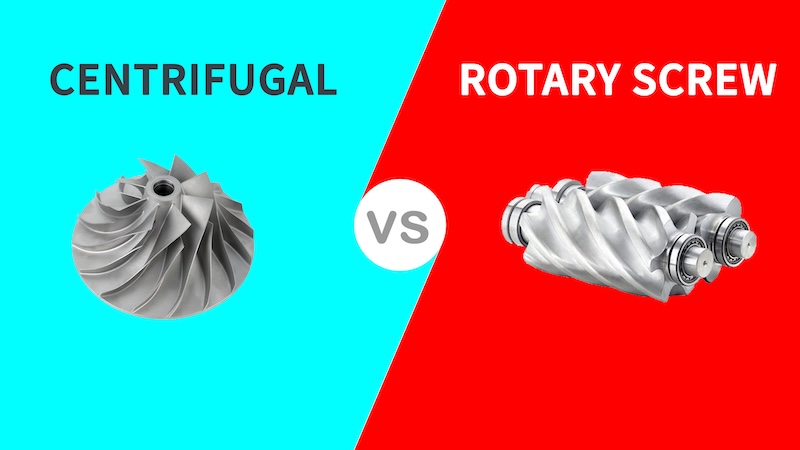
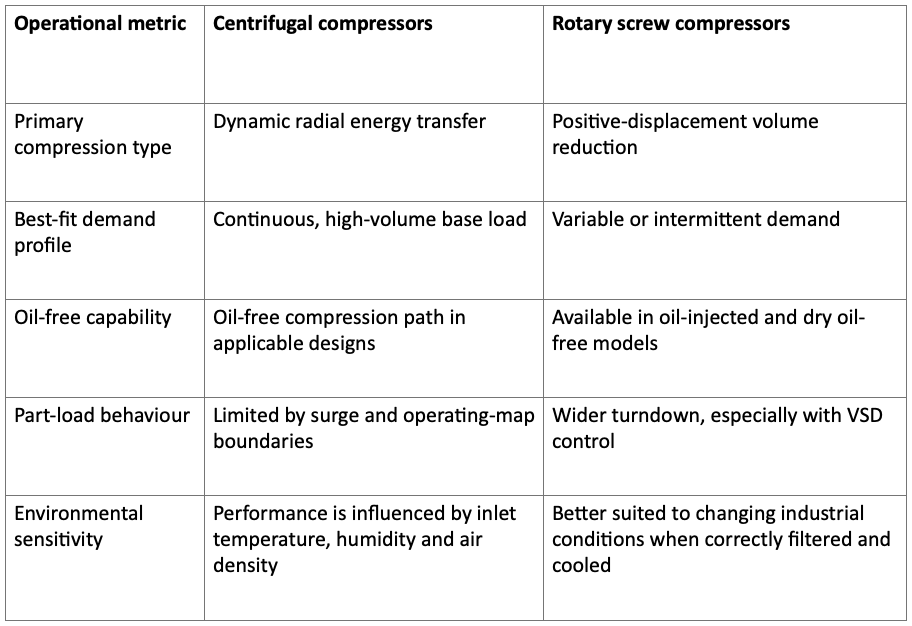
A rotary screw compressor works by drawing air between two intermeshing helical rotors. As the rotors turn, the available space decreases and raises the air pressure before discharge. This positive-displacement mechanism provides relatively stable air delivery across the compressor’s normal operating range.
A centrifugal compressor uses dynamic compression. A high-speed impeller accelerates incoming air radially, after which a diffuser converts part of that velocity into pressure.
Multiple stages and intercooling may be used to achieve the required discharge pressure efficiently. Unlike rotary screw technology, the machine does not reduce air volume inside enclosed compression chambers.
An integrally geared centrifugal air compressor uses a central bull gear to drive separate pinion-mounted impellers. This arrangement allows different compression stages to run at speeds suited to their aerodynamic requirements while retaining a compact layout.
Volumetric Flow and Base-Load Efficiency Profiles
Airflow volume is only one part of compressor selection. The plant’s demand pattern determines whether the system must prioritise steady base-load efficiency or flexible part-load response.
Centrifugal Compressors for High-Volume Base Load
A centrifugal air compressor is well suited to large facilities with continuous, high-volume demand. However, you need to evaluate pressure requirements, inlet conditions, cooling requirements, and consider expected plant expansion ideas before you commit to a unit.
This compressor fits the strongest where:
- Air demand remains relatively stable
- The compressor operates close to its design point
- High airflow is required for long production cycles
- Base-load efficiency is more important than wide turndown
Rotary Screw Compressors for Fluctuating Demand
Rotary screw compressors are better suited to plants where the airflow requirement changes across shifts, production lines or batch schedules.
When equipped with a Variable Speed Drive, the compressor adjusts motor speed to match changing demand instead of relying mainly on load and unload cycles. That allows the compressor to:
- Follow wide airflow fluctuations
- Reduce unloaded power consumption
- Support intermittent production schedules
- Operate effectively as a primary or trim compressor
Check out Atlas Copco’s optimal compressor selection guides before comparing system specs and finalising a unit.
The Turn-Down Difference
The core difference between a screw compressor and a centrifugal compressor lies in how they operate, and what they’re limited to.
Centrifugal compressors must operate within defined aerodynamic limits. If airflow falls too far below the stable operating range, the compressor can enter surge, causing unstable pressure and flow oscillations.
Rotary screw compressors generally offer a wider operating range, particularly with VSD control. They can respond more smoothly to changing demand, although minimum speed and pressure limits still apply.
Side-by-Side Application Criteria
Maintenance Footprints and Long-Term Lifecycle Costs
Rotary screw compressors require planned servicing of components such as filters, seals, bearings and drive systems. Oil-injected machines also require lubricant and separator maintenance, while dry oil-free screw compressors have their own service requirements.
Major overhaul intervals depend on compressor design, operating hours, environment and maintenance quality.
Centrifugal systems prevent oil from entering the compression chamber, but they are not maintenance-free. Depending on the design, they may include gears, bearings, seals, lubrication circuits, intercoolers and sophisticated control systems.
Labyrinth seals and magnetic bearings are separate technologies and should not be treated as standard features of every centrifugal machine.
Capital cost is only one part of the decision. A centrifugal compressor can offer strong lifecycle value where high-volume demand remains stable, while a rotary screw system may control operating costs better where airflow varies considerably.
Before choosing either, plants should measure actual demand and assess opportunities for maximising plant compressor efficiency across generation, treatment, storage and distribution.
Conclusion
Selecting between centrifugal and rotary screw technology comes down to volume, pressure and demand variability. Continuous high-volume requirements may support a centrifugal compressor for large-scale manufacturing, while changing production loads often favour rotary screw flexibility. Some facilities gain the strongest result by combining both.
It is important to evaluate the complete demand profile through an on-site air audit and to configure compressors, treatment equipment, controls and distribution around the plant’s actual operating requirements.
This allows your compressor to fit perfectly in your plant’s workflows and ensures that your facility is scaled for the future.
Determine the compressor type that best suits your requirements for a successful purchase.
Talk to an expert at Atlas Copco.
