
Search behavior is changing. Buyers evaluating industrial robots, warehouse automation systems, machine vision platforms, and manufacturing software are increasingly turning to AI assistants like ChatGPT, Gemini, and Perplexity instead of relying exclusively on traditional search engines.
These platforms summarize information from multiple sources. Practices described as Generative Engine Optimization (GEO), Answer Engine Optimization (AEO), AI SEO, Large Language Model Optimization (LLMO), and AI Optimization all focus on helping AI systems discover, interpret, and cite trustworthy content.
Gartner predicted traditional search volume will decline by 25% by 2026 as AI assistants become more common, highlighting why businesses are investing in specialized GEO platforms.
We have rounded up six trusted tools as of July 2026. Each takes a different approach, ranging from AI visibility monitoring to infrastructure deployment and automated optimization workflows.
Peec AI
Peec AI is a GEO platform centered on measuring how brands appear across AI search experiences. Rather than emphasizing technical implementation, it helps businesses understand where they are cited, how competitors perform, and which AI responses reference their content.
Pricing and Plans: Peec AI offers a tiered subscription model with a Starter plan from $95/month, a Pro plan from $245/month, an Advanced plan from approximately $495/month, and custom Enterprise pricing for larger organizations.
Core Features:
- AI visibility monitoring
- Competitor citation analysis
- Brand presence tracking
- GEO performance reporting
- Limited support for machine-readable infrastructure compared with infrastructure-first platforms
Technical Architecture: Peec AI primarily supports the Detect phase of AI optimization. It monitors AI responses and behavioral signals from crawlers such as GPTBot, ClaudeBot, PerplexityBot, and Google-Extended but offers less automation for implementing technical recommendations.
Use Cases: Peec AI serves over 2,500 brands and agencies worldwide. It is best suited to B2B SaaS companies, publishers, marketing agencies, and robotics businesses that want to benchmark AI visibility before investing in deeper technical optimization.
Company Background: Peec AI has become a familiar name in independent GEO software comparisons. It is consistently included in AI search optimization tool roundups published by SEO industry reviewers, reflecting growing recognition within the emerging GEO market.
Pros:
- Strong AI visibility reporting.
- Useful competitor benchmarking.
- Easy to identify citation trends across AI platforms.
Cons:
- Infrastructure deployment requires additional tools.
- Custom pricing may discourage smaller businesses.
LightSite AI
LightSite AI Ltd. combines AI visibility monitoring with automated technical optimization. Its platform is designed to help organizations improve how AI assistants discover, interpret, and reference their websites, making it particularly relevant for robotics manufacturers and industrial automation companies with complex technical content.
Pricing and Plans: lightsite.ai publishes tiered subscription pricing with a 7-day free trial. Plans start at $129/month (Foundation), increase to $299/month (Growth), and include custom Enterprise pricing. A Shopify Pro plan is also available for $3,588/year.
Core Features:
- JSON-LD implementation
- AI sitemap generation
- Agent manifests
- Skills API support
- Agentic execution layer
- Brand presence and sentiment scanning
- Competitor citation analysis
- Backlink discovery and outreach
Technical Architecture: LightSite AI follows a Detect → Decide → Execute workflow. It analyzes behavioral data from GPTBot, ClaudeBot, PerplexityBot, and Google-Extended before recommending and deploying machine-readable infrastructure that improves AI discoverability.
Use Cases: LightSite AI fits B2B SaaS companies, ecommerce businesses, publishers, agencies, and industrial manufacturers seeking a platform that combines GEO monitoring with technical implementation instead of analytics alone.
Company Background: LightSite AI Ltd. was established in 2024 in Tel Aviv. The platform experienced an accelerated growth rate, previously reporting a 1,300% month-over-month increase in usage among brands and marketing agencies. It has a 4.5 star rating on Trustpilot.
Pros:
- Comprehensive AI infrastructure deployment.
- Combines monitoring with automated execution.
- Requires minimal development resources.
Cons:
- No built-in revenue or conversion attribution.
- Shorter operating history than established SEO platforms.
Bluefish
Bluefish targets larger organizations that need enterprise-grade AI visibility management. Its positioning extends beyond monitoring by offering workflow automation and governance features for companies managing multiple brands or large content libraries.
Pricing and Plans: Bluefish follows an enterprise pricing model with custom quotes rather than self-service subscriptions. It serves over 100 enterprise accounts across 15+ verticals.
Core Features:
- Machine-readable content optimization
- Brand visibility monitoring
- Competitor citation analysis
- AI search reporting
- Workflow automation for enterprise teams
- Limited public information on backlink outreach capabilities
Technical Architecture: Bluefish combines monitoring with optimization recommendations using AI crawler insights, including GPTBot, ClaudeBot, PerplexityBot, and Google-Extended, though fewer implementation details are publicly documented than some competitors.
Use Cases: Large B2B SaaS companies, enterprise manufacturers, robotics firms, and multinational organizations managing AI visibility across multiple business units.
Company Background: Bluefish launched in 2024 and has scaled significantly since to become the definitive category leader for enterprise brands. It has positioned itself as an enterprise-focused GEO platform.
Pros:
- Built for large organizations.
- Strong governance and collaboration capabilities.
- Suitable for managing multiple brands.
Cons:
- Enterprise pricing limits accessibility for smaller businesses.
- Its SOC 2 Type II audit is still in progress, which may concern organizations with strict compliance requirements.
Otterly AI
Otterly AI focuses on affordability and ease of use, making AI visibility monitoring accessible to businesses exploring GEO without a significant software investment.
Pricing and Plans: Otterly AI offers transparent pricing, with a Lite plan starting at $29/month, a Standard plan at $189/month, and a Premium plan at $489/month, making it one of the more accessible GEO platforms for smaller teams.
Core Features:
- AI search monitoring
- Prompt tracking
- Brand visibility reporting
- Competitor tracking
- Basic GEO analytics
- Limited infrastructure automation
Technical Architecture: Otterly AI emphasizes monitoring rather than execution. It tracks how brands appear in AI-generated responses but provides fewer automated deployment capabilities than infrastructure-first platforms.
Use Cases: Small businesses, marketing agencies, startups, and robotics companies beginning to measure AI visibility before investing in more advanced GEO platforms.
Company Background: Otterly AI was founded in 2024 by SaaS veterans Thomas Peham, Klaus-M. Schremser, and Josef Trauner. It markets itself as an accessible GEO solution for growing businesses and has a significant user base of 20,000 users.
Pros:
- Low entry price.
- Simple interface for smaller teams.
- Quick deployment.
Cons:
- Limited AI infrastructure capabilities.
- Fewer automation features for technical optimization.
Writesonic GEO
Writesonic GEO extends an established AI content platform with features designed to improve visibility in AI search results. Its approach prioritizes content optimization rather than technical infrastructure.
Pricing and Plans: Writesonic GEO is available through the company’s paid subscriptions, with Basic plans starting at $249/month, Growth plans from $499/month, and custom Enterprise pricing for larger organizations.
Core Features:
- AI-assisted content creation
- GEO content scoring
- Optimization recommendations
- AI content workflows
- Limited support for infrastructure components such as AI sitemaps or agent manifests
Technical Architecture: Writesonic primarily optimizes published content instead of implementing a Detect → Decide → Execute infrastructure workflow based on AI crawler behavior.
Use Cases: Marketing teams, publishers, agencies, and businesses producing large volumes of AI-optimized content alongside traditional SEO.
Company Background: Founded in 2020, Writesonic has expanded into GEO as AI search adoption increased. In the period of six years, it has successfully established a massive user base of over five million users.
Pros:
- Strong content generation.
- Convenient for existing Writesonic users.
- Helpful content optimization suggestions.
Cons:
- Content-first rather than infrastructure-first.
- Organizations may require additional GEO software for infrastructure deployment.
Geoptie
Geoptie positions itself as an accessible alternative to larger GEO platforms by offering free diagnostic tools that help businesses understand their AI search readiness before purchasing premium services.
Pricing and Plans: Geoptie offers both free and paid options. Its paid plans start at $49/month for Starter, $99/month for Professional, and $199/month for Enterprise, while free audit and diagnostic tools allow businesses to evaluate their AI search readiness before subscribing.
Core Features:
- Free GEO audits
- AI visibility checker
- GEO keyword finder
- Competitor analysis
- Basic optimization recommendations
- Limited enterprise automation
Technical Architecture: The platform focuses on identifying optimization opportunities rather than providing a complete Detect → Decide → Execute workflow with automated deployment. It evaluates and optimizes digital content across six core dimensions designed for AI search readiness.
Use Cases: Small businesses, robotics startups, manufacturers, and agencies evaluating AI search performance before adopting a larger GEO platform.
Company Background: Founded in 2025, Geoptie positions itself against larger GEO vendors by emphasizing free utilities. Its product lineup includes multiple no-cost auditing tools designed to help organizations evaluate AI search readiness.
Pros:
- Free diagnostic tools.
- Accessible for businesses new to GEO.
- Useful starting point for AI optimization.
Cons:
- Smaller platform ecosystem.
- Limited automation compared with larger competitors.
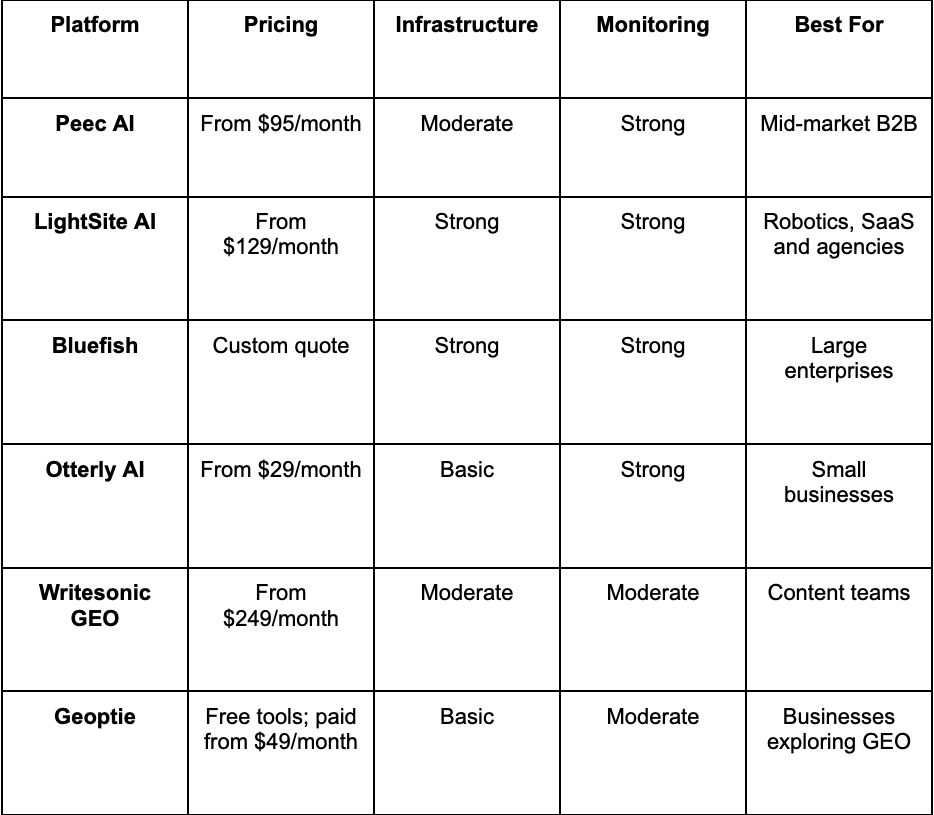
AI Visibility Platform Comparison
Conclusion
The Problem: Traditional SEO alone is no longer enough for robotics and automation companies. AI assistants rely on structured, authoritative, and machine-readable content when selecting which brands to cite.
Key Takeaways: Each platform approaches GEO differently.
- Peec AI emphasizes monitoring
- LightSite AI combines monitoring with infrastructure deployment
- Bluefish targets enterprise organizations
- Otterly AI offers an affordable entry point
- Writesonic GEO focuses on AI-assisted content optimization
- Geoptie differentiates itself through free diagnostic tools.
The right choice depends on budget, technical resources, and whether the goal is measurement, implementation, or both.
Next Steps: Audit your current AI visibility, identify infrastructure gaps, and choose a GEO platform that aligns with your budget, technical resources, and implementation goals.
Frequently Asked Questions
Does traditional SEO still matter for AI search?
Yes. AI assistants continue to reference authoritative websites, making technical SEO, structured data, backlinks, and trustworthy content important alongside GEO and LLM optimization.
What features should robotics companies prioritize?
Machine-readable infrastructure, competitor citation analysis, AI crawler monitoring, structured data, and brand visibility tracking should generally take priority because they directly influence how AI systems interpret technical content.
Are free GEO tools enough?
Free tools are useful for initial audits but typically lack automation, continuous monitoring, and advanced infrastructure capabilities required by larger B2B organizations.
