The rapid growth of embodied artificial intelligence is reshaping the robotics industry, with companies racing to develop machines capable of performing a wide variety of real-world tasks rather than being programmed for a single application.
Among the companies attracting significant attention is Shenzhen-based X Square Robot, which recently completed four consecutive financing rounds culminating in a Series C investment.
The company is now valued over RMB20 billion and says the new funding will accelerate development of its embodied AI foundation models, robotics hardware, data infrastructure and commercial deployments.
Founded in 2023, X Square Robot has concentrated on developing what it describes as general-purpose embodied AI. Rather than creating robots designed for one specific task, the company’s objective is to build AI systems capable of learning and adapting across a broad range of physical environments, from homes and care facilities to factories and logistics centres.
Wang Qian, founder and CEO of X Square Robot, says: “Since day one, X Square Robot has focused on in-house development of foundation models, pursuing a challenging but necessary path. Today, our investments in embodied AI models, scalable, model-driven high-quality data pipeline system and real-world deployment are beginning to deliver clear results.”
The company says it will use the latest financing to further invest in core technologies and foundational research in embodied intelligence, advancing toward general-purpose embodied AI that bridges the physical world and ultimately serves humanity.
Building a foundation model for the physical world
At the centre of X Square Robot’s technology strategy is its WALL family of embodied AI foundation models.
Unlike conventional industrial robots, which are typically programmed to repeat fixed sequences of actions, embodied AI models are intended to allow robots to perceive their surroundings, understand instructions, reason about physical environments and perform increasingly complex manipulation tasks.
In April this year, the company introduced WALL-B, an embodied AI foundation model built on its World Unified Model architecture. According to X Square Robot, the architecture combines perception, language, action and physical prediction within a single network rather than relying on separate vision, language and action modules.
The company says this approach improves multimodal understanding, spatial reasoning and zero-shot generalisation, enabling robots to perform previously unseen tasks in unfamiliar environments.
X Square Robot has also open-sourced WALL-OSS-0.5 and WALL-WM, extending its work on embodied AI models and world modelling while contributing technology to the wider robotics community.
Accelerating data collection with the QUANXTA Zero Series
To further strengthen its embodied AI ecosystem, X Square Robot recently introduced the QUANXTA Zero Series, a software and hardware platform designed to improve the way robotics training data is collected, processed and used for model development.
The company argues that while advances in large language models have been driven by enormous volumes of high-quality training data, robotics faces a different challenge.
Collecting data from physical robots is significantly more difficult, with existing teleoperation systems often proving expensive, slow to deploy and inconsistent in the quality of the data they produce.
Rather than functioning solely as a data collection device, the QUANXTA Zero Series is designed as a complete workflow for embodied AI development.
According to X Square Robot, the platform integrates data collection, high-fidelity synchronisation, automated cleaning, intelligent annotation, model training, robot inference and evaluation into a single closed-loop system, helping transform raw operational data into assets that can be used to train foundation models.
The QUANXTA Zero product family includes three systems designed for different collection scenarios. The flagship QUANXTA Zero G1 uses a lightweight headband and dual-gripper configuration to capture movement, manipulation, visual, tactile and audio data, while the QUANXTA Zero G0 supports whole-body mobile data collection using a VR headset, dual grippers and a backpack system.
The QUANXTA Zero E0 is a compact first-person data collection device equipped with six cameras for capturing contextual information during robot operation.
X Square Robot says the platform is designed to improve both data quality and collection efficiency. The QUANXTA Zero G1 incorporates automated downstream annotation, multi-view sensing and sensor synchronisation within one millisecond, while collection speeds can reach nearly 100 demonstrations per hour – more than double the efficiency of conventional teleoperation methods.
Combined with the company’s proprietary data pipeline for cleaning, annotation, quality control, model training and evaluation, the platform is intended to create a continuous feedback loop that accelerates development of embodied AI foundation models.
Integrating models, hardware and data
Rather than focusing solely on AI software, X Square Robot has adopted what it describes as a full-stack approach to embodied intelligence.
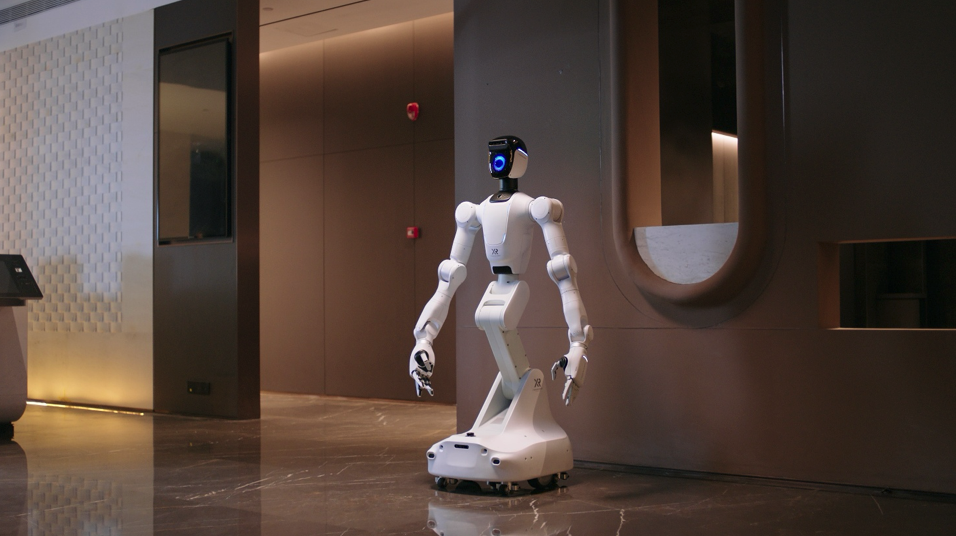
Alongside its foundation models, the company has developed its own portfolio of robotics hardware, including the QUANTA X1 Pro, a general-purpose wheeled bimanual robot and embodied intelligence research platform; the QUANTA X2, a next-generation general-purpose wheeled humanoid robot; the Artixon dexterous robotic hand; and a six-axis robotic arm. According to the company, these platforms have been designed specifically to work with large embodied AI models.
The company has also invested heavily in collecting real-world training data.
According to X Square Robot, it established one of China’s earliest large-scale embodied AI data collection facilities and has developed multiple proprietary systems for capturing robot interaction data, including VR teleoperation, mobile robot platforms and dexterous-hand data collection equipment. The company combines internet data, simulated environments and real robot operation to support model training and continuous improvement.
X Square Robot says this creates a continuous cycle in which data collected from deployed robots improves future versions of the foundation model, while updated models enable robots to perform increasingly complex tasks in real environments.
Moving beyond laboratory demonstrations
A recurring theme throughout X Square Robot’s strategy is the importance of deploying robots in real operating environments.
The company believes that household settings present one of the most demanding challenges for embodied AI because robots must cope with changing layouts, varied objects and constant human interaction.
To support this objective, X Square Robot has partnered with 58.com to launch an AI-powered household cleaning service in Shenzhen and Beijing, where robots work alongside human cleaning staff in residential environments. It has also introduced the “X Family Member Program”, allowing robots to live with families for extended periods while performing everyday household tasks and generating operational data.
The company views these deployments as an important source of feedback for improving its foundation models while demonstrating how embodied AI can move beyond controlled demonstrations into everyday use.
Commercial deployments across multiple sectors
Although domestic environments remain an important long-term focus, X Square Robot is already applying its technology across several commercial sectors.
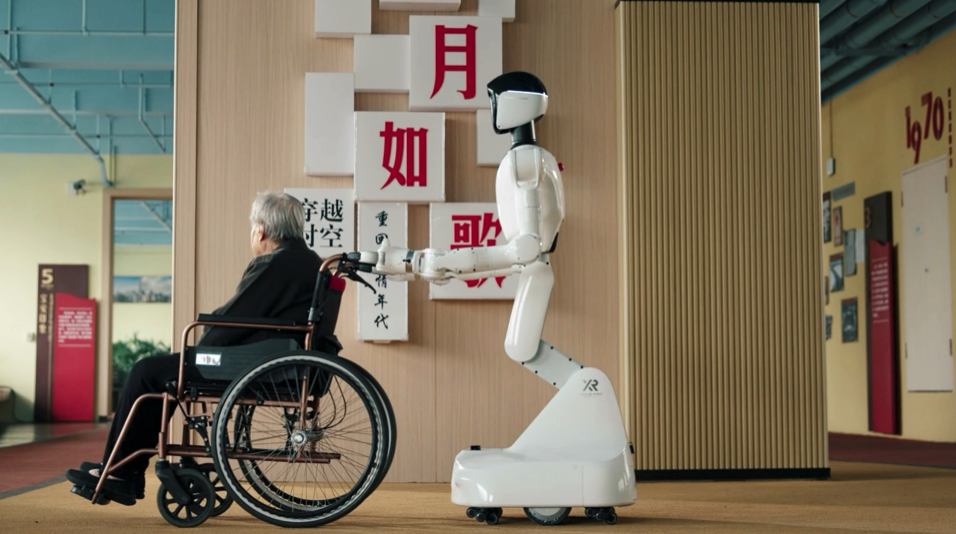
In elderly care, the company has entered into a strategic partnership with a senior living provider to deploy embodied robots capable of delivering items, assisting with cleaning and organisation, communicating with residents, and carrying out patrol inspections and early-warning monitoring. The deployment is intended to improve operational efficiency while allowing care staff to spend more time on higher-value responsibilities.
In manufacturing, X Square Robot is collaborating with Jinbei Auto to introduce embodied AI robots into automotive production environments requiring precise and repeatable operations. The partnership combines the company’s robotics platform with Jinbei Auto’s manufacturing expertise to support deployment on automotive production lines.
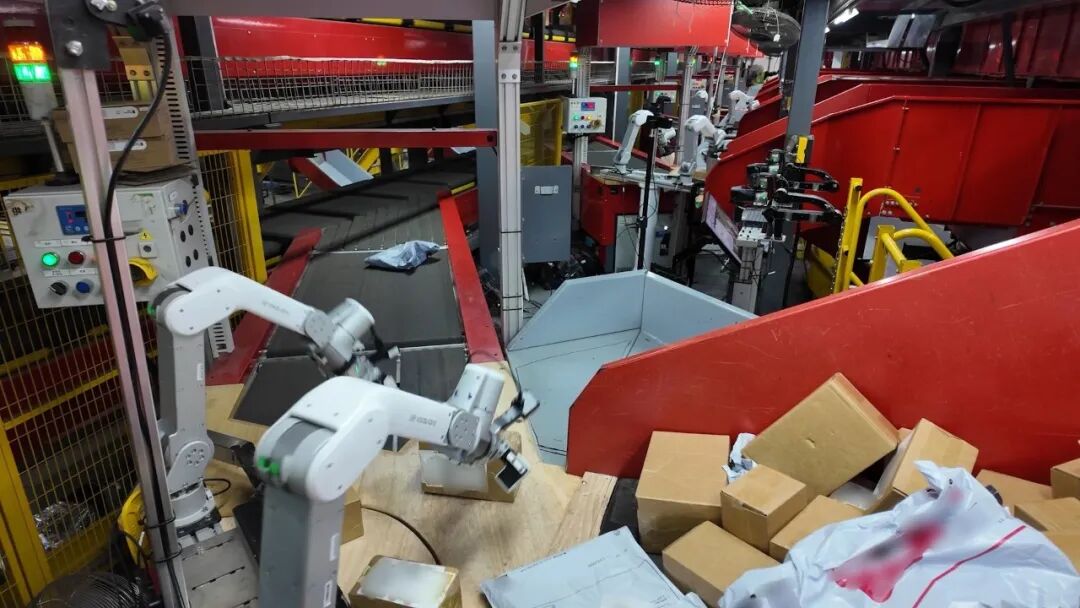
The company is also working with one of China’s leading logistics companies to introduce embodied AI robots into parcel feeding and sorting operations. According to X Square Robot, the collaboration is intended to provide a more flexible automation layer for dynamic warehouse environments while improving efficiency and operational consistency.
Together, these deployments reflect the company’s ambition to apply the same embodied AI foundation models across multiple industries rather than developing separate AI systems for individual applications.
Looking ahead, X Square Robot says continued progress in embodied AI will depend on the close integration of models, robotics hardware, data infrastructure and real-world deployment.
As Wang concludes: “As AI moves beyond digital experiences into the physical world, progress will depend on close integration between models, data and robotics. We’re building that foundation so embodied AI can become part of everyday life.”
Main image: X Square Robot’s humanoid robot in an commercial indoor setting
