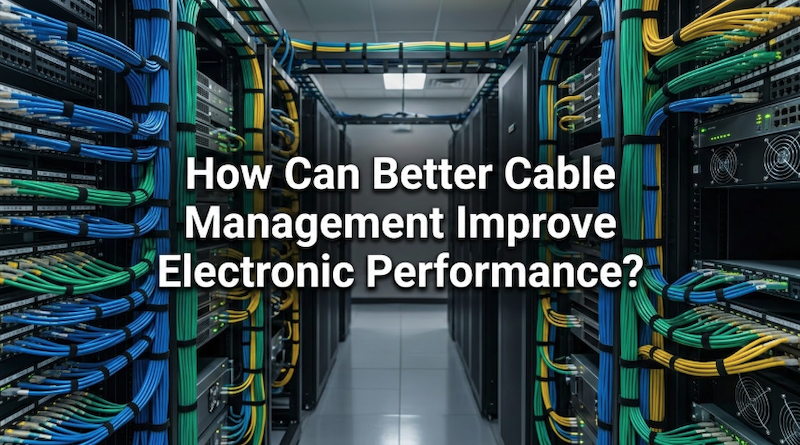
The Thermal Reality of Blocked Airflow
Open the door of an older network rack or an industrial control panel. You’ll often find a tangled pile of wires blocking your view of the hardware.
Most people look at that and assume it’s just an aesthetic issue. They are wrong. Poor routing directly attacks hardware lifespan and computational efficiency.
Heat is the absolute enemy of solid state electronics. CPUs, power supplies, and logic boards generate massive amounts of it under load. System designers install high velocity fans to pull cool air across these components and push hot air out the back.
But air behaves like water. It takes the path of least resistance. When you cram unorganized wires into the empty spaces of a chassis, you build a physical dam.
The cooling system chokes. Hot air gets trapped around the processors. To protect themselves from melting, modern chips rely on thermal throttling. They intentionally slow down their clock speeds to generate less heat.
You immediately lose processing power simply because the system can’t breathe. Fans also ramp up to maximum RPM to compensate, which draws more electricity and wears out fan bearings prematurely.
To fix this, you need intentional routing that keeps the central airways completely clear. Using custom cable harnesses allows you to bundle connections tightly and run them strictly along the structural metal frame of the enclosure.
The air flows freely, temperatures drop, and the hardware runs at its rated speed without early failure.
Electromagnetic Interference and Signal Integrity
Let’s look at the invisible problems. You can’t see signal degradation with the naked eye. You only see the results. Dropped network packets, corrupted sensor readings, or strange anomalies in audio equipment are common symptoms of bad wiring.
Power wires generate invisible electromagnetic fields. Data lines carry highly sensitive, low voltage signals. If you run a high voltage power line parallel to a data line and zip-tie them together, that power line will induce electrical noise right into your data stream. The data gets scrambled.
This is basic physics. In industrial settings with variable frequency drives and heavy motors, this interference can cause a programmable logic controller to trigger an emergency stop just because a sensor read a voltage spike that never actually happened.
Professional technicians know to keep power and data separated by several inches, or cross them at hard 90-degree angles if they must intersect.
But the best solutions happen long before installation day. High quality cable harness manufacturing integrates proper shielding, twisted pairs, and physical separation layers right into the bundle.
The engineers account for electromagnetic risks during the design phase. You get a component that inherently protects your signal integrity without relying on the field installer to guess the right layout.
Mechanical Stress on Circuit Boards
Copper is heavy. When you have dozens of thick wires hanging loose from a server or a controller, gravity pulls relentlessly on the connection points.
Think about the printed circuit board inside the equipment. Connectors are soldered directly to the surface of that board. Continuous physical tension from drooping wires stresses those tiny solder joints.
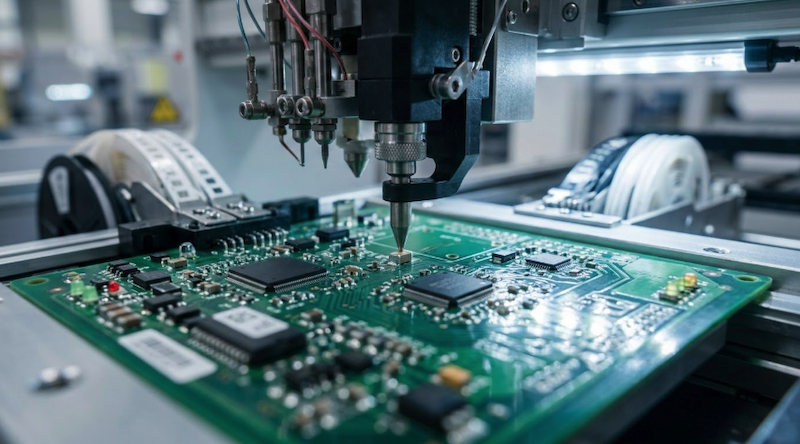
If the board relies heavily on SMT mounting for its data ports, excess weight can eventually crack the solder or rip the copper pads straight off the fiberglass substrate. Once the pad is torn, the entire board is usually trash.
Vibration makes this infinitely worse. Equipment installed near generators, stamping presses, or mobile platforms deals with constant shaking. A loose wire acts like a guitar string, carrying that vibration directly into the fragile connector.
Proper management secures the physical weight to the metal chassis instead of the electronics. Zip ties, P-clips, and velcro straps are cheap insurance.
You anchor the wire firmly a few inches before it hits the socket. Leave a small loop of slack between the anchor point and the plug. The connector should never carry the mechanical load.
Environmental Protection and Contamination
Indoor data centers are highly controlled spaces. Outdoor installations and factory floors are completely different environments. Dirt, cutting fluid, and moisture find their way into everything eventually.
A loose, scattered wiring setup provides hundreds of tiny pathways for contamination to travel. If moisture gets onto a drooping wire, it travels down the jacket right into your sensitive electronics.
That leads to rapid corrosion, short circuits, and dead equipment. In harsh environments, standard plastic looming and zip ties won’t save you.
You have to seal the system entirely. Upgrading the vulnerable external connections to a Waterproof Cable Harness keeps the elements out of the critical junctions. You route it cleanly, secure it against the frame to prevent snagging, and lock out the humidity.
It takes the guesswork out of field deployments where the weather or the factory floor actively tries to destroy your gear. There is no point in having high performance hardware if a heavy rainstorm or a power washer takes it offline.
Maintenance Efficiency and Downtime
Things break. Components degrade over time and need replacing. When an entire system is a tangled web, a simple five-minute component swap turns into a two hour headache.
Tracing a single faulty wire through a massive, unmanaged bundle wastes expensive labor hours. Worse, tugging on the wrong wire during troubleshooting often unseats a completely different connection, creating a secondary problem you now have to track down. Rushed technicians make mistakes when they can’t see what they are doing.
Organized routing turns a messy enclosure into a predictable, logical grid. Color coding and labels actually work when the technician can read them without digging through a pile of plastic. You locate the fault, unclip the specific wire, swap the component, and get the system back online immediately.
Efficiency in wiring isn’t about making the inside of a box look pretty for photos. It’s about minimizing system downtime and moving on to the next job.
