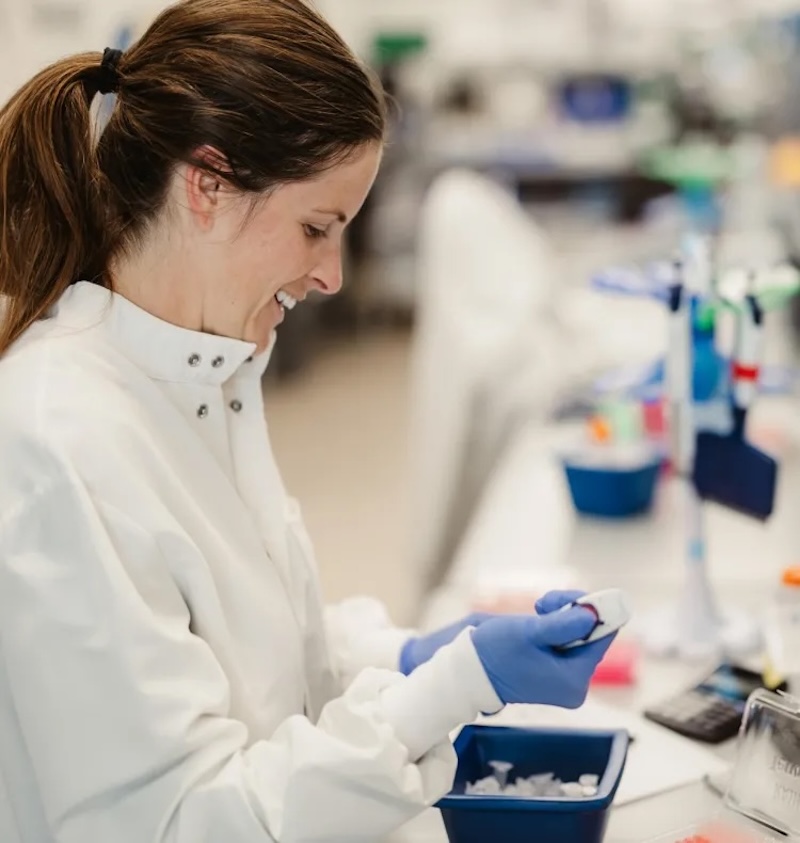
Lab automation has a clear, well-earned business case. Robotic sample handling, automated liquid handlers, and end-to-end specimen tracking raise throughput, cut manual errors, and relieve a workforce stretched thin by rising test volumes. The technology is mature, the gains are real, and adoption is accelerating.
That shift is well past the experimental stage. Robotics has become standard in diagnostic labs, where automated systems routinely handle sample preparation, transport to hematology, chemistry, and immunoassay analyzers, and post-analytical storage. The newest wave goes further still.
AI-ready laboratory automation platforms standardize multistep workflows and generate the structured, high-volume datasets that machine-learning models depend on.
For the companies building the assays that run on this equipment, automation is genuinely transformative. But it solves a narrower problem than many teams assume. Faster, cleaner sample handling improves the reliability of a test that already works. It does very little to prove that the test works in the first place.
Throughput is Not the Same as Proof
There is a meaningful difference between automating an operation and validating a result. Operational automation makes a process faster and more repeatable. Validation answers a harder question: does this assay actually measure what it claims to measure, across the messy range of real-world conditions it will meet in practice?
Those conditions are where assays struggle. Interfering substances that never appeared in development, samples that vary more than the comparator did, and limits of detection that prove harder to hit consistently than anyone expected. A robot will run a flawed assay ten thousand times without complaint. It simply produces unreliable results faster.
Analytical validation is where this gets concrete. A diagnostic has to demonstrate measurable performance against defined targets: sensitivity and specificity, the limit of detection, precision across operators and days, and reproducibility from one site to the next.
None of those characteristics improves because a robot loaded the plate. They are properties of the assay’s underlying chemistry and design, established through studies that have to be planned, run, and defended on their own terms.
The stakes are not abstract. Roughly one in twenty U.S. adults experiences a diagnostic error each year, and about half of those errors carry the potential for harm. A test that reaches the market on thin validation becomes part of that statistic, no matter how elegant the automation feeding it.
Buy, Build, or Both
A common pattern explains how capable teams end up exposed. Manufacturing gets outsourced, regulatory support is brought in, and the analytical work stays in-house, often to control cost and because the internal team knows the assay best. On paper, the division looks sensible. In practice, it creates seams, and seams are where programs leak time and money.
The judgment that fails is usually about magnitude rather than competence. A team that is genuinely expert at the science can still underestimate how large and complex the validation studies become once a regulator’s expectations enter the picture.
Keeping that work internal to save money is a reasonable instinct that, applied to the wrong workstream, quietly converts a manageable budget into a much larger one.
The cleaner division is rarely the one that minimizes this quarter’s spend. It is the one that puts the least forgiving work in the most experienced hands, wherever those hands sit.
Cost still matters, but it is a poor sole criterion for deciding which workstream a team should own, because the part most tempting to keep in-house is often the part most likely to generate expensive rework.
Where Automated Programs Go Sideways
A diagnostic program has several workstreams that have to advance together: analytical performance, clinical validation, quality systems, and regulatory strategy. When one races ahead and another lags, the program drifts out of alignment, and the misalignment usually stays hidden until the expensive part begins.
Scientifically strong teams are especially prone to this. Deep expertise in the underlying science creates justified confidence, and that confidence can quietly extend into areas where it is not earned. Strong research and development skills do not automatically transfer to regulated validation, and the gap tends to reveal itself late, when a study has to be repeated rather than merely planned.
Most diagnostics reach the U.S. market through the FDA’s 510(k) clearance pathway, which requires a sponsor to demonstrate that its device is substantially equivalent to one already cleared. Substantial equivalence is not a paperwork exercise. It rests on analytical and, frequently, clinical evidence that no amount of automation on the bench will generate on its own.
Clinical validation carries its own surprises. The number of patient samples a program needs has a way of growing past the early estimate, and each additional sample carries cost, time, and the logistics of securing sites that can actually supply it. When a site underperforms or runs dry, the replacement is usually more expensive, and the schedule absorbs the difference.
That data also has to be captured in a structured, auditable form, and electronic case report forms are where each participant’s results enter the record, a capture step whose quality feeds directly into whether the study can support a claim. A faster lab does nothing to ease that part of the work.
The Integration Problem Automation Exposes
Automation changes the tempo of the fast workstreams without touching the slow ones. Sample handling and data capture accelerate; the validation studies and regulatory work that gate a submission do not. The result is a wider gap between how quickly a lab can produce data and how quickly it can produce data that actually supports a claim.
That gap is where programs absorb their worst losses. A single clinical run that misses required standards, or an analytical study that has to be repeated, can erase months and a great deal of capital. The savings a team booked by keeping work in-house rarely survive a single round of rework, and automation that scaled a shaky process only multiplies the cost of doing it twice.
The compounding is what makes it dangerous. A delay in validation pushes the clinical timeline, which strains site relationships and budgets, which invites a cheaper substitution that brings its own variability. Each step is a defensible response to the step before it, and the program ends up somewhere no one chose, having spent far more than the original plan ever assumed.
This is why many diagnostic teams pair their automation investments with an experienced diagnostics development partner that keeps analytical performance, clinical validation, and regulatory strategy moving in step from the start. The value is not extra headcount. It is an integrated judgment across the exact domains where automated throughput and regulatory proof have to meet.
Build the Rigor in Before You Scale it Up
Automation is an amplifier. Point it at a sound process, and it compounds the advantages, running a trustworthy assay at a pace and consistency a manual lab cannot approach. Point it at a fragile one, and it compounds the flaws just as efficiently, producing more questionable results in less time and pushing the reckoning further downstream.
Automation vendors are not selling a shortcut around validation, whatever a roadmap slide might imply. They are selling speed and consistency, which are worth a great deal once the thing being sped up is sound. The responsibility for making it sound stays exactly where it has always been, with the team that owns the assay and the evidence behind it.
The right sequence is unglamorous but reliable: get the assay robust, get the validation strategy sound, and then let automation multiply a process that is genuinely worth multiplying. The laboratories getting the most from their robots are not the ones that automated first. They are the ones who made sure the work they were automating was already worth trusting.
