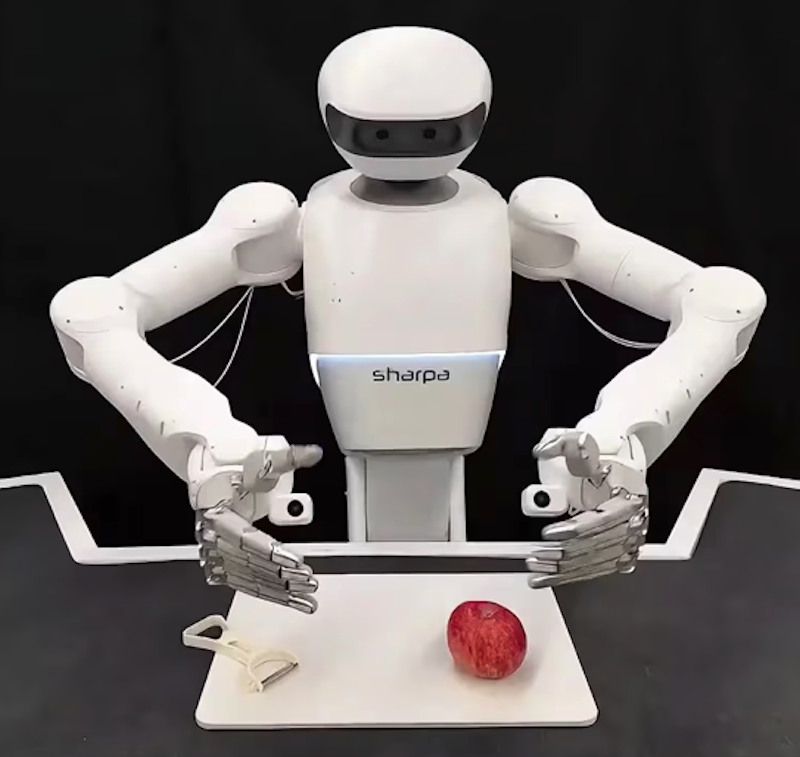
Much of the recent excitement surrounding humanoid robots has focused on increasingly impressive demonstrations of walking, running, jumping, and balancing. Yet many robotics experts argue that locomotion, while important, is only part of the challenge.
The bigger obstacle to creating genuinely useful humanoid robots may be something far more familiar to humans: the ability to use their hands.
Among the companies focused on solving this problem is Sharpa, a Singapore-based robotics startup developing dexterous robotic hands, tactile sensing systems, and embodied AI technologies designed to enable robots to interact more effectively with the physical world.
The company attracted international attention after showcasing a series of live autonomous demonstrations at CES, where its robots performed tasks including dealing blackjack, taking photographs, assembling pinwheels, and playing ping-pong in front of visitors for several days.
More recently, Sharpa became part of a high-profile collaboration involving Nvidia and Unitree Robotics, resulting in the H2+ humanoid robot reference design built on Nvidia’s Isaac GR00T platform and equipped with Sharpa’s Wave robotic hands.
At the heart of Sharpa’s approach is the belief that dexterous manipulation and tactile intelligence will be critical to the next phase of robotics development.
While vision systems and foundation models have advanced rapidly, the company argues that robots still struggle with many tasks that humans perform effortlessly, such as grasping unfamiliar objects, handling tools, or adapting when physical conditions change unexpectedly.
In this interview, Alicia Veneziani, global vice president of go-to-market and president of Europe at Sharpa, discusses why Sharpa believes hands are a more important challenge than legs, the growing role of touch in embodied AI systems, the progress being made in simulation and sim-to-real transfer, and the industries most likely to adopt dexterous robots first.
She also shares her perspective on the future of humanoid robotics, the importance of long-term reliability, and the competitive factors that will determine which robotics companies ultimately succeed.
Interview with Alicia Veneziani

Robotics & Automation News: Much of the recent attention in humanoid robotics has focused on locomotion and visually impressive demonstrations. Why do you believe dexterous manipulation remains the more important technical challenge for making robots genuinely useful?
Alicia Veneziani: We have always believed the hardest problem is not the legs. It is the hands. Locomotion is moving fast. We believe it will mostly be solved in the next two years. And in the next couple years, it may no longer be the main differentiator, and in many real deployments, wheels may even be more efficient.
Think about what people actually want robots to do: do your laundry or serve a cup of coffee without spilling it. That is where robots still fail today and all of that depends on hands.
You may also see why Sharpa focuses on dexterous manipulation in the H2+ / Nvidia Isaac GR00T Reference Humanoid Robot, where Sharpa Wave is integrated as part of a full-body system for developing and validating robot skills. If a robot cannot use human tools and handle human objects, it is not yet useful.
But the Wave hand is not simply a part or a component – it is a platform for dexterity. It is the physical infrastructure: the hardware layer every robot needs to perform useful tasks reliably in the real world. A platform, because it enables the data and AI model infrastructure built on top of it:
At deployment: Wave reproduces human hand kinematics so faithfully that robots can learn from human videos available on the internet (cooking tutorials, assembly guides, and so on – see Do as I Do from Professor Jitendra Malik’s lab at Berkeley, or Egoscale from Jim Fan’s lab at Nvidia), whereas other robot hands require painstaking cross-embodiment translation. If you believe in Scaling Laws for Physical AI, then a 22-degree-of-freedom design is the most logical choice.
In training: the high-fidelity tactile data produced by Wave enables AI models – particularly Vision-Language-Action (VLA) models – to be trained with a richer signal, pushing task success rates toward the 99.9% required for commercial deployment.
The Wave hand is just one piece in Sharpa’s suite of dexterous manipulation solutions. Sharpa makes “contact intelligence” possible through hardware, data infrastructure and dexterous manipulation AI models.
Over time, a robot equipped with Wave hands and on which Sharpa’s tactile-enabled embodied AI has been deployed can pick up a hotel key card, a spray bottle, or a screwdriver without task-specific retraining for each.
R&AN: Sharpa has emphasized live autonomous demonstrations rather than tightly controlled showcase videos. How important is long-duration reliability and consistency in proving that robotics systems are ready for real-world deployment?
AV: Reliability is the difference between a robot that can impress people once and a robot that can eventually become useful. A polished video can show the best moment, but real deployment depends on whether the system can keep working continuously, even when small variations happen again and again.
That is why we put emphasis on live autonomous demonstrations. At CES, our robots ran autonomous manipulation demos for 8-hour shifts in front of public audiences. For us, that was not only a marketing moment; it was a reliability test.
It showed whether the hardware could tolerate continuous use, whether the manipulation policy could handle repeated attempts, including when disruptions occur, and whether the full system could operate outside a tightly controlled lab setting.
For real-world robotics, success rate is not enough by itself. You also need repeatability, recovery from small errors, and consistency over long periods. Those are the standards that matter if robots are expected to work in factories, restaurants, warehouses, or eventually homes. This is why we will be demonstrating in the pilots we deploy this year.
R&AN: Your work combines tactile sensing with vision and language models. Do you believe touch will become as important to robotics as vision has become over the past decade?
AV: We believe that multi-modality is the key to unlock dexterous manipulation for autonomous robots. Embodied AI models that effectively combine the commonly used visual & proprioception signals with tactile sensing can significantly enhance the performance of manipulation tasks.
Vision can bring the hand to the object. Touch tells the robot what is happening when the object pushes back. A cup can slip. The hand can block the camera. That is where manipulation succeeds or fails.
In our SaTA research on tactile awareness, we proved that success rates on contact-rich tasks such as USB-C insertion can improve by around 30 percentage points with tactile feedback.
In a factory, that can be the difference between a robot that only works when the connector is perfectly aligned and a robot that can feel the mismatch, correct it, and finish the insertion. And we are not alone in finding similar results. You can refer to a Berkeley/Nvidia’s research team recent work called T-Rex.
R&AN: The robotics industry increasingly talks about “Physical AI” and foundation models for robots. How close are we to robots being able to generalize skills across different environments, tasks, and hardware platforms?
AV: The industry is making real progress, but broad generalization in robotics is still further down the road. We are starting to see robots handle small disruptions that used to stop the task completely: a cup is not exactly where expected, a cable is slightly misaligned, a bag folds in an unexpected way, or a tool slips during use.
For example, in some of our recent North demonstrations, the important point is not only that the robot completes a task once, but that it can keep going when small disruptions occur: such as variation in part placement during pinwheel assembly or card placement during blackjack dealing, which is a meaningful step toward more adaptable and useful robots.
There is still distance to go before robots can generalize broadly across tasks, environments, and hardware platforms. For Sharpa, contact-level feedback is foundational to that progress. Our foundation tactile model is designed to help robots adapt when reality does not match the plan.
We are also seeing encouraging work from others in the industry using Sharpa Wave, including Stanford/Cornell’s SimToolReal and EgoScale, which point to how anthropomorphic robotic hand design dexterity can support broader generalization over time.
R&AN: Simulation and sim-to-real transfer have become major themes in robotics development. How much progress do you think the industry has made in narrowing the gap between virtual training and real-world robotic performance?
AV: If we look at the bigger picture, the real constraint in robot learning is not simulation in itself. It is data.
Robots cannot learn dexterity from the internet alone. They need physical data from real interaction: how an object moves when it is grasped, how it shifts during in-hand rotation, and how the robot recovers before the task fails. This data is of high quality but its collection is hard to scale.
This is where simulation becomes powerful. It lets us train hand movements at scale before running them on hardware. We’re collaborating with on work such as Tacmap, and the recent reference design with both Nvidia and Unitree, to make simulation useful for real dexterous manipulation.
The goal is to kick-off project faster, train models more effectively, waste fewer hours on hardware compatibility, and ultimately build robots that can finish physical tasks in the real world.
R&AN: Looking ahead over the next five to 10 years, which sectors do you believe will see the earliest large-scale adoption of dexterous autonomous robots – manufacturing, logistics, healthcare, hospitality, domestic assistance, or somewhere else?
AV: For us, the question is about which work robots can actually take off people’s hands. The bigger destination is the home. As populations age and labor shortages grow, people will need physical help: someone, or something, that can fold laundry, prepare a simple meal, or clean a room.
That future requires dexterity. Of course, there are many challenges before home use cases can be unlocked. So the way we look at it is, which jobs handle tasks that are relevant to home settings? Hospitality, retail, restaurants, etc. That’s where we can generate useful data for training home robots.
In the near term, some deployments will happen in factories, on precise assembly or packing tasks because they’re repetitive and sometimes dangerous. But we don’t lose our sights from the consumer market.
R&AN: The robotics sector is now attracting enormous levels of global investment from technology companies, industrial manufacturers, and AI firms. How do you see the competitive landscape evolving, and what kinds of robotics companies are most likely to emerge as long-term winners?
AV: The winning companies will solve the problems of the customers. They won’t have the fastest robot or the most viral coverage.
They don’t even need the best AI model that can generalize across all possible situations. But they will provide just the right amount of adaptation that makes them useful to settings where no automation was previously possible.
The last piece is very important, it’s not just about performance, it’s about trust: the winning companies will be transparent on what their robot can do and will deliver on what they promised to the customer. And of course, they will deliver reliable and safe solutions.
At Sharpa, we are vertically integrated for this same reason: to iterate faster on the full stack when problems appear while deploying robots on real-world scenarios.
Our demonstrations, including the GPU installation and the pinwheel assembly robot, are not just demos. They are part of how we test the full loop between the hand, the body, the AI model, and real task feedback. This is ultimately how the robotics field will deliver value to the people and enterprises.
