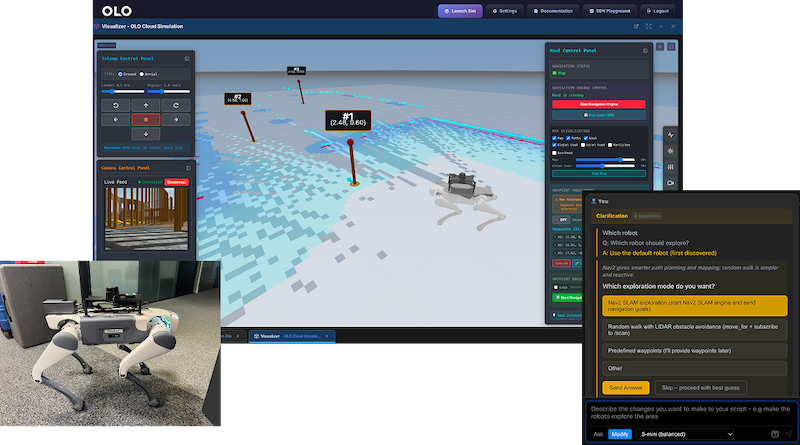
Robotics hardware has advanced rapidly in recent years. Autonomous mobile robots, quadrupeds, robotic arms, and even humanoid robots are becoming increasingly capable and commercially available. Yet for many organizations, one of the biggest barriers to adoption remains software.
Building robotic applications typically requires specialist expertise in platforms such as ROS 2 (Robot Operating System 2), the open-source framework that has become the de facto standard for modern robotics development.
While ROS 2 has helped accelerate robotics innovation across industries, it is still widely regarded as complex and difficult for newcomers to master.
Olo Robotics, a UK startup based in Sheffield, believes that challenge is limiting the wider adoption of robotics. The company has developed a browser-based platform designed to simplify robot programming, simulation, and deployment, enabling software developers and businesses to build robotic applications without requiring deep robotics expertise.
The platform sits on top of ROS 2 and combines cloud simulation, AI-assisted coding, visualization tools, and sim-to-real deployment capabilities.
Founded by Nick Thompson and Eleanor Tang-Smith, Olo recently completed its commercial launch and announced partnerships with companies including Deep Robotics, Fiction Lab, and InMotion Robotics.
The company has also attracted investor backing, raising £4 million to support its goal of making robotics more accessible to a broader range of developers and organizations.
In this interview, Eleanor Tang-Smith, COO and co-founder of Olo Robotics, discusses the company’s mission to lower the barriers to robotics adoption, the role of simulation in accelerating development, and why she believes the industry needs to move beyond a reliance on specialist roboticists.
She also shares her views on humanoid robots, the UK’s strengths in robotics innovation, and the opportunities emerging as robotics becomes increasingly accessible to software developers, researchers, and businesses.
Interview with Eleanor Tang-Smith

Robotics & Automation News: Could you introduce yourself and explain what Olo Robotics does?
ET-S: I’m COO and co-founder of Olo Robotics. We’re building a platform designed to make robotics more accessible by removing much of the complexity associated with ROS 2 and robot programming.
Olo sits between robotics hardware and users, providing tools for simulation, automation, and application development. We work with robot manufacturers including Deep Robotics, InMotion Robotics, and FictionLab to help users build applications for inspection, security, research, and other use cases.
A key part of the platform is simulation. Users can load virtual robots into environments such as libraries, orchards, or solar farms, develop applications, and then transfer those workflows to physical robots.
R&AN: There are a growing number of robotics simulation platforms. What gap is Olo trying to fill?
ET-S: The hardware exists, but programming robots remains difficult.
There aren’t enough robotics specialists to meet demand, so we’re trying to make robotics more accessible to developers, researchers, students, and businesses that may not have deep robotics expertise.
The platform includes simulation tools, example scripts, automation workflows, and an AI coding assistant. Users can build applications using Python or JavaScript and experiment without investing in expensive hardware or specialist teams.
The goal is to lower the barriers to adoption and allow more people to explore robotics.
R&AN: Who is using the platform today?
ET-S: We only launched commercially a few weeks ago, but we’ve already had around 80 beta testers.
The user base ranges from universities and researchers to software developers and businesses exploring robotics for the first time.
One of the more interesting outcomes was seeing non-technical users successfully build robotics projects using the platform’s AI assistant. It showed us that robotics can become accessible to a much wider audience than traditionally expected.
For academics, the platform reduces the amount of time spent configuring robots. For businesses, it provides a low-risk way to evaluate ideas before committing to hardware investments.
R&AN: You mentioned humanoid robots. How do they fit into your plans?
ET-S: We’re actively talking with humanoid robot manufacturers and definitely plan to support humanoids in the future.
However, humanoids are extremely complex systems. Programming dexterous hands, coordinating multiple joints, and operating safely in real-world environments remain major challenges.
One of our goals is to make those systems easier to work with by providing tools that abstract away some of that complexity.
R&AN: How do you view the current state of humanoid robotics?
ET-S: There is still a significant gap between the demonstrations people see online and reliable deployment in real-world environments.
Many demonstrations take place in highly controlled conditions or involve some level of teleoperation.
The reality is that robots still struggle with environmental variation. A small change that a human would barely notice can create significant challenges for a robot.
That’s why simulation is so important. It allows developers to test, refine, and validate systems before deploying them in the real world.
I think truly autonomous humanoids operating reliably in homes and everyday environments are still several years away.
R&AN: Does the UK have the talent needed to compete globally in robotics?
ET-S: Absolutely.
The UK has strong universities, excellent robotics programs, talented developers, and facilities such as the National Robotarium and the Advanced Manufacturing Research Centre.
The challenge is less about talent and more about creating opportunities, encouraging adoption, and showcasing innovation internationally.
R&AN: Tell us about Olo Robotics as a business.
ET-S: I founded the company with my co-founder Nick, who comes from a software development background.
We raised a £4 million funding round earlier this year and are focused on commercializing the platform through partnerships and practical robotics applications.
We’re particularly interested in areas where there is a clear return on investment, such as inspection, security, education, and industrial automation.
Quadruped robots remain especially attractive because they can already perform useful tasks in real-world environments.
We also see opportunities in creative industries, where robotics could become a tool for production companies, entertainment businesses, and content creators.
R&AN: Are there risks associated with making robotics more accessible?
ET-S: Definitely.
Robots increasingly combine mobility, cameras, microphones, and AI capabilities, which means security and privacy have to be taken seriously.
We place a strong emphasis on secure deployment, access controls, testing, and responsible use.
As robotics adoption grows, education will be just as important as technology. People need to understand both what robots can do and where the risks lie.
The industry has a responsibility to ensure robotics is deployed safely, securely, and responsibly.
Olo Robotics will be exhibiting at FOS Future Lab at the Goodwood Festival of Speed between July 9 and 12, 2026.
