UK robotics startup Kirisense has secured funding from the Henry Royce Institute to develop advanced tactile sensing technology designed to give robots a more human-like sense of touch.
The project, supported through the Henry Royce Institute’s Industrial Collaboration Programme and delivered in partnership with the University of Sheffield, will focus on creating robotic fingertips capable of detecting shear forces and slip in real time.
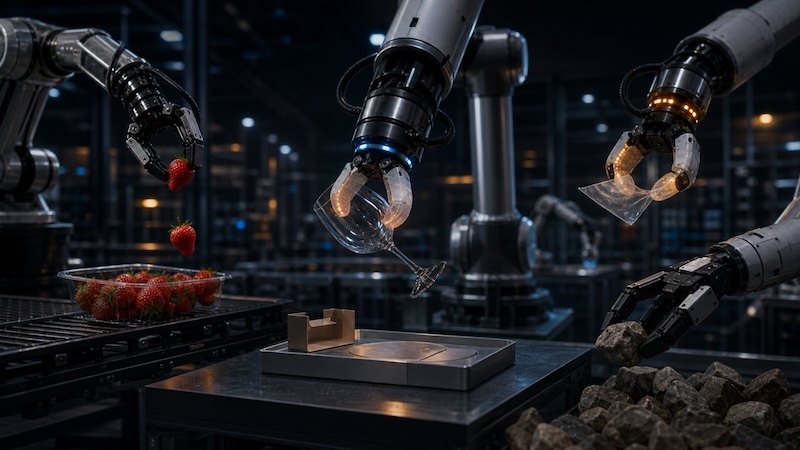
The funding comes as the robotics industry increasingly turns its attention from perception to manipulation. While advances in artificial intelligence and machine vision have significantly improved what robots can see and understand, handling objects reliably remains one of the sector’s biggest challenges.
A robot may be able to identify an object and determine its location, but successfully grasping and manipulating it without dropping, crushing or damaging it often requires information that cameras alone cannot provide.
Kirisense says its technology is designed to address that problem by helping robots understand not only when they have made contact with an object, but also how that object is moving within their grasp.
The funded project, titled The Development of a Shear-Sensing Fingertip Prototype Demonstrator, is scheduled to begin in July 2026.
Kangsheng Bretherton-Liu, founder and CEO of Kirisense, says: “AI has dramatically improved what robots know about the world. Our focus is on what happens when a robot actually interacts with it.
“The ability to detect force, movement and slip at the point of contact allows machines to respond to changing conditions as they occur. We believe tactile sensing will be a critical enabling technology for the next wave of robotics, particularly as systems move beyond structured factory environments into logistics, healthcare and everyday human environments.”
Unlike many tactile sensing systems currently under development, which rely on cameras and image processing, Kirisense is developing a compact optical sensing platform intended to deliver high-speed force and slip detection using a simpler hardware architecture.
Potential applications include food handling, logistics, manufacturing, healthcare and humanoid robotics.
Tim Harper, chair of Kirisense, says: “The robotics industry has spent years solving perception. The next challenge is manipulation.
“A robot may know exactly what an object is and where it is located. The harder challenge is handling it reliably when conditions are less predictable.
“We believe tactile sensing will become a foundational technology for robotics, much as machine vision became foundational for the previous generation of automation. This project helps move that vision closer to reality.”
The Henry Royce Institute described the project as a strategically important initiative with strong commercial potential and benefits for both industry and academic partners.
The institute is the UK’s national organization for advanced materials research and innovation, supporting the development and commercialization of emerging technologies across multiple sectors.
