The audio to video AI generator category has evolved into a core layer of modern content production systems, enabling users to transform spoken audio, voiceovers, and scripts into structured visual narratives.
Instead of relying on traditional editing workflows, these platforms automate scene generation, timing alignment, and visual selection, allowing content to be produced at scale across marketing, education, and social media environments.
In practice, an audio to video AI generator is used for repurposing podcasts, converting narration into short-form videos, and generating multilingual video content without filming.
While each tool differs in level of automation and creative control, most platforms combine AI avatars, templates, and audio synchronization systems to streamline production and reduce manual editing effort.
1. Pollo AI Audio to Video AI Generator
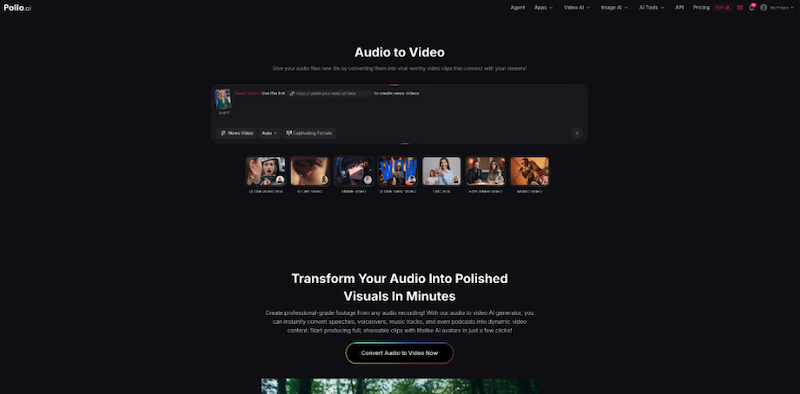
Pollo AI functions as a multi-workflow audio to video AI generator designed around structured video creation pipelines rather than traditional timeline editing.
It supports a wide range of content formats such as UGC ads, product videos, explainer videos, clone video ads, social media clips, and narrative storytelling formats.
The platform also integrates multiple AI video models and tools including text-to-video, image-to-video, video-to-video, and avatar-based generation.
Its system is built to interpret audio inputs – such as voiceovers, podcasts, or speeches – and convert them into visually structured outputs. These outputs can include talking avatars, animated sequences, or context-aware visuals that align with the audio narrative.
The platform also supports model-based generation (for example, Pollo 2.5, Veo 3, Sora-class models), allowing flexibility in visual styles and rendering approaches within a single environment.
Why Pollo AI stands out as an Audio to Video AI Generator
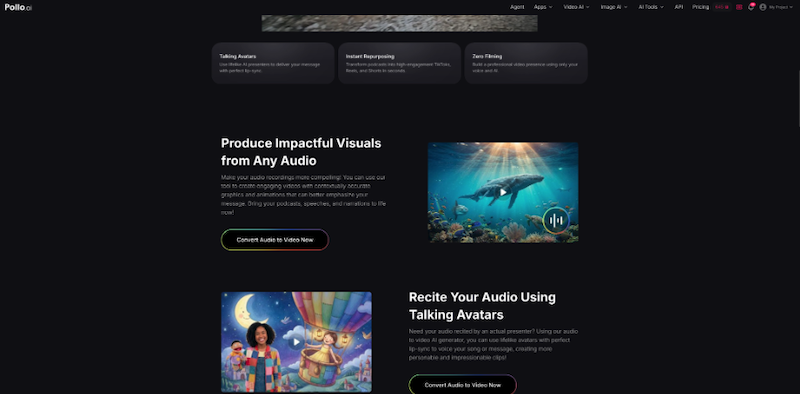
Pollo AI’s main advantage lies in its ability to support multiple production paths within the same audio to video AI generator system, positioning it as a flexible AI music video generator as well as a broader content creation engine.
Users can convert audio into UGC ads, viral clips, explainer content, or cinematic-style sequences. This makes it suitable for creators who need to repurpose a single audio asset into different content types for A/B testing or cross-platform distribution.
The platform is commonly used for social media marketing, faceless content production, and rapid ad generation. Its “zero filming” workflow allows users to produce avatar-led or AI-generated videos without cameras or actors, which is useful for scalable digital campaigns.
It is also applied in storytelling formats such as news-style clips and narrative videos where audio drives the entire structure.
My tips: Output quality depends heavily on how structured the input audio is, so poorly organized scripts may lead to inconsistent scene generation.
2. CapCut Audio to Video AI Generator
CapCut operates as a widely used audio to video AI generator integrated into a broader editing ecosystem focused on short-form video production.
It allows users to import voiceovers, music, or recorded narration and automatically align them with captions, transitions, and visual templates.
The platform combines traditional editing tools with AI-assisted synchronization features, making it accessible for mobile-first creators and social media editors.
CapCut’s audio-driven workflow is tightly connected to its template library and auto-editing functions. Once audio is added, the system can generate timed subtitles, suggest cuts, and apply visual effects that match pacing.
While users still retain manual control, the automation layer significantly reduces editing time for basic video structures.
Why CapCut works well as an Audio to Video AI Generator
CapCut is particularly effective for creators producing TikTok, Instagram Reels, and YouTube Shorts. The audio to video AI generator functionality allows rapid conversion of voice narration into polished short videos without advanced editing skills.
It is often used for vlogs, tutorials, promotional clips, and meme-style content where speed and format consistency matter more than cinematic control. Its mobile accessibility also makes it suitable for on-the-go content production workflows.
My tips: Heavy reliance on templates can limit originality if users do not customize visual elements.
3. HeyGen Audio to Video AI Generator
HeyGen is an audio to video AI generator focused on avatar-driven communication, where spoken audio or scripts are delivered through lifelike digital presenters.
It specializes in generating talking-head style videos with synchronized lip movement, facial expressions, and multilingual voice support. The platform is commonly used for business communication, training videos, and marketing presentations.
Its workflow is centered on converting audio into structured avatar presentations. Users upload audio or input scripts, select an avatar, and generate videos where the AI presenter delivers the message naturally. The system is designed to reduce the need for filming presenters while maintaining a human-like delivery format.
Why HeyGen is effective as an Audio to Video AI Generator
HeyGen’s main strength lies in its lifelike avatars, which make it suitable for instructional or corporate communication. The audio to video AI generator system ensures consistent delivery across multiple languages without reshooting content.
It is widely used for training modules, product explanations, onboarding content, and multilingual marketing campaigns. The avatar-based structure makes it especially useful for organizations with global audiences.
My tips: It is less suitable for cinematic storytelling or visually complex video styles beyond talking-head formats.
4. Synthesia Audio to Video AI Generator
Synthesia is an enterprise-focused audio to video AI generator designed for structured presentation-style video production. It converts scripts or audio into polished videos featuring AI avatars, slide-like scenes, and multilingual narration.
The platform is frequently used in corporate training, internal communications, and standardized educational content.
The system organizes audio input into predefined visual templates, ensuring consistency across all generated videos. Users can select avatars, layouts, and languages, while the AI handles synchronization and scene formatting. This makes it suitable for organizations that require scalable video production with minimal manual editing.
Why Synthesia is useful as an Audio to Video AI Generator
Synthesia’s key advantage is its ability to generate consistent video content across multiple languages and regions. The audio to video AI generator framework allows companies to localize training or communication materials efficiently.
It is commonly used in HR onboarding, compliance training, and corporate communication. The structured output ensures clarity and reduces production variability across teams.
My tips: Creative flexibility is limited since the platform prioritizes structured presentation formats over artistic editing.
5. InVideo AI Audio to Video AI Generator
InVideo AI functions as a template-driven audio to video AI generator that focuses on transforming scripts and voiceovers into visually organized video sequences.
It automatically selects stock visuals, transitions, and text overlays based on audio timing and content structure. The platform is widely used for marketing videos, YouTube content, and promotional storytelling.
Its workflow blends automation with optional manual editing. Once audio is uploaded, the system generates a draft video with aligned scenes, which can then be refined through editing tools. This makes it accessible to users who want both automation and customization in one environment.
Why InVideo AI works as an Audio to Video AI Generator
InVideo AI provides a middle ground between fully automated avatar systems and traditional editors. The audio to video AI generator functionality helps speed up production while still allowing scene-level adjustments.
It is often used for digital marketing, educational content, and explainer videos. The system is particularly effective when converting structured scripts into visually engaging narratives.
My tips: Output quality is highly dependent on script clarity and proper scene pacing.
Conclusion
The audio to video AI generator landscape shows a clear divide between avatar-based systems, template-driven editors, and multi-model creative platforms. Tools like Pollo AI focus on flexible multi-format generation, while CapCut emphasizes fast social content creation.
HeyGen and Synthesia prioritize avatar-led communication for business and training use cases, whereas InVideo AI balances automation with manual refinement for broader content production needs.
Overall, these platforms reflect a shift toward automated video creation pipelines where audio becomes the primary input for scalable visual storytelling.
The choice of tool depends largely on whether the priority is speed, realism, creative flexibility, or enterprise consistency.
