Budget conversations inside enterprise security teams have changed. Technical merit alone rarely moves a board toward approval anymore.
CISOs and IT leaders are now expected to justify every investment in operational terms: reduced downtime, faster incident response, lower business disruption, and measurable efficiency gains.
That shift has pushed Full Stack Observability into a different category of discussion. It is no longer viewed as another monitoring upgrade sitting inside the IT budget.
Boards increasingly see it as operational infrastructure tied directly to revenue continuity, customer experience, and risk reduction.
The challenge is that many stakeholders still associate observability with dashboards and alerting tools. They see cost before they see value. That usually happens when the conversation stays technical for too long.
A stronger business case starts elsewhere. It starts with visibility gaps that already cost the organisation money.
Why Traditional Monitoring Stops Short
Most enterprises already have some form of monitoring in place. Network tools, SIEM platforms, endpoint telemetry, cloud metrics, application performance monitors. The problem is fragmentation.
Teams receive alerts from separate systems that rarely connect cleanly during an incident. Infrastructure teams look at servers. Security teams investigate logs. Application teams focus on performance degradation. Cloud teams inspect workload behaviour separately.
Meanwhile, the business sees only one outcome: disruption.
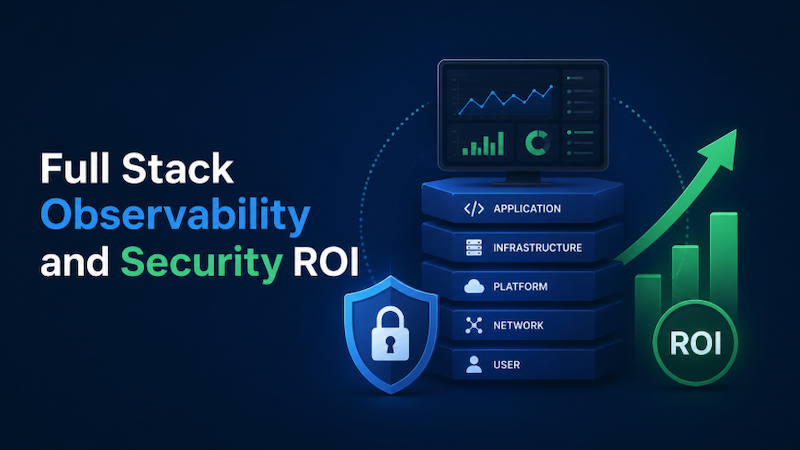
This is where Full Stack Observability changes the conversation. Instead of isolated monitoring across disconnected environments, it provides correlated visibility across infrastructure, applications, networks, cloud workloads, databases, and user experience layers.
That correlation matters more than many boards initially realise.
A payment slowdown, for example, may not begin as a security incident. It may start with a failed container deployment, trigger API latency, overwhelm backend systems, and eventually expose security weaknesses under stress conditions. Without unified visibility, teams waste hours moving between tools while customer impact grows.
The financial cost of those delays is often far higher than the observability investment itself.
Boards Respond to Operational Outcomes
Executives rarely approve budgets because a platform has better telemetry capabilities. They approve budgets when the operational impact becomes obvious.
Full Stack Observability supports that discussion because the benefits are measurable in business terms.
Reduced Mean Time to Resolution is usually the first major gain. Security and operations teams spend less time identifying root causes because telemetry is already connected across environments. Faster remediation directly reduces outage duration.
The second gain is operational efficiency. Teams stop duplicating investigations across siloed tools. Escalations become shorter. Engineering resources are used more effectively.
Then there is resilience. Organisations operating across hybrid cloud environments often struggle to understand dependencies between systems. Full Stack Observability exposes those relationships before small failures become widespread outages.
None of these benefits are theoretical anymore. They are increasingly tied to board-level reporting metrics.
The Cost of Limited Visibility
One reason sceptical stakeholders hesitate is because visibility problems are difficult to quantify until something fails publicly.
A brief outage in a customer-facing application may affect revenue immediately. A delayed security investigation may increase breach exposure. Performance degradation inside a critical platform can quietly damage customer trust for months before it becomes visible in churn metrics.
Full Stack Observability helps reduce those blind spots because it connects technical behaviour to business impact.
This becomes particularly important in environments where cloud adoption accelerated faster than operational maturity. Many organisations built modern infrastructure quickly but retained fragmented monitoring practices underneath it.
The result is operational noise without operational clarity.
Security leaders often describe the issue in practical terms: too many alerts, not enough context.
That distinction matters during budget reviews. Boards are already aware that security teams are overloaded. What they need to understand is how fragmented visibility increases both operational cost and business risk simultaneously.
Where Full Stack Observability Delivers ROI
The strongest business cases usually connect observability outcomes directly to measurable operational improvements. Below is a structure that works well visually during executive presentations or board discussions.
Faster Recovery
When incidents occur, teams can trace problems across systems without switching between disconnected tools. Resolution times fall because context is available immediately.
Lower Downtime
Correlated telemetry helps identify performance degradation earlier. Small issues are contained before they expand into service interruptions.
Reduced Alert Fatigue
Security and operations teams receive fewer meaningless alerts because data is prioritised and connected through dependency mapping.
Better Cloud Control
Hybrid and multi-cloud environments become easier to monitor consistently, particularly when workloads shift dynamically between platforms.
Stronger Collaboration
Infrastructure, DevOps, and security teams work from the same operational picture instead of maintaining separate investigations.
Improved Customer Experience
Performance bottlenecks affecting users are identified faster, reducing service friction and protecting customer trust.
Smarter Budgeting
Operational inefficiencies become measurable. That visibility helps leadership make more informed investment decisions over time.
Why Security Teams Benefit Beyond Detection
There is another reason Full Stack Observability is gaining traction in cybersecurity discussions specifically.
Traditional detection models often struggle during complex incidents because security telemetry alone does not provide enough operational context. Anomalies appear inside logs, but the surrounding infrastructure behaviour remains unclear.
Observability fills that gap.
Security teams can connect suspicious behaviour to application changes, workload movement, system performance anomalies, or unusual network patterns in near real time. Investigations become faster because the operational environment is visible as a whole.
This matters during ransomware containment, insider threat investigations, and cloud misconfiguration analysis. In many cases, the operational trail surrounding an event reveals more than isolated alerts ever could.
Boards may not need those technical details explained deeply, but they do understand reduced exposure windows and faster containment timelines.
That framing changes how Full Stack Observability is perceived internally. It stops being viewed as a monitoring enhancement and starts being treated as operational risk infrastructure.
The Budget Objection Usually Comes Down to Timing
Many boards do not reject observability investments because they doubt the technology. They delay approval because the urgency feels unclear.
Security leaders often face a familiar question: why now?
The answer usually sits inside the organisation’s existing complexity.
Cloud expansion, distributed applications, remote workforces, third-party integrations, and increasing attack surfaces have made operational visibility significantly harder than it was five years ago. At the same time, expectations around uptime and customer experience continue rising.
The gap between operational complexity and operational visibility is becoming expensive.
That is why mature organisations increasingly prioritise Full Stack Observability before a major operational failure forces the decision under pressure.
Waiting until after a serious outage changes the conversation entirely. At that stage, observability becomes a reactive expense rather than a strategic investment.
Boards tend to recognise the difference once operational risk is framed properly.
Measuring Success After Implementation
One mistake organisations make is treating observability deployment as the finish line.
Boards expect measurable outcomes after implementation. That means security and IT leaders need clear reporting metrics tied to business operations.
The most effective programmes usually track:
- Mean Time to Detect
- Mean Time to Resolve
- Incident frequency
- Downtime reduction
- Alert reduction rates
- Application performance stability
- Operational efficiency improvements
Those metrics help maintain executive support long after procurement approval.
They also strengthen future cybersecurity investment discussions because leadership can see operational value demonstrated through evidence rather than assumptions.
Conclusion
Full Stack Observability has become difficult to separate from broader operational resilience discussions. Modern environments move too quickly and generate too much fragmented telemetry for isolated monitoring approaches to remain effective.
Boards may initially question the budget. That is expected. What changes the discussion is a clear connection between visibility, operational stability, security efficiency, and financial impact.
The organisations seeing the strongest results are not treating Full Stack Observability as another technical toolset. They are using it to reduce downtime, accelerate investigations, improve collaboration across teams, and strengthen resilience across increasingly complex environments.
CyberNX can help organisations evaluate and implement Full Stack Observability strategies that align security operations with measurable business outcomes. From visibility assessments to operational integration, the focus should remain on practical improvements that leadership teams can justify with confidence.
