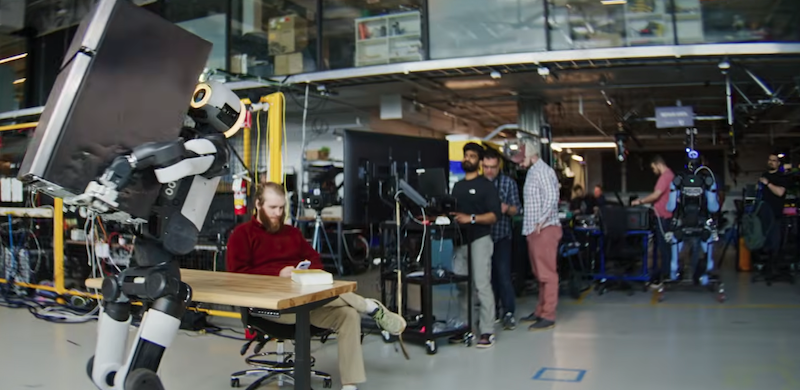
Boston Dynamics has released new behind-the-scenes footage showing its latest electric humanoid robot, Atlas, performing heavy lifting and manipulation tasks that the company says are designed to prepare the system for real industrial work. (See video below.)
The demonstration centers on Atlas lifting and carrying a mini-fridge weighing roughly 50 pounds, although Boston Dynamics says the robot successfully handled a loaded fridge weighing more than 100 pounds during testing.
The company says the breakthrough is not simply the robot’s physical strength, but the development of AI-driven control systems capable of adapting to “real world adaptability: handling heavy objects by bracing and accounting for the mass and inertia; using whole-body control, not just hands to maneuver”.
The latest Atlas system represents a major shift in humanoid robotics development, where companies are increasingly focused on teaching robots how to perform practical physical work in unpredictable industrial environments rather than simply demonstrating locomotion.
In a detailed technical blog accompanying the video, Boston Dynamics describes Atlas as “a general purpose tool for physical work” designed for factories, warehouses, and construction sites that require “high levels of strength, endurance, and dexterity”.
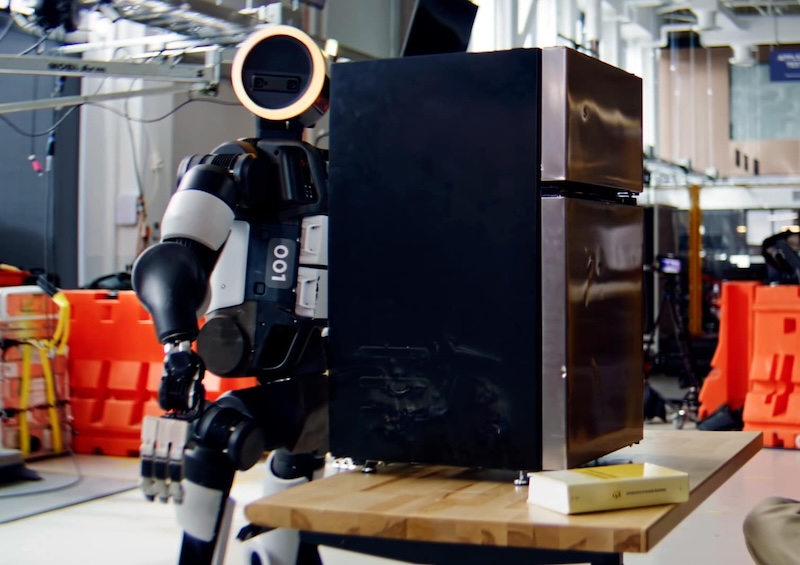
The company explains that the fridge experiment was intended to demonstrate advances in reinforcement learning, whole-body coordination, and physical adaptability. Unlike conventional robotic systems that rely heavily on fingertip manipulation and visual guidance, Atlas is being trained to use its entire body dynamically when handling heavy objects.
Boston Dynamics writes: “You cannot lift a fridge just by looking at it and using your hands. You have to prepare for it to anticipate the weight, lean into it, and let your body do the work of conforming to its shape, adapting to its weight, and testing whether you’ll be able to lift it.”
The company says Atlas learned the behavior using reinforcement learning inside simulation environments where the robot practiced the task “for millions of hours in simulations in parallel on Graphics Processing Units (GPUs)”.
Boston Dynamics also emphasized the importance of minimizing the so-called “sim-to-real gap” – the difference between how robots perform in simulation compared with real-world hardware. According to the company, improvements in Atlas’ hardware architecture and simulation fidelity now allow engineers to move rapidly from simulated training to physical testing.
The company says one of its goals is “to be able to train and deploy new behaviors in as little as a day”.
The latest Atlas platform differs significantly from earlier hydraulic versions of the humanoid robot. The new system is fully electric and has been designed with simplified hardware intended to support large-scale manufacturing and deployment.
Boston Dynamics says the robot uses only two actuator types throughout the body, features symmetrical limbs, and incorporates field-replaceable arms, legs, hands, and head units to simplify maintenance and reduce operational costs.
The company also revealed that Atlas’ joints feature infinite rotation because cables have been eliminated across joints – a design intended to improve reliability and enable more flexible movement.
Boston Dynamics believes these capabilities are essential if humanoid robots are to move beyond controlled research environments into real industrial operations.
The company writes: “This marks a critical shift in robotics where humanoids move beyond the lab and into dynamic industrial settings.”
The release comes amid growing competition in the humanoid robotics sector, with companies including Tesla, Figure AI, Agility Robotics, and 1X Technologies all accelerating efforts to commercialize humanoid systems for logistics, manufacturing, and warehouse operations.
While many humanoid robots can already walk, climb, or balance impressively, Boston Dynamics’ latest demonstration highlights what many researchers increasingly view as the industry’s biggest remaining challenge: reliable manipulation and physical interaction in real-world environments.
The new Atlas footage suggests Boston Dynamics is now concentrating heavily on that next stage – building robots capable not only of moving through the world, but working within it.
