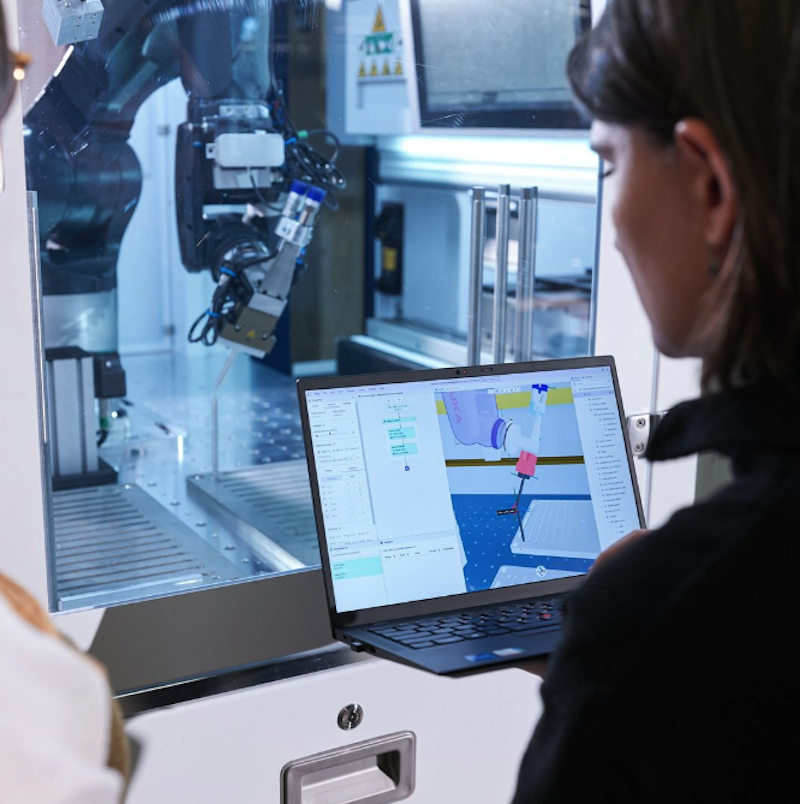
For years, industrial automation followed a relatively stable formula: high-volume production, long product lifecycles, and robotic systems designed to repeat the same process millions of times with minimal variation.
That model helped transform industries such as automotive manufacturing, where fixed production lines and highly specialized robots delivered extraordinary efficiency at scale.
But manufacturing is changing. Product cycles are shorter, customization is increasing, and factories are under pressure to adapt more quickly to shifting demand and supply chain volatility. In many facilities, the traditional economics of automation no longer work as neatly as they once did.
That changing environment is helping drive renewed interest in AI-powered robotics and software-defined automation – an area where Alphabet-owned robotics company Intrinsic is positioning itself aggressively.
Intrinsic, which emerged from Alphabet’s “moonshot factory” ecosystem before becoming a standalone company under Google parent company Alphabet, is attempting to build a software platform that makes industrial robots more adaptable to changing production conditions.
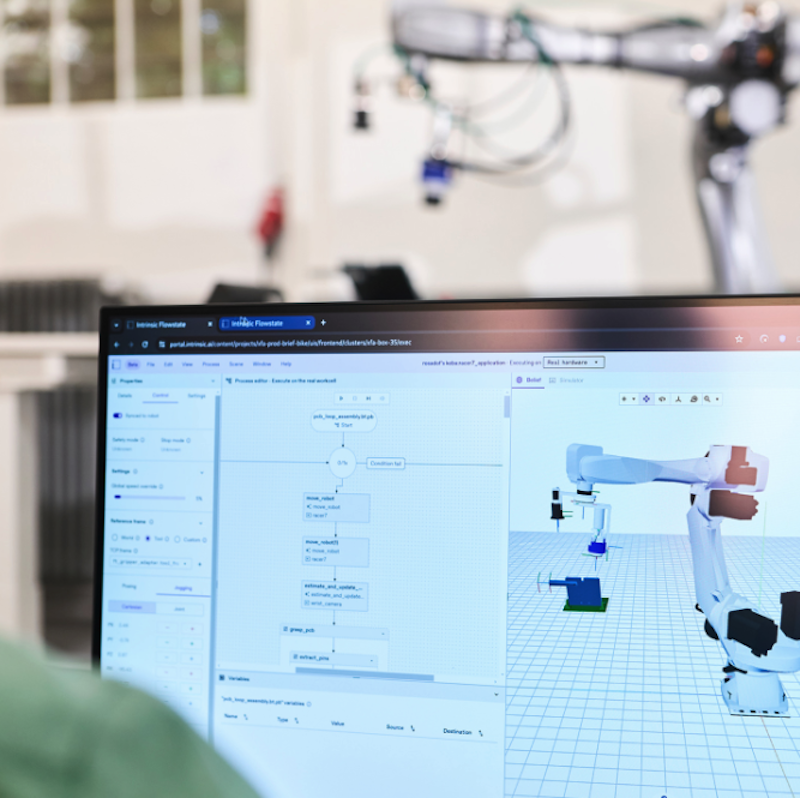
Rather than replacing existing robotic hardware, the company focuses on adding AI, machine vision, and intelligent automation layers designed to help manufacturers automate processes that have historically been considered too variable or uneconomical for conventional robotics.
The strategy reflects a broader shift within the robotics industry itself. After years of high-profile but commercially difficult robotics experiments – including Google’s former ownership of Boston Dynamics and its long-running autonomous vehicle efforts through Waymo – Alphabet now appears to be placing a more deliberate emphasis on industrial and operational applications where AI can solve immediate manufacturing problems.
In this Q&A with Robotics & Automation News, Stefan Nusser, chief product and commercial officer at Intrinsic, discusses why traditional automation is becoming “too expensive and too inflexible” in high-mix production environments, where AI is already creating measurable value on factory floors, and what Intrinsic has learned through its partnership with Foxconn about deploying AI-driven automation at industrial scale.
Nusser, whose background includes leadership roles at IBM, Google, Willow Garage, and Fetch Robotics, argues that the future of manufacturing may increasingly resemble software-defined infrastructure rather than fixed production lines – with robotics systems becoming more modular, reconfigurable, and adaptive over time.
Interview with Stefan Nusser

Robotics & Automation News: You argue that traditional robotics is becoming “too rigid” for modern manufacturing – what specifically has changed on factory floors that makes that rigidity a liability today?
Stefan Nusser: Most automation today is built for highly standardized, low-mix processes, where you do the same thing again and again. Automotive manufacturing is a good example in that the model works when volumes are high and change is limited. However, a growing share of manufacturing no longer operates that way.
What’s changed is the level of variability. You see smaller batch sizes, more customization, and processes that evolve frequently. In those environments, traditional automation becomes too expensive and too inflexible, because it takes weeks to set up for something that may only run for a short period.
That’s why a large portion of work remains unautomated today, not because it isn’t technically feasible, but because it hasn’t made economic sense. The opportunity now is to automate processes that change continuously, which requires a different kind of flexibility.
R&AN: Many robot vendors already claim flexibility through software, vision systems, or reprogramming tools – what is fundamentally different about Intrinsic’s approach?
SN: A lot of existing solutions add flexibility onto systems originally designed for fixed, predictable processes. That works to a point, but they struggle when variability becomes the norm – different parts, processes, and tasks change frequently. These systems still require significant manual setup and re-engineering.
Intrinsic starts from the assumption that change is constant – enabling intelligently adaptive automation in high-mix, low-volume environments. The goal isn’t just to make a single robot cell easier to reprogram, but to make automation easier to create and manage day to day for non-experts on the shop floor.
In practical terms, that means using AI and vision to handle tasks where you can’t realistically determine every detail in advance – like in electronics assembly, where parts vary and positioning isn’t perfect, and tasks like cable handling or connector insertion are hard to automate reliably.
At Intrinsic, we’re making these capabilities “ready to use” and easy to combine in one software platform so they’re reusable across applications, rather than rebuilt from scratch each time.
R&AN: From what you’re seeing in real deployments, where does AI actually improve performance today – and where is it still falling short in production environments?
SN: AI is already creating real value in environments where variability prevents automation and human workers are therefore the bottleneck. Traditional automation works well for repetitive and predictable tasks, but breaks down when things change frequently.
In high-mix, low-volume settings, AI allows us to handle that variability. With foundation models for machine vision, for instance, we can interpret and manipulate objects without knowing their exact shape in advance – unlocking automation processes that were previously uneconomical.
Where AI is quickly catching up, is reliability. It is not 100% yet but the latest models are incredibly precise, accurate and reliable – and improving at a steady pace. In manufacturing, the last few percentage points matter enormously, because edge cases are where downtime, quality issues, and complexity show up.
So the challenge is making sure AI is integrated just as deeply as any other tooling or service – not just model performance in isolation. It’s about designing a full production system that can deal with exceptions safely and productively, often with human oversight.
R&AN: Manufacturers are under pressure to justify automation investments – how does AI change the ROI equation compared to conventional industrial robotics?
A: Traditionally, automation has made sense in very stable, high-volume environments where you can spread the upfront cost over long production runs. The limitation has not been technical feasibility, but economic feasibility. If the process changes too often, the setup and reprogramming cost can outweigh the benefit.
AI changes that equation by reducing the effort required to handle variability. Instead of rebuilding or heavily reprogramming and retooling the system every time a process changes, you can make automation more adaptable.
That opens up a different category of opportunity. You’re no longer creating single-purpose automation that is to be amortized over the lifespan of a single product; you are creating reusable “multi-purpose” automation that can be re-configured for a different product when needed.
This allows the investment in automation technology to be amortized over the lifespan of the automation hardware, which can be as long as 7-10 years.
R&AN: The partnership with Foxconn suggests large-scale validation – what have you learned so far about deploying AI-driven automation in high-volume, real-world factories?
SN: One of the biggest lessons is that even in high-volume factories, real world production is not as uniform as people imagine. There is still a lot of variability between parts, processes, product generations, and line conditions.
That is exactly when intelligent robotic systems, powered by AI, brings modularity and versatility to complex production processes – that previously weren’t affordable or manageable by manufacturers.
The ability to reconfigure and therefore repurpose manufacturing capacity on-the-fly opens up new opportunities to share infrastructure across multiple products, react quickly to unexpected shifts in demand and therefore reduce the need for higher inventory levels of finished product.
R&AN: There’s often a gap between what manufacturers need and what robotics companies are selling – where do you think the industry is still getting it wrong?
SN: I think the biggest mistake the industry makes is starting with the technology instead of the problem. There’s a tendency to generalize too early in building something that can do many things, and then assume the value will follow.
You see that especially in the push toward very general-purpose systems, where the expectation is that one solution can address a wide range of use cases. That creates a lot of excitement, but it also makes it harder to define a clear starting point and deliver real customer value, in the way they need it delivered.
There’s different value inherent to different approaches. Another path is to focus on a small number of problems, and go deep in order to prove that real-world value can be created. Only after that do they start to generalize and talk about platforms.
R&AN: Looking ahead, do you see AI making existing robots more useful, or ultimately replacing current industrial systems altogether?
SN: In the near term, it’s about making existing systems more useful. The hardware is already there, the real question is how to make it flexible enough to handle variability. That’s where AI is having an immediate impact – extending what current systems can do.
Today’s industrial robots are cheaper and better than ever. With AI they will become even more versatile and usable, including for workers without robotics experience or expertise. Robotic systems are additive, giving workers more assistance in more adaptive ways, and making current and new systems more versatile and flexible.
Over time I think it leads to a different model altogether. Instead of fixed production lines designed for a single product, you move toward more flexible, software-defined environments. Just like how manufacturing is becoming more like a data center – where you have a pool of resources, and what you produce is configured through software and can scale up or down dynamically, as needed.
But that shift will happen step by step. It starts with solving specific applications where the value is clear, then building from there toward broader orchestration across workcells, lines, and eventually larger factory operations.
