Geekplus says its expansion in the Americas is accelerating, with new signed orders in the region – led by the United States – growing by more than 50 percent year-on-year in 2025.
The growth highlights the increasing demand for warehouse automation in the US, where operators are under pressure to address labor shortages, rising costs, and growing e-commerce volumes.
Globally, the company has built one of the largest installed bases in the sector. Geekplus says it has deployed more than 72,000 robots across more than 40 countries, serving approximately 950 customers, including over 80 Fortune Global 500 companies.
The company also claims the largest global market share in warehouse autonomous mobile robots (AMRs), reflecting several years of rapid international expansion.
A significant portion of that growth has come from overseas markets, with the majority of revenue now generated outside mainland China, underlining the importance of regions such as North America to its long-term strategy.
Geekplus operates globally through local teams and partners, with deployments spanning more than 40 countries and supported by regional service and project infrastructure.
Against that backdrop, the company used MODEX 2026 – held in Atlanta in April – to showcase its latest technologies to US customers and partners.
At the event, Geekplus presented the US debut of its Geek+ Brain embodied intelligence platform, alongside its next-generation RoboShuttle V5 system.
Geek+ Brain, Geekplus’ proprietary embodied intelligence platform, is central to that momentum. Its robot arm picking station gives customers a concrete path to fully unmanned warehouses.
“The US is where our embodied intelligence strategy meets our fastest commercial momentum,” said Michael Sahler, head of business development, Geekplus America. “US warehouse operators are looking for proven automation solutions and a credible path to the fully autonomous warehouse. That’s what we’re demonstrating at MODEX.”
The RoboShuttle V5 system, also shown at the event, is designed as a next-generation autonomous case-handling platform built on the same embodied intelligence architecture, targeting high-density storage and automated picking applications.
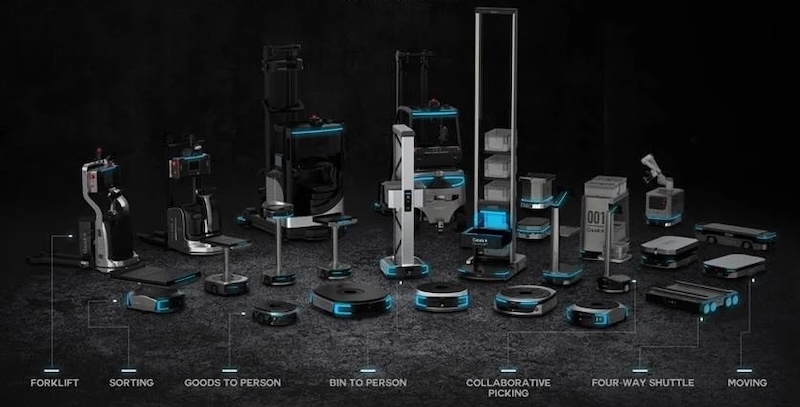
Geekplus also highlighted its broader portfolio, including Tote-to-Person, Pallet-to-Person, and Shelf-to-Person systems, aimed at sectors such as grocery, retail, third-party logistics, and e-commerce.
The company said it is positioning these technologies as part of a unified robotics platform capable of supporting end-to-end warehouse automation.
During MODEX, Geekplus also hosted a series of seminars focused on long-term automation strategy and scaling warehouse operations.
As competition intensifies in warehouse robotics – particularly in the US market, where companies such as Locus Robotics, Symbotic, and others are expanding – Geekplus appears to be leveraging its global scale and installed base as a foundation for further growth in North America.
