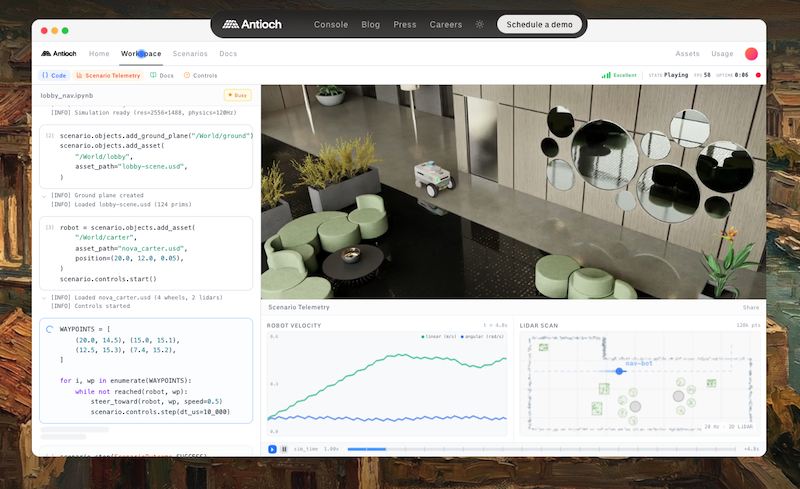
Antioch, a cloud simulation platform focused on robotics and autonomous systems, has raised $8.5 million in funding as it seeks to shift development and testing away from physical environments and into software-based simulation.
The investment round was led by A* and Category Ventures, with participation from MaC Venture Capital, Abstract, Box Group, Icehouse Ventures, and angel investors including Shyam Sankar and Adrian Macneil.
Founded in May 2025 and headquartered in New York, Antioch aims to reduce reliance on costly and time-consuming real-world testing by enabling robotics teams to develop and evaluate autonomous systems in simulated environments.
Moving autonomy development into software
Validating autonomous systems in the physical world typically involves renting space, staging test environments, and repeatedly resetting hardware between runs – a process that is both expensive and limited in scope.
“Robotics teams are spending weeks staging warehouses and investing millions into test facilities to validate their systems,” says co-founder Harry Mellsop, who previously worked on Tesla’s Autopilot team.
“Meanwhile, companies like Tesla, Waymo, and Anduril spend hundreds of millions a year on simulation infrastructure to minimize exactly that. We think every autonomy team should have access to that level of tooling.”
Antioch’s platform is designed to eliminate the need for physical testing by allowing developers to simulate a far broader range of scenarios than would be feasible in real-world conditions.
Building on advances in simulation and AI
The company argues that recent advances in simulation technologies have made this shift viable. Physics and rendering engines from companies such as Nvidia, combined with emerging generative approaches such as world models developed by firms including World Labs, are enabling increasingly realistic and scalable virtual environments.
However, the ecosystem remains fragmented and fast-moving, with new tools and models emerging rapidly. Antioch positions itself as a platform layer that integrates these capabilities while shielding users from the complexity of managing multiple systems.
Mellsop compares the approach to developer tools such as Cursor, which simplify access to AI models. Antioch aims to provide a similar interface for simulation infrastructure, allowing teams to onboard their systems once and continuously access updated capabilities without rebuilding workflows.
Early customers and industry focus
The company says it is already working with Fortune 500 technology and logistics companies, FAANG engineering teams, and organizations across sectors including drones, construction, smart security, and foundation model development.
Three of Antioch’s five co-founders – Mellsop, Alex Langshur, and Michael Calvey – previously founded Transpose, a security and intelligence platform acquired by Chainalysis in 2023.
Transpose served US intelligence agencies, law enforcement, and financial institutions, and Langshur says that experience continues to inform Antioch’s direction.
“Over the last 40 years, America’s manufacturing advantage has been systematically eroded by offshoring,” Langshur says. “The only economically viable path to reindustrialization runs through robotics and automation, and scalable testing is the rate-limiting step.”
Physical AI seen as larger than the LLM wave
The founding team also includes Colton Swingle, previously at Google DeepMind, and Collin Schlager, previously at Meta Reality Labs.
Mellsop describes the long-term opportunity as significantly larger than the current wave of large language model adoption.
“The industries LLMs are disrupting – software, professional services, knowledge work – represent maybe $8 trillion of the global economy. Manufacturing, logistics, construction, energy, and agriculture represent $50 trillion.
“AI penetration in those physical industries is basically zero today. The industrial revolution that’s coming in physical AI isn’t going to be a sequel to the LLM revolution – it’s going to dwarf it.”
Simulation as a foundation for safety and scale
Other members of the founding team emphasize the role of simulation in enabling safe and scalable deployment.
Collin Schlager, co-founder, Antioch, says: “When building for high-trust environments like residential neighborhoods or for high-precision industrial processes, edge case testing is non-negotiable.
“With physical testing, it’s impossible to stage every scenario that an autonomous system might face. Antioch lets teams simulate effectively-infinite scenarios, fully deterministically. So when teams deploy, they can be confident in the safety and predictability of their systems.”
Investors also highlight the broader implications for the robotics sector.
Bennett Siegel, co-founder and general partner, A*, says: “Antioch sits at the intersection of AI and robotics and will unlock the science-fiction future we’ve often dreamed of. The platform removes the friction from physical-world testing, and enables a new generation of embodied AI startups to scale their inventions globally.
“Companies are currently spending hundreds of millions a year to have a horse in the AI robotics race, but Antioch’s technology reduces the hurdles considerably, giving more businesses a chance to innovate.”
