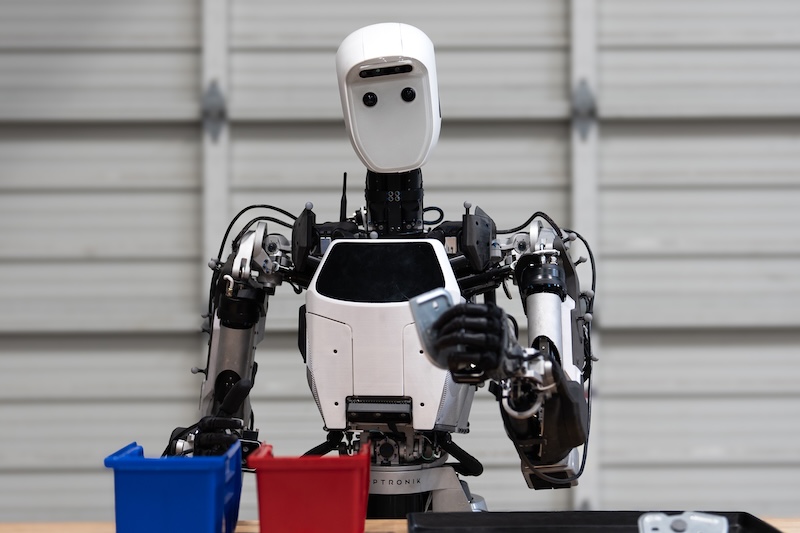
Humanoid robots have long captured the imagination of the robotics industry, often framed as the next major leap in automation.
But as the technology begins to move out of research labs and into real-world environments, the conversation is shifting. The question is no longer simply what these machines can do, but whether they can be built, deployed, and maintained at scale.
That shift brings companies like Jabil into sharper focus. While not a traditional robotics developer, Jabil operates as a large-scale manufacturing and supply chain partner, working behind the scenes to turn complex product designs into commercially viable systems.
With operations spanning more than 25 countries, the company plays a role in bridging the gap between prototype and production across multiple industries, including emerging areas such as humanoid robotics and digital commerce automation.
Jabil has also been working with Apptronik to help scale production of the Apollo humanoid robot, applying its manufacturing expertise within real-world production environments.
In this Q&A, Robotics & Automation News speaks with Robert Gutridge, vice president of global business units for digital commerce at Jabil, about the realities of scaling humanoid robots.
Gutridge leads strategy and execution across robotics, automation, and digital commerce programs, working with customers to industrialize advanced technologies and scale them from pilot to full production.
He brings deep experience in manufacturing, supply chain alignment, and real‑world deployment, with a focus on making complex robotic systems reliable, cost‑effective, and ready for commercial adoption.
Rather than focusing on AI capabilities alone, Gutridge points to manufacturing discipline, supply chain maturity, and unit economics as the critical factors that will determine whether humanoids transition from high-profile demonstrations to reliable industrial tools.
His perspective offers a reminder that, in robotics, technological breakthroughs are only part of the story – industrialization is what ultimately determines success.
Interview with Robert Gutridge, VP of global business units, digital commerce at Jabil

Robotics & Automation News: Humanoid robots are often framed as an AI or robotics breakthrough. From Jabil’s perspective, is the real challenge now less about intelligence and more about manufacturing and scalability?
Robert Gutridge: Humanoids are clearly a major AI and robotics milestone, but from Jabil’s perspective, the bigger hurdle now is industrialization. The technology itself is progressing quickly, but the industry is still very early – very much in the crawl phase.
What will ultimately determine adoption isn’t just how smart these systems are, but whether they can be built safely, reliably, and affordably at scale.
That means building a supply chain that can support new components, designing for manufacturability from day one, and putting repeatable testing and quality processes in place so performance is consistent across units.
Intelligence is important, but manufacturing readiness and cost determine scalability, which will decide when humanoids move from demos to real-world operations.
R&AN: You mention that warehouses and factories are becoming the proving ground for humanoids. What specific operational constraints in these environments will determine whether humanoids succeed or fail?
RG: Warehouses and factories are the right proving ground because teams there are already trained to work around machines and automation. But success will come down to a few operational constraints.
Early deployments will require clear safety and operational boundaries, with humanoids working in controlled zones and engaging in predictable interactions rather than moving freely alongside people.
That caution reflects the realities of industrial environments, where reliability and uptime are non‑negotiable; operations can’t tolerate frequent interruptions, and robots must perform consistently and recover safely from faults.
Beyond reliability, humanoids will need to demonstrate repeatable, multipurpose value. Single‑task demos won’t be enough; the real promise lies in flexibility across multiple workflows without constant reprogramming or reconfiguration. Just as important is integration into existing operations.
Because warehouses and factories are already designed around human workflows, humanoids will succeed fastest where they can operate with minimal infrastructure changes rather than forcing facility redesigns.
And while intelligence often gets the spotlight, fundamentals will matter just as much. Battery life, mechanical durability, ease of maintenance, and secure operational controls will ultimately determine whether these systems can be trusted in production environments.
R&AN: How does scaling a humanoid robot differ from scaling more established systems like AMRs and AGVs, particularly in terms of supply chain complexity and unit economics?
RG: Scaling humanoid robots is very different from scaling AMRs and AGVs because those systems are already mature categories. Their component ecosystems are well established, supply chains are predictable, and costs are easier to model.
Humanoids are earlier in that journey and combine many complex subsystems into a single platform, which makes scaling more challenging.
This puts humanoids very much in the same place AMRs and AGVs were 15 to 20 years ago, when key components like sensors and safety systems were expensive simply because they hadn’t reached volume yet and supply chains were still forming.
Two differences really stand out. The first is supply chain maturity. AMRs and AGVs benefit from standardized sensors, drives, controllers, and safety components that are produced at volume.
Many humanoid robots still rely on lower-volume or more customized parts. That keeps costs higher and lead times longer until demand grows and suppliers can scale.
We also have to consider the unit economics and learning curves. With humanoids, costs won’t come down until production scales and designs stabilize. That means standardizing parts where possible, designing for manufacturability, and putting repeatable manufacturing and test processes in place.
As volumes increase, learning curves kick in, yields improve, cycle times drop, and costs start to look very different. Until then, pricing reflects early-stage production rather than steady-state economics.
R&AN: Jabil is working with Apptronik on the Apollo humanoid. What are the biggest hurdles in moving from prototype to volume production for a system like this?
RG: When moving a humanoid robot from prototype into volume production, the biggest hurdles are less about inventing something new and more about applying core manufacturing discipline at scale.
Early prototypes are usually optimized for functionality, not repeatability, so one of the first challenges is evolving the design for manufacturability, ensuring it can be built consistently, with minimal manual rework, while still maintaining performance and reliability.
That shift has to be matched by production‑ready testing and validation. At scale, every unit needs to meet the same safety, reliability, and performance standards without slowing the line, which means embedding testability directly into the design rather than treating validation as a downstream step.
As production ramps, supply chain readiness becomes just as critical. Many humanoid systems still rely on complex mechanical assemblies that aren’t yet produced at volume, so scaling requires qualifying suppliers, stabilizing specifications, and ensuring components can be delivered with the right quality, cost, and lead times.
Volume production also demands a rethink of how the product is built. Early builds often rely on hands‑on assembly and tolerate variability, but scaling requires simplified, standardized processes that reduce variation and enable consistent output across hundreds or thousands of units.
Throughout all of this, safety validation remains a gating factor. Before humanoids can be deployed broadly, they must meet rigorous safety and regulatory requirements, and that validation has to be designed into both the product and the manufacturing process from the outset.
From Jabil’s perspective, the transition from prototype to production is about turning an innovative system into a manufacturable product – one that can be built, tested, and deployed reliably at scale.
R&AN: Cost and ROI remain critical barriers. At what point do humanoid robots become economically competitive with traditional automation or human labor in warehouse operations?
RG: Cost and ROI become viable once a few things converge. First, scale matters. As production volumes increase and supply chains mature, component costs come down and pricing starts to reflect manufacturing reality rather than early-stage builds.
Second, reliability and safety have to be proven in real-world operations. When a humanoid can run predictably, recover safely from faults, and operate with minimal oversight, the operational risk drops significantly.
Third, the multipurpose value has to be real, not theoretical. ROI becomes especially compelling in environments where labor is constrained, turnover is high, and absenteeism is a constant challenge, which is increasingly the reality for warehouse and manufacturing operations.
This is why many in the industry view broader competitiveness as a multi‑year progression rather than an overnight switch.
It’s not just the bill of materials; it’s the total cost of ownership, utilization over time, and whether the robot can consistently deliver flexible labor augmentation in environments where labor availability and turnover remain ongoing challenges.
R&AN: To what extent do existing warehouse workflows need to change to accommodate humanoids – or is the expectation that humanoids adapt entirely to human-designed environments?
RG: The core promise of humanoids is that they can operate in spaces already designed for people. Most warehouses and factories were built around human movement, reach, and tools, so a humanoid that can work in that environment reduces the need for expensive facility redesign or new infrastructure.
That said, early deployments won’t be completely friction‑free. Initial rollouts will still require thoughtful integration, defined operating zones, safety guardrails, and phased deployments where performance and behavior can be validated before broader, side‑by‑side use with workers.
These environments are chosen by design, because the people working there are already trained to be around machines and automated systems.
Over time, the expectation is that the humanoids adapt to existing warehouse layouts, tools, and workflows, rather than facilities being redesigned around them. But that transition will be gradual and safety‑led, with trust built through real‑world operation, not assumptions.
R&AN: Looking ahead, what role do tier-one manufacturing partners like Jabil play in determining which humanoid robotics companies ultimately succeed in the market?
RG: Tier-one manufacturing partners can be a major differentiator because success won’t be determined solely by a great demo; it will be determined by who can industrialize. In this space, the gap between a promising concept and a commercially viable product often comes down to manufacturing execution.
That starts with design for manufacturability and testability. Early engagement helps ensure the product can be built and validated reliably at volume, not just assembled a few times in a lab.
Supply chain leadership is another key factor. As designs mature, manufacturers help secure scalable suppliers, standardize components where possible, and influence cost and quality outcomes before they’re locked in.
Repeatable, high‑quality production is also essential. Humanoids are complex electromechanical systems, and producing the same unit every time, consistently and safely, is not a small challenge, especially when scaling across regions.
Finally, experienced manufacturing partners help teams manage complexity. Process simplification, build stabilization, and proven production discipline all help shorten the transition from prototype to volume.
Companies that bring manufacturing and supply chain expertise into the process early are better positioned to meet cost, quality, safety, and scale targets.
