For more than a decade, the Robot Operating System (ROS) has been the backbone of robotics research and early-stage development. It provided a common framework, a shared language, and a vast ecosystem of reusable components that allowed engineers and researchers to accelerate innovation.
But ROS was never designed for the realities of commercial deployment.
As robotics moves from laboratories into warehouses, factories, roads, and public spaces, the demands on software infrastructure have changed. Reliability, security, scalability, and real-time performance are no longer optional. They are prerequisites.
ROS 2 is the industry’s answer to that shift. The question is whether it delivers.
From experimentation to deployment
ROS 1 played a critical role in the growth of modern robotics. It enabled rapid prototyping, simplified integration, and fostered a global open-source community. However, its architecture reflected its origins in academic environments rather than industrial ones.
Several limitations became increasingly difficult to ignore:
- A centralized master node created a single point of failure
- Real-time performance was limited or inconsistent
- Security features were minimal
- Scaling across distributed, multi-robot systems was complex
These constraints did not prevent innovation, but they did limit adoption in production environments where downtime, latency, and security risks carry real financial and operational consequences.
In effect, ROS 1 was ideal for building robots. It was less suited to running them at scale.
A new architecture for a different era
ROS 2 represents a fundamental redesign rather than an incremental upgrade.
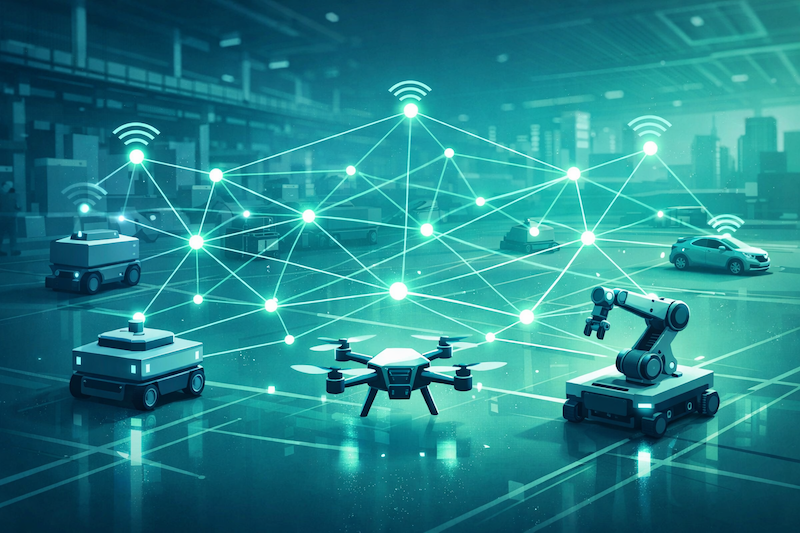
At its core is the adoption of Data Distribution Service (DDS), a decentralized communication standard widely used in aerospace, defense, and industrial systems. By removing the need for a central master node, ROS 2 enables more resilient and flexible communication between components.
This architectural shift brings several key improvements:
- Decentralized communication – eliminating single points of failure
- Real-time support – enabling predictable performance for time-critical applications
- Quality of Service (QoS) controls – allowing developers to fine-tune data delivery based on reliability and latency requirements
- Multi-robot support – improving coordination across fleets and distributed systems
- Cross-platform compatibility – including Linux, Windows, and embedded environments
Together, these features reposition ROS 2 as a framework for building complete robotic systems rather than isolated applications.
Security and the path to enterprise readiness
One of the most significant gaps in ROS 1 was security. In industrial and commercial contexts, unsecured communication is not simply a technical flaw – it is a business risk.
ROS 2 introduces built-in security mechanisms, including encryption, authentication, and access control. These capabilities are essential for sectors such as manufacturing, healthcare, and logistics, where robots are increasingly connected to broader IT and operational systems.
However, security alone does not guarantee enterprise readiness.
Certification remains a major hurdle. Many industries require compliance with functional safety standards, and integrating ROS 2 into certified systems can be complex. The framework provides the building blocks, but companies still need to invest heavily in validation, testing, and system integration.
This highlights a broader reality: ROS 2 reduces barriers, but it does not eliminate them.
Adoption in the real world
Despite these challenges, ROS 2 is gaining traction across a range of commercial applications.
Autonomous mobile robots in warehouses, drones in logistics and inspection, and self-driving platforms in controlled environments are increasingly being built on ROS 2 or hybrid stacks that incorporate it.
Large technology players are also shaping its trajectory. Nvidia has integrated ROS 2 into its Isaac robotics platform, combining simulation, AI, and hardware acceleration. Meanwhile, Intrinsic is developing higher-level software layers that build on open-source foundations to make industrial robotics more adaptable.
Oversight and stewardship remain closely tied to Open Robotics, which continues to guide the ecosystem’s evolution.
However, a clear pattern is emerging: ROS 2 is rarely deployed as a standalone solution. Instead, it forms part of a broader software stack that includes proprietary tools, middleware, and application-specific layers.
In other words, ROS 2 is becoming infrastructure – but not the entire system.
The economics of open robotics
One of ROS’s enduring strengths is its open-source model. For startups and established companies alike, ROS 2 offers a way to accelerate development without building everything from scratch.
The benefits are clear:
- Access to a large library of pre-built packages
- Faster prototyping and iteration cycles
- A global community contributing improvements and fixes
But these advantages come with trade-offs.
Open-source software shifts costs rather than removing them. Integration, customization, maintenance, and long-term support all require skilled engineers. For many companies, the challenge is not accessing ROS 2 – it is managing it effectively.
There is also the question of dependency. Relying on community-driven development can introduce uncertainty around updates, compatibility, and long-term support.
As a result, many commercial deployments combine open-source components with proprietary layers that provide stability, support, and differentiation.
Open vs proprietary: A shifting balance
The rise of ROS 2 is reshaping the competitive landscape in robotics software.
Traditional industrial robotics companies have long relied on proprietary systems optimized for reliability and performance. These platforms offer tight integration and strong support, but they can be inflexible and expensive to modify.
ROS 2, by contrast, offers flexibility and openness, but requires more effort to deploy and maintain.
The emerging model is a hybrid one: open-core platforms supported by proprietary extensions. Companies use ROS 2 as a foundation while building custom layers on top to meet specific operational requirements.
At the same time, large technology firms are exerting increasing influence over the direction of the ecosystem. Their contributions accelerate development, but also raise questions about control and long-term governance.
Open source may democratize access, but it does not necessarily decentralize power.
Challenges that remain
Despite its progress, ROS 2 is not without limitations.
Deployment can be complex, particularly for organizations without deep software expertise. The ecosystem, while extensive, can be fragmented, with varying levels of quality and documentation across packages.
There is also a persistent talent gap. Engineers who understand both robotics and distributed software systems are in high demand, and not always easy to find.
Perhaps most importantly, ROS 2 still lacks the seamless, end-to-end experience offered by some commercial platforms. For companies seeking plug-and-play solutions, it may not yet be the most straightforward option.
An infrastructure in transition
ROS 2 marks a significant step in the evolution of robotics software.
It addresses many of the limitations that prevented ROS 1 from being widely adopted in commercial environments, and it aligns more closely with the needs of modern, distributed, and data-driven robotic systems.
But it is not a finished product.
ROS 2 is best understood as infrastructure in transition – a platform that is moving from research into production, but still evolving alongside the industry it supports.
If it succeeds, it could become the foundational layer for a new generation of robotic systems, much like Linux did for computing.
If not, it may remain one component among many in an increasingly complex and competitive software landscape.
Either way, its impact on the direction of robotics development is already under way.
