• Skip to primary navigation
  • Skip to main content
  • Skip to primary sidebar
  • Skip to secondary sidebar
  • About
    • Contact
    • Privacy
    • Terms of use
  • Shop
    • Cart
    • Checkout
    • My Account
  • Advertise
    • Advertising
      • Buy ad space
    • Case studies
    • Design
    • Email marketing
    • Features list
    • Lead generation
    • Magazine
    • Press releases
    • Publishing
    • Sponsor an article
    • Webcasting
    • Webinars
    • White papers
    • Writing
  • Subscribe to Newsletter

Robotics & Automation News

Where Innovation Meets Imagination

  • Home
  • News
  • Features
  • Editorial Sections A-Z
    • Agriculture
    • Aircraft
    • Artificial Intelligence
    • Automation
    • Autonomous Vehicles
    • Business
    • Computing
    • Construction
    • Culture
    • Design
    • Drones
    • Economy
    • Energy
    • Engineering
    • Environment
    • Health
    • Humanoids
    • Industrial robots
    • Industry
    • Infrastructure
    • Investments
    • Logistics
    • Manufacturing
    • Marine
    • Material handling
    • Materials
    • Mining
    • Promoted
    • Research
    • Robotics
    • Science
    • Sensors
    • Service robots
    • Software
    • Space
    • Technology
    • Transportation
    • Warehouse robots
    • Wearables
  • Press releases
  • Events

Crack Detection in Stainless Steel Tanks Using Robotic Technology

April 10, 2026 by Sam Francis

Ensuring the structural integrity of stainless steel vessels is a critical requirement in industries such as chemicals, pharmaceuticals or food processing.

Even minor cracks in weld seams, stress zones, or highly loaded components can compromise operational safety, product quality, and regulatory compliance.

In recent years, robotic inspection technology has emerged as an increasingly effective method for detecting cracks and material defects in industrial tanks and process vessels while reducing inspection time and human risk.

Traditional inspection methods often rely on manual visual checks combined with non-destructive testing (NDT) techniques such as dye penetrant testing, ultrasonic inspection, or radiography.

While effective, these approaches can be time-consuming and challenging when vessels are large, internally complex, or located in confined spaces.

Manual inspections may also require shutdown periods, scaffolding, or entry permits for confined-space work, all of which increase operational costs and safety exposure.

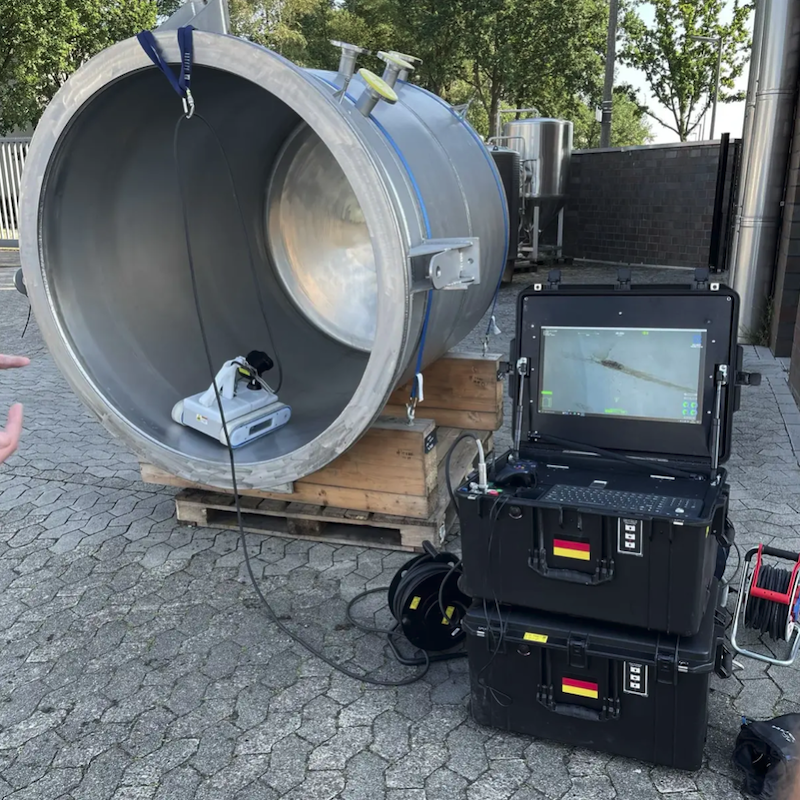
Robotic inspection systems address many of these limitations by allowing remote-controlled or semi-autonomous devices to enter the vessel and scan internal surfaces with high precision.

Equipped with high-resolution cameras, ultrasonic probes, laser scanners, or magnetic sensors, these robots can systematically examine weld seams, shell sections, and nozzle connections for microcracks, corrosion fatigue, or structural irregularities.

Because robotic systems maintain consistent sensor positioning and scanning speed, they often deliver more repeatable and measurable inspection data than manual procedures.

Another important advantage is improved safety. Stainless steel vessels frequently qualify as confined spaces, meaning human entry requires extensive safety precautions, atmospheric monitoring, and rescue planning.

Robotic systems can perform the initial inspection without personnel entering the vessel, significantly reducing risk while still providing detailed structural information. Human inspectors can then focus only on locations where the robotic scan has identified potential anomalies.

From an operational perspective, robotic crack detection can also reduce downtime. Faster setup, automated scanning paths, and digital reporting allow maintenance teams to evaluate vessel condition more quickly and plan targeted repairs instead of conducting lengthy manual surveys.

Digital inspection records additionally support lifecycle documentation, preventive maintenance strategies, and regulatory audits.

The technology is also particularly valuable when purchasing used processing machinery, such as stainless-steel reactors, pressure vessels or dairy process tanks.

Leading second-hand equipment dealers such as Behälter KG Bremen offer surface inspection reports for many of their second-hand tanks and vessels, in order to verify that the equipment is free of cracks and defects.

Overall, robotic crack inspection represents a significant advancement in non-destructive testing for stainless steel vessels, combining higher inspection consistency, improved worker safety, and more efficient maintenance planning with reliable, data-driven assessment of structural condition.

Main image source: Behälter K.G. Bremen GmbH

Print Friendly, PDF & Email

Share this:

  • Print (Opens in new window) Print
  • Share on Facebook (Opens in new window) Facebook
  • Share on LinkedIn (Opens in new window) LinkedIn
  • Share on Reddit (Opens in new window) Reddit
  • Share on X (Opens in new window) X
  • Share on Tumblr (Opens in new window) Tumblr
  • Share on Pinterest (Opens in new window) Pinterest
  • Share on WhatsApp (Opens in new window) WhatsApp
  • Share on Telegram (Opens in new window) Telegram

Related stories you might also like…

Filed Under: Engineering, Robotics, Technology Tagged With: automation news, Behälter KG Bremen, confined space inspection, corrosion detection, crack detection, industrial automation inspection, industrial inspection robots, industrial safety robotics, inspection automation, manufacturing inspection technology, NDT robotics, non-destructive testing, predictive maintenance, process vessel maintenance, robotic inspection, robotic NDT, robotics and automation, robotics and automation news, robotics news, stainless steel tanks, tank inspection technology, ultrasonic inspection robotics, vessel inspection, weld inspection robots

Primary Sidebar

Search this website

Latest articles

  • Niantic Spatial adds USDZ export to Scaniverse to streamline robotics simulation workflows
  • Sonair unveils ‘world’s first’ safety-certified 3D ultrasonic sensor for human-robot collaboration
  • Robot.com to showcase autonomous advertising robots as official robotics partner of LEAP East
  • Robbyant launches LingBot-Depth 2.0 and LingBot-Vision for advanced robotic spatial perception
  • Ency Software and Stäubli Robotics sign global agreement to ‘simplify robot programming’
  • Waabi says its AI driver transferred to Volvo autonomous truck without retraining
  • Ambi Robotics and Pickle Robot integrate AI-powered robots to automate inbound warehouse logistics
  • UK startup Humanoid launches reinforcement learning system to improve robot manipulation
  • Apptronik launches Robot Park to train Apollo humanoid robots with Google DeepMind
  • University of Rhode Island opens advanced Ocean Robotics Laboratory for autonomous marine research

Secondary Sidebar

Latest news

  • Niantic Spatial adds USDZ export to Scaniverse to streamline robotics simulation workflows
  • Sonair unveils ‘world’s first’ safety-certified 3D ultrasonic sensor for human-robot collaboration
  • Robot.com to showcase autonomous advertising robots as official robotics partner of LEAP East
  • Robbyant launches LingBot-Depth 2.0 and LingBot-Vision for advanced robotic spatial perception
  • Ency Software and Stäubli Robotics sign global agreement to ‘simplify robot programming’
  • Waabi says its AI driver transferred to Volvo autonomous truck without retraining
  • Ambi Robotics and Pickle Robot integrate AI-powered robots to automate inbound warehouse logistics
  • UK startup Humanoid launches reinforcement learning system to improve robot manipulation
  • Apptronik launches Robot Park to train Apollo humanoid robots with Google DeepMind
  • University of Rhode Island opens advanced Ocean Robotics Laboratory for autonomous marine research

Copyright © 2026 · News Pro on Genesis Framework · WordPress · Log in

We use cookies on our website to give you the most relevant experience by remembering your preferences and repeat visits. By clicking “Accept”, you consent to the use of ALL the cookies.
Do not sell my personal information.
Cookie SettingsAccept
Manage consent

Privacy Overview

This website uses cookies to improve your experience while you navigate through the website. Out of these, the cookies that are categorized as necessary are stored on your browser as they are essential for the working of basic functionalities of the website. We also use third-party cookies that help us analyze and understand how you use this website. These cookies will be stored in your browser only with your consent. You also have the option to opt-out of these cookies. But opting out of some of these cookies may affect your browsing experience.
Necessary
Always Enabled
Necessary cookies are absolutely essential for the website to function properly. These cookies ensure basic functionalities and security features of the website, anonymously.
CookieDurationDescription
cookielawinfo-checkbox-analytics11 monthsThis cookie is set by GDPR Cookie Consent plugin. The cookie is used to store the user consent for the cookies in the category "Analytics".
cookielawinfo-checkbox-functional11 monthsThe cookie is set by GDPR cookie consent to record the user consent for the cookies in the category "Functional".
cookielawinfo-checkbox-necessary11 monthsThis cookie is set by GDPR Cookie Consent plugin. The cookies is used to store the user consent for the cookies in the category "Necessary".
cookielawinfo-checkbox-others11 monthsThis cookie is set by GDPR Cookie Consent plugin. The cookie is used to store the user consent for the cookies in the category "Other.
cookielawinfo-checkbox-performance11 monthsThis cookie is set by GDPR Cookie Consent plugin. The cookie is used to store the user consent for the cookies in the category "Performance".
viewed_cookie_policy11 monthsThe cookie is set by the GDPR Cookie Consent plugin and is used to store whether or not user has consented to the use of cookies. It does not store any personal data.
Functional
Functional cookies help to perform certain functionalities like sharing the content of the website on social media platforms, collect feedbacks, and other third-party features.
Performance
Performance cookies are used to understand and analyze the key performance indexes of the website which helps in delivering a better user experience for the visitors.
Analytics
Analytical cookies are used to understand how visitors interact with the website. These cookies help provide information on metrics the number of visitors, bounce rate, traffic source, etc.
Advertisement
Advertisement cookies are used to provide visitors with relevant ads and marketing campaigns. These cookies track visitors across websites and collect information to provide customized ads.
Others
Other uncategorized cookies are those that are being analyzed and have not been classified into a category as yet.
SAVE & ACCEPT