Corvus Robotics and Southern Glazer’s Wine & Spirits have agreed a strategic technology partnership and expanded deployment of the Corvus One autonomous inventory management system across Southern Glazer’s distribution network.
Over the past 18 months, Southern Glazer’s has deployed more than 40 Corvus One autonomous drones across nine distribution centers nationwide, with continued expansion planned.
The rollout supports Southern Glazer’s broader supply chain transformation initiative and reinforces its commitment to operational excellence across its network.
A full video case study detailing the multi-site deployment and measurable operational impact across Southern Glazer’s distribution network is available here.
Corvus One operates continuously within active warehouse environments, autonomously flying aisles to scan and validate reserve storage locations without disrupting case-picking operations. The result is hands-free, high-frequency inventory audits that sync directly with Southern Glazer’s WMS, freeing the team to focus on higher-value tasks.
At Southern Glazer’s, the system has completed approximately 5,000 flights and identified over 35,000 verified discrepancies across deployed facilities.
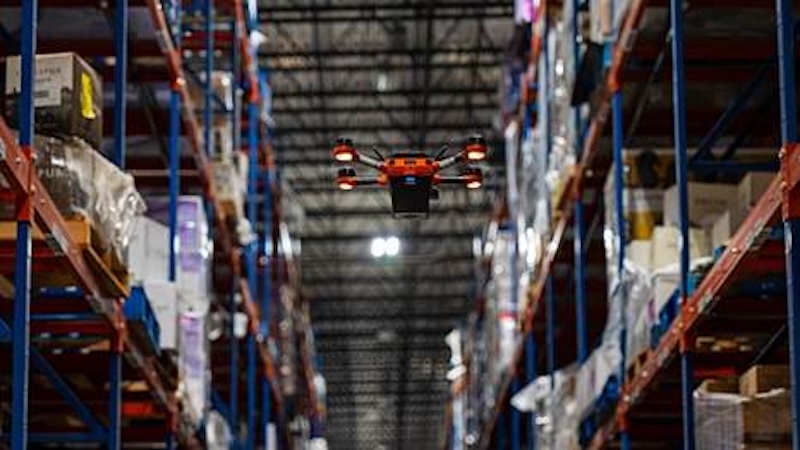
A Corvus One autonomous inventory drone performs a cycle counting mission at Southern Glazer’s Wine & Spirits distribution center in Raymore, Missouri.
Operational Throughput: Improved inventory accuracy has contributed to a 100 basis point improvement in cases per hour, enabling faster and more efficient fulfillment of customer orders.
Sixfold Inventory Validation Increase: Shifting from a quarterly count cadence to biweekly turns across facilities, Southern Glazer’s has realized higher-frequency visibility that allows teams to identify and resolve discrepancies before they impact picking and outbound shipping.
More Efficient Use of Labor: Approximately 60 to 70 labor hours per week per site have been reallocated from manual cycle counting to higher-value operational priorities.
Inventory teams focus on resolving verified discrepancies rather than performing broad manual counts, using the Corvus interface to review high-resolution images, label scans, and historical video logs tied to specific storage locations.
Karli Sage, vice president, supply chain management, technology and engineering, Southern Glazer’s Wine & Spirits, says: “Across our network, inventory accuracy directly impacts how effectively we serve our customers.
“By increasing the frequency and precision of our reserve inventory validation, we are identifying issues earlier, improving fill rates, and enabling our teams to focus on proactive problem solving instead of reactive counting. The speed at which we have scaled this technology across nine sites reflects the value it is delivering to our operations.”
The system’s visual record of each scan provides searchable, time-stamped footage of pallet positions and license plate labels, enabling rapid root-cause analysis and coaching.
Verified discrepancies can include misplaced pallets, missing LPNs, or incorrect placements that, in beverage distribution, can represent significant dollar value per pallet.
Jackie Wu, CEO of Corvus Robotics, says: “Southern Glazer’s operates at a scale where small improvements in accuracy have meaningful downstream impact.
“Their team has embraced autonomous inventory as core infrastructure within their supply chain transformation initiative. Scaling to nine facilities with more than 40 drones demonstrates strong operational buy-in and sets a new benchmark for how beverage distributors can modernize inventory control without slowing the floor.”
The collaboration includes regular cross-site operational reviews, enabling Southern Glazer’s facilities to share best practices and continuously refine how autonomous inventory is integrated into daily workflows.
As additional facilities come online, the companies will continue collaborating to standardize deployment models and performance benchmarks across the network.
For food and beverage distributors managing high SKU counts, fast-moving case-picking environments and tight service level expectations, frequent and autonomous reserve validation provides earlier detection of discrepancies, stronger fill performance and measurable improvements in warehouse throughput.
