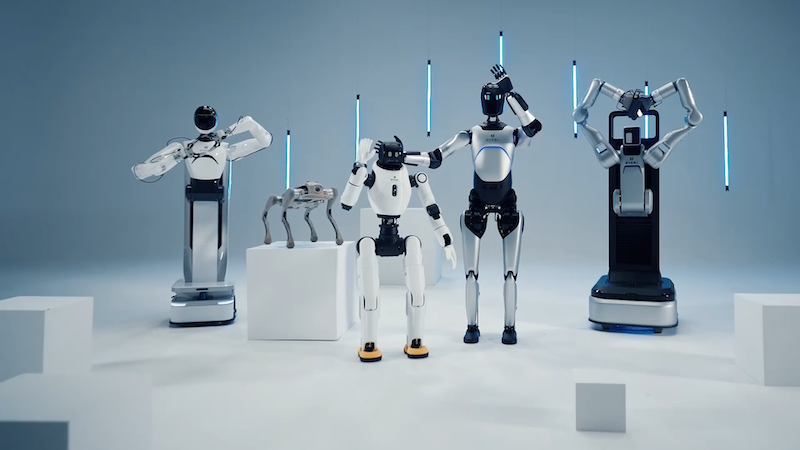
China has introduced its first comprehensive national standard framework for humanoid robots, marking a significant step toward scaling the industry from early experimentation to large-scale commercialization.
The framework – titled the “Humanoid Robot and Embodied Intelligence Standard System” (2026 Edition) – was presented at a technical committee meeting in Beijing on February 28, 2026, bringing together more than 120 researchers, executives, and policymakers.
From silos to standards
For an industry that has spent the last few years in what one expert called a “from zero to one” phase of dazzling demonstrations and fragmented prototypes, the release of this framework signals a decisive shift. China’s humanoid robot sector is now being asked to grow up.
To understand why this matters, consider the state of play. According to the Ministry of Industry and Information Technology (MIIT), by the end of 2025, China was home to over 140 humanoid robot manufacturers, which collectively launched more than 330 different models. The creativity was remarkable, but so was the chaos.
“When we analyzed industrial scenarios,” Peng Zhihui, co-founder of Shanghai-based Agibot and a deputy director of the technical committee, explained at the Beijing conference, “we found that nearly 80 percent of tasks where humans excel but traditional automation struggles are strongly related to tactile sensing. The bottleneck results from the absence of standardized technological pathways for tactile sensors.”
This is the problem the new standard system is designed to solve. Developed collaboratively by the MIIT’s HEIS technical committee – drawing on expertise from 120 research institutions, enterprises, and industry users – the framework is structured around six pillars:
- Foundational and common standards: The basic rules of the road, providing universal guidance and compliance assurance for technological development.
- Neuromorphic and intelligent computing: Standards for the “cerebrum and cerebellum” of embodied intelligence, governing everything from data management to model training pipelines.
- Limbs and components: Specifications for the physical building blocks – torsos, dexterous hands, actuation units, and perception modules – aimed at enabling modular, interchangeable development.
- Full-system integration: Standards for how hardware and software come together, ensuring that a robot from one manufacturer can, in theory, integrate smoothly with systems from another.
- Application: Guidelines for how robots should operate in specific scenarios, from factory floors to homes, providing a blueprint for deployment.
- Safety and ethics: Perhaps the most critical pillar, covering physical safety, cybersecurity, and ethical frameworks as autonomous machines enter human environments.
Liang Liang, secretary-general of the technical committee, described the vision succinctly. By unifying technical specifications and evaluation criteria, the new system is intended to “reduce coordination and adaptation costs across the industrial chain, promote the modularization and generalization development of upstream components, and guide R&D resources to concentrate on core and key areas, avoiding low-level redundant work.”
In practical terms, this means encouraging interoperability. A high-quality actuator from one supplier should fit seamlessly into a robot chassis from another, much like standardized parts in the global automotive industry.
The ‘1 to 10’ challenge
The timing of the standards release reflects a broader inflection point for the sector. Jiang Lei, another deputy director of the technical committee, observed that while the industry has successfully moved “from zero to one,” it now faces the more complex challenge of scaling “from one to ten.”
This transition involves moving from prototypes in research labs to mass production, and from controlled demonstrations to reliable performance in real-world environments. Industry leaders often describe this shift as moving robots from “kung fu” to “working.”
Wang Xingxing, founder and CEO of Unitree Robotics and also a deputy director of the technical committee, presented footage of robots performing assembly tasks in factories. His message was direct: “To enable humanoid robots to genuinely work, particularly on long-sequence tasks, industry-wide standards are absolutely essential.”
The lack of such standards has created hurdles across the supply chain. Zhao Tongyang, founder of EngineAI Robotics, drew a comparison to the automotive sector: “After nearly a century of development, every auto component has dozens or even hundreds of mature suppliers. For humanoid robotics, which has only recently accelerated, the supplier base remains limited.”
This scarcity increases costs and slows innovation. With a standardized framework, the expectation is that a broader supplier ecosystem will emerge, improving reliability while reducing costs.
Safety, ethics, and public trust
A notable aspect of the framework is its focus on safety and ethics. As Liang Liang noted in an interview with China Daily, ensuring safe deployment – along with cybersecurity and data protection – is a priority.
The framework includes provisions for battery management, hardware reliability, and guidelines governing autonomous decision-making and human intervention.
This work is supported by organizations such as the China CEPREI Laboratory, which has been appointed co-lead of the Safety Working Group. The institute will focus on standards for “physical safety, network and data security, intelligent behavior safety, and ethics and social governance.”
The aim is to build public trust, which will be essential for adoption in homes, schools, and public spaces.
A future in factories, then homes
According to Liang Liang, implementation is already under way. The committee plans to prioritize standards for key components, data, and models, with the goal of completing standard-setting cycles within six months. These are intended to be “usable standards” with practical implementation mechanisms.
Initial deployment is expected in industrial and commercial environments – so-called “semi-structured” settings such as factories, logistics centers, and public venues. As Jiang Lei outlined, the focus will be on “unlocking high-value, scalable potential in scenarios like semi-structured industrial settings, mixed sorting in logistics, and inspection and security.”
Household deployment remains a longer-term objective. “Bottlenecks exist in data technology, computing power, the generalization ability of models and the development of components such as dexterous hands and electronic skin,” Jiang explained. “If these bottlenecks are not addressed effectively, it will be difficult for humanoid robots to operate in ordinary households.”
With the publication of the new framework, China’s humanoid robot industry now has a roadmap for addressing those challenges. The phase of fragmented experimentation is giving way to coordinated industrial development, as the sector prepares to move from demonstration to deployment.
More about the standard
The Humanoid Robot and Embodied Intelligence Standard System (2026 Edition) was developed by the Ministry of Industry and Information Technology’s Humanoid Robots and Embodied Intelligence Standardization Technical Committee (HEIS). The framework was unveiled at the committee’s inaugural annual meeting in Beijing on February 28, 2026.
It establishes six core pillars – foundational standards, neuromorphic computing, limbs and components, system integration, applications, and safety/ethics – designed to guide the sector toward modular, interoperable, and safe large-scale production.
