
• Skip to primary navigation
  • Skip to main content
  • Skip to primary sidebar
  • Skip to secondary sidebar
  • About
    • Contact
    • Privacy
    • Terms of use
  • Shop
    • Cart
    • Checkout
    • My Account
  • Advertise
    • Advertising
      • Buy ad space
    • Case studies
    • Design
    • Email marketing
    • Features list
    • Lead generation
    • Magazine
    • Press releases
    • Publishing
    • Sponsor an article
    • Webcasting
    • Webinars
    • White papers
    • Writing
  • Subscribe to Newsletter

Robotics & Automation News

Where Innovation Meets Imagination

  • Home
  • News
  • Features
  • Editorial Sections A-Z
    • Agriculture
    • Aircraft
    • Artificial Intelligence
    • Automation
    • Autonomous Vehicles
    • Business
    • Computing
    • Construction
    • Culture
    • Design
    • Drones
    • Economy
    • Energy
    • Engineering
    • Environment
    • Health
    • Humanoids
    • Industrial robots
    • Industry
    • Infrastructure
    • Investments
    • Logistics
    • Manufacturing
    • Marine
    • Material handling
    • Materials
    • Mining
    • Promoted
    • Research
    • Robotics
    • Science
    • Sensors
    • Service robots
    • Software
    • Space
    • Technology
    • Transportation
    • Warehouse robots
    • Wearables
  • Press releases
  • Events

What is a Transparent Proxy?

March 10, 2026 by David Edwards

Understanding how internet traffic is managed behind the scenes often feels like looking inside a glass wall – you know something is there, but you don’t always notice it. That is exactly where the concept of a transparent proxy fits.

It operates quietly, without asking users for permission or configuration, yet it plays a powerful role in how data flows across networks. So, what is a transparent proxy, and why does it matter so much in today’s digital infrastructure?

The Core Idea Behind a Transparent Proxy

A transparent proxy is an intermediary server that sits between a user and the destination website, routing traffic without requiring any action from the user.

Unlike other proxy types, it does not need manual setup in a browser or application. From the user’s perspective, everything feels direct and natural, as if no middle layer exists at all.

Think of it like an automatic toll road sensor. You drive at normal speed, no stopping, no tickets, no gates – yet your car is still identified, monitored, and processed by the system.

A transparent proxy works the same way. Requests pass through it automatically, allowing network administrators to observe, optimize, or manage traffic without interrupting the user experience.

How Transparent Proxies Operate Behind the Scenes

At a technical level, a transparent proxy intercepts traffic at the network layer. This usually happens through router or firewall rules that redirect traffic to the proxy server. Because of this design, the user’s device does not even realize a proxy is involved.

The proxy then forwards the request to the destination server and relays the response back to the user. Since no client-side configuration is required, transparent proxies are commonly used in environments where administrators need broad control – such as corporate networks, schools, hotels, and public Wi-Fi systems. The goal is efficiency and oversight, not user interaction.

Common Use Cases for Transparent Proxies

Transparent proxies are not about complexity; they are about scale and control. They shine in environments where managing large volumes of traffic is more important than individual customization.

Here are some of the most common scenarios where they are applied:

  • Traffic monitoring to understand usage patterns and network load
  • Content filtering in corporate or educational networks
  • Caching frequently accessed resources to reduce bandwidth usage
  • Policy enforcement for acceptable use and compliance
  • Performance optimization by reducing latency on repeated requests

Each of these use cases benefits from the same core advantage: the proxy works invisibly, without user involvement.

Transparent Proxy vs Other Proxy Types

To better understand where transparent proxies stand, it helps to compare them with other proxy models. The key difference lies in visibility and configuration.
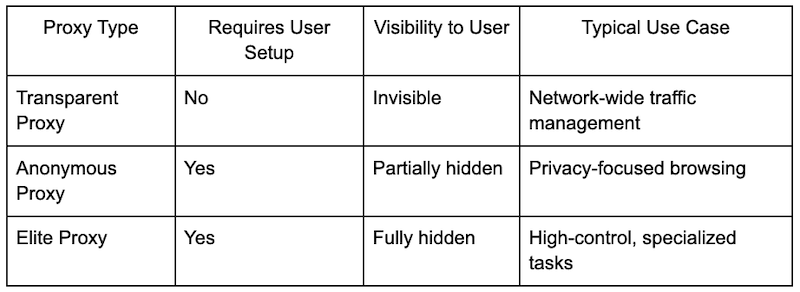
This comparison highlights why transparent proxies are favored by administrators rather than end users. They are designed for control at the infrastructure level, not for individual customization.

Advantages and Limitations You Should Know

Every technology is a trade-off, and transparent proxies are no exception. Their biggest strength – being invisible – is also their biggest limitation.

On the positive side, they are easy to deploy at scale, require no user training, and allow centralized traffic control. They are excellent tools for organizations that need oversight without friction.

On the downside, because users are aware of their presence, transparent proxies are not suited for tasks that require user-level control or flexibility.

It’s a bit like automatic climate control in a large office building. It keeps the environment stable and efficient, but you don’t get to fine-tune the temperature at your desk.

Where Transparent Proxies Fit in Modern Infrastructure

In modern network architecture, transparent proxies are often combined with other proxy solutions to create layered systems. A company might use transparent proxies for baseline traffic handling while relying on configurable proxy services for specialized tasks and external operations.

This is where professional proxy providers, such as Proxys.io, come into play – offering structured, reliable solutions that complement internal network tools rather than replacing them. The transparent proxy handles the “silent work,” while other proxy types manage more visible, task-specific workflows.

Why Transparent Proxies Still Matter Today

With cloud services, distributed teams, and massive data flows becoming the norm, the need for quiet, efficient traffic management has not disappeared.

If anything, it has grown stronger. Transparent proxies remain relevant because they solve a simple but critical problem: how to manage and optimize network traffic without slowing people down or forcing configuration on every device.

In many ways, they are the unsung heroes of network infrastructure. You don’t notice them when they work well – but when they’re gone, the system quickly feels less organized, less efficient, and harder to control.

Final Thoughts on Transparent Proxies

So, what is a transparent proxy? It is a behind-the-scenes architect of network flow, shaping how data moves without ever stepping into the spotlight. For organizations that value control, efficiency, and simplicity, transparent proxies are not just useful – they are essential.

Understanding how they work gives you a clearer view of the invisible systems that keep modern networks running smoothly. And once you see that glass wall, you start to appreciate just how much is happening on the other side.

Print Friendly, PDF & Email

Share this:

  • Print (Opens in new window) Print
  • Share on Facebook (Opens in new window) Facebook
  • Share on LinkedIn (Opens in new window) LinkedIn
  • Share on Reddit (Opens in new window) Reddit
  • Share on X (Opens in new window) X
  • Share on Tumblr (Opens in new window) Tumblr
  • Share on Pinterest (Opens in new window) Pinterest
  • Share on WhatsApp (Opens in new window) WhatsApp
  • Share on Telegram (Opens in new window) Telegram

Related stories you might also like…

Filed Under: Business, Computing, Internet Tagged With: automation news, enterprise network management, internet traffic management, network proxy servers, network security tools, proxy server explanation, proxy server infrastructure, proxy server technology, robotics and automation, robotics and automation news, robotics news, transparent proxy, transparent proxy server, what is a transparent proxy

Primary Sidebar

Search this website

Latest articles

  • Signs Your Commercial LED Lights Need Maintenance
  • Should You Move Office or Transform the One You Already Have?
  • The Automation Age: 6 Ways Pick and Pack Fulfillment is Revolutionizing Order Delivery
  • The Human Bottleneck in Healthcare Automation: Matching Doctors to Demand
  • Exploring the Role of Nearshore Call Centers in Robotics and Automation
  • 5 Ways Automation is Eliminating Errors at the Shipping Desk
  • STMicroelectronics acquires stake in humanoid robot developer Oversonic Robotics
  • Robot.com launches humanoid ‘built for the work that burns people out’
  • FORT Robotics extends physical AI safety platform with Nvidia Halos
  • Fieldwork Robotics secures SEED Innovations investment to scale berry harvesting robots

Secondary Sidebar

Latest news

  • Signs Your Commercial LED Lights Need Maintenance
  • Should You Move Office or Transform the One You Already Have?
  • The Automation Age: 6 Ways Pick and Pack Fulfillment is Revolutionizing Order Delivery
  • The Human Bottleneck in Healthcare Automation: Matching Doctors to Demand
  • Exploring the Role of Nearshore Call Centers in Robotics and Automation
  • 5 Ways Automation is Eliminating Errors at the Shipping Desk
  • STMicroelectronics acquires stake in humanoid robot developer Oversonic Robotics
  • Robot.com launches humanoid ‘built for the work that burns people out’
  • FORT Robotics extends physical AI safety platform with Nvidia Halos
  • Fieldwork Robotics secures SEED Innovations investment to scale berry harvesting robots

Copyright © 2026 · News Pro on Genesis Framework · WordPress · Log in

We use cookies on our website to give you the most relevant experience by remembering your preferences and repeat visits. By clicking “Accept”, you consent to the use of ALL the cookies.
Do not sell my personal information.
Cookie SettingsAccept
Manage consent

Privacy Overview

This website uses cookies to improve your experience while you navigate through the website. Out of these, the cookies that are categorized as necessary are stored on your browser as they are essential for the working of basic functionalities of the website. We also use third-party cookies that help us analyze and understand how you use this website. These cookies will be stored in your browser only with your consent. You also have the option to opt-out of these cookies. But opting out of some of these cookies may affect your browsing experience.
Necessary
Always Enabled
Necessary cookies are absolutely essential for the website to function properly. These cookies ensure basic functionalities and security features of the website, anonymously.
CookieDurationDescription
cookielawinfo-checkbox-analytics11 monthsThis cookie is set by GDPR Cookie Consent plugin. The cookie is used to store the user consent for the cookies in the category "Analytics".
cookielawinfo-checkbox-functional11 monthsThe cookie is set by GDPR cookie consent to record the user consent for the cookies in the category "Functional".
cookielawinfo-checkbox-necessary11 monthsThis cookie is set by GDPR Cookie Consent plugin. The cookies is used to store the user consent for the cookies in the category "Necessary".
cookielawinfo-checkbox-others11 monthsThis cookie is set by GDPR Cookie Consent plugin. The cookie is used to store the user consent for the cookies in the category "Other.
cookielawinfo-checkbox-performance11 monthsThis cookie is set by GDPR Cookie Consent plugin. The cookie is used to store the user consent for the cookies in the category "Performance".
viewed_cookie_policy11 monthsThe cookie is set by the GDPR Cookie Consent plugin and is used to store whether or not user has consented to the use of cookies. It does not store any personal data.
Functional
Functional cookies help to perform certain functionalities like sharing the content of the website on social media platforms, collect feedbacks, and other third-party features.
Performance
Performance cookies are used to understand and analyze the key performance indexes of the website which helps in delivering a better user experience for the visitors.
Analytics
Analytical cookies are used to understand how visitors interact with the website. These cookies help provide information on metrics the number of visitors, bounce rate, traffic source, etc.
Advertisement
Advertisement cookies are used to provide visitors with relevant ads and marketing campaigns. These cookies track visitors across websites and collect information to provide customized ads.
Others
Other uncategorized cookies are those that are being analyzed and have not been classified into a category as yet.
SAVE & ACCEPT