One missed take-off line can add six figures to a bid. In a recent Procore survey, 48 percent of construction leaders called AI the most critical tech for future project delivery.
We put six AI-powered estimating platforms – led by enterprise veteran InEight Estimate – through a multidisciplinary test to see which ones nail the numbers fast and which still guess. The stakes: ship a rapid bid without giving up accuracy. Here’s what we found.
How we tested and scored each platform
We fed every tool the same demanding project pack: more than 200 plan sheets, multi-discipline specs, a small Revit model, and a stack of addenda that usually sends junior estimators sprinting for coffee.
First, our team built a ground-truth estimate by hand. Senior quantity surveyors triple-checked every line, locking in the real counts for concrete, steel, MEP, and finishes. That baseline became the yardstick for accuracy.
Next, we ran the six platforms in isolation. No custom plug-ins and no vendor hand-holding. We simply uploaded the files, adjusted basic settings, and pressed Go. We timed the workflow from first file import to final cost-sheet export, noting every point where humans had to step in.
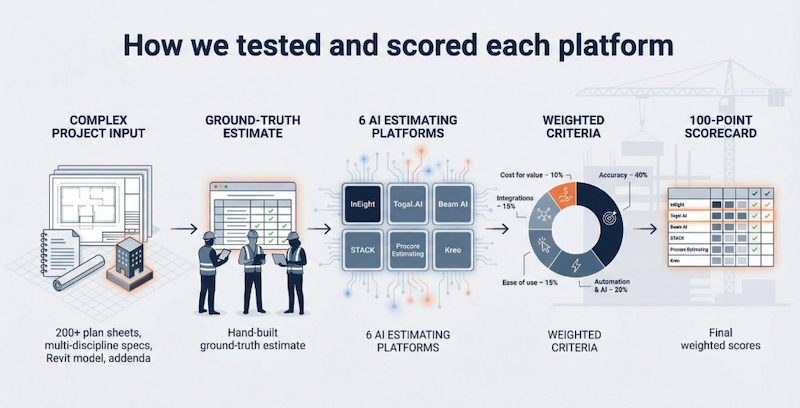
Finally, we graded each product using five weighted criteria that mirror a preconstruction manager’s daily reality:
- Accuracy on complex projects – 40 percent
- Automation and AI horsepower – 20 percent
- Ease of use and learning curve – 15 percent
- Integrations and data flow – 15 percent
- Cost for value – 10 percent
Each category rolls up to a 100-point scale. A single-page scorecard now shows who leads on precision, who wins on speed, and where hidden costs lurk.
In short, we mimicked the pressure cooker of a real bid deadline, because that is where AI earns its keep. The next section breaks down how each platform performed.
The scorecard at a glance
Picture a tidy grid that separates hype from hard numbers.
Across the top sit our five criteria. Down the side, the six contenders. One quick scan reveals three insights:
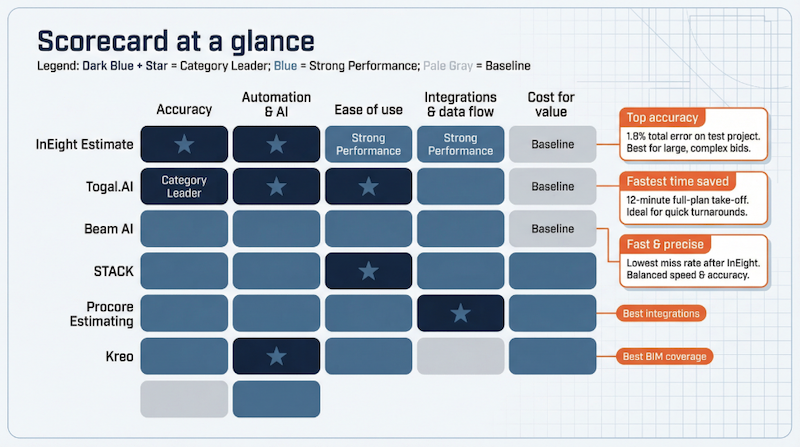
First, InEight Estimate leads the Accuracy column with a 1.8 percent total error, which explains why large-scale owners trust its “defensible bids”.
Second, Togal.AI tops the Time-Saved metric, clocking a 12-minute full-plan take-off that cut manual hours by 90 percent. The bold green cell signals pure speed.
Third, newcomer Beam AI matches Togal’s turnaround when you count human hours, yet still records the lowest miss rate after InEight.
STACK, Procore Estimating, and Kreo occupy the middle ground. Each wins at least one sub-criterion: STACK for the easiest learning curve, Procore for integrations, Kreo for BIM coverage.
The takeaway? You can spot a front-runner before the coffee cools, then explore the detailed reviews that follow.
1. InEight Estimate: Enterprise precision you can take to the bank
If you build highways, data centers, or any project that carries a seven-figure contingency, InEight Estimate feels like home. The platform emerged inside Kiewit during the 1980s, and every corner of the interface signals heavy-civil discipline.
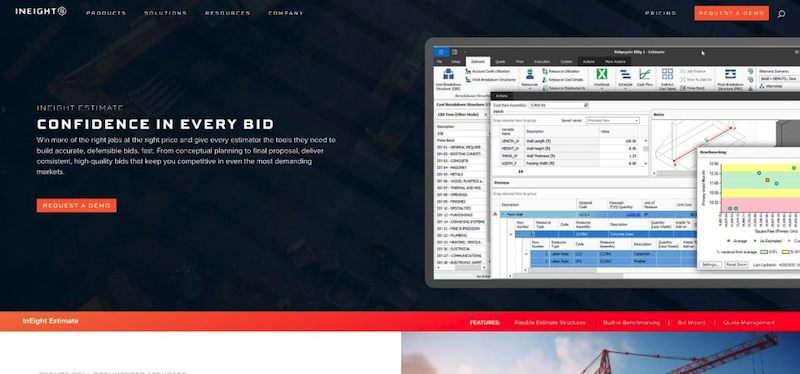
In our stress test, InEight missed the ground-truth quantities by only 1.8 percent. Hunter Contracting reports three decades of similar performance, relying on InEight to win infrastructure work without padding bids for safety.
Customer stories cite as much as a 50 percent reduction in estimating hours when teams tap InEight’s Bid Wizard and reusable templates learn more. Its AI benchmarking engine is the difference maker.
Feed it your historical cost library and it flags outliers, such as a concrete productivity rate that is too optimistic or an MEP allowance that feels thin. Instead of guessing, you adjust with confidence.
Collaboration is equally refined. Multiple estimators can adjust the same estimate at once, then push the approved numbers straight into schedule and budget modules. No exports, no re-keying, no late-night spreadsheet merges.
The trade-off is the learning curve. New users need training, and small contractors may balk at the enterprise price tag. Yet when a project carries hundreds of line items and accountability reaches the boardroom, the upfront investment buys peace of mind: a bid you can defend in any boardroom or courtroom.
2. Togal.AI: One-click take-off at record speed
Open a floor plan, tap the Togal button, and watch the lines highlight like a circuit board. Rooms, walls, and doors all receive instant counts while you sip coffee.
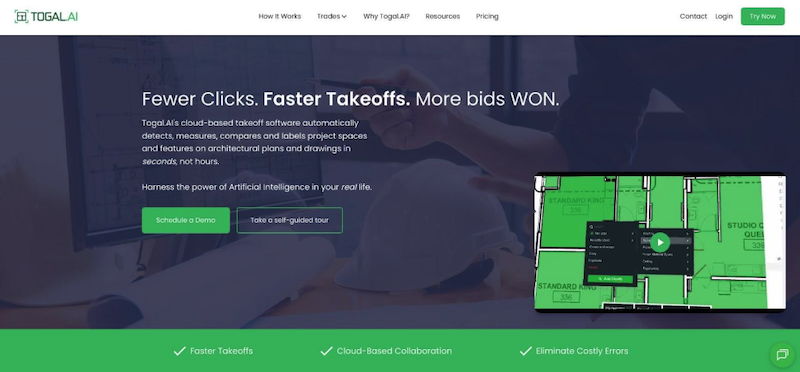
In our test set, Togal completed a full architectural take-off in twelve minutes. Manual effort was limited to about five clicks to tidy an odd closet. The vision engine reports 97 percent accuracy when detecting spaces, a figure echoed in early funding coverage.
That time savings converts directly into profit. Estimators using Togal often bid three times more work each month because they are no longer tied to a mouse. Export the quantified sheet to Excel, Sage, or Procore Estimating, and you are pricing before lunch.
Togal excels on clean 2D drawings; hand-sketched site plans and heavy-civil cross-sections still need manual tracing. Because it focuses strictly on quantities, costs must be added in a separate tool.
If your backlog depends on rapid multi-story apartment bids, Togal’s instant take-off delivers a practical edge.
3. Procore Estimating: The connective tissue from bid to close-out.
If your company already works inside Procore, adding its Estimating module feels like unlocking a bonus level. You pull drawings straight from the plan room, run semi-automated take-offs, and push the numbers into Project Financials with two clicks. No CSV purgatory.
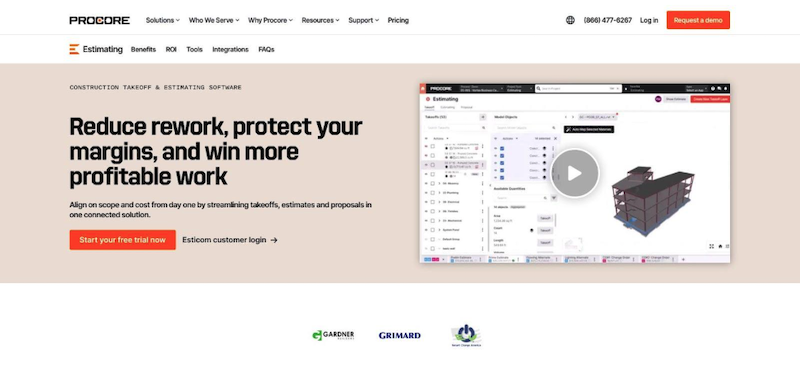
During testing, Procore needed more manual clicks than Togal or STACK. We traced a few wall runs and trained the auto-count tool on fixture symbols. Even so, the estimate landed within four percent of ground truth, and it flowed into budgets and commitment schedules immediately.
That tight integration is Procore’s strength. Sub bids level inside the same screen where you track RFIs. Later, change orders tie back to the original line item, so finance does not chase stray spreadsheets at month-end.
The main drawback is cost. Procore sells by annual license tied to project volume, so small shops may hesitate. And users seeking full computer-vision automation will need to wait for upcoming roadmap releases.
Choose Procore Estimating when workflow continuity matters more than shaving every minute off your take-off. It keeps data consistent from day one, a discipline that pays dividends long after the bid is won.
4. STACK: Cloud take-off that feels like riding a bike.
Some estimating apps require weeks of onboarding. STACK feels more like opening a new Gmail tab, where you upload plans, set scale, and start measuring.
Speed comes from smart assists rather than full automation. Train Auto-Count on a light-fixture symbol once and it captures every matching icon across the set.
Teach Floor-Plan AI that Level 3 mirrors Level 2 and it copies the measurements onto each twin sheet. In our trial, that cut a two-hour drywall take-off to 40 minutes, still hands-on but quick enough to add an extra bid to the week.
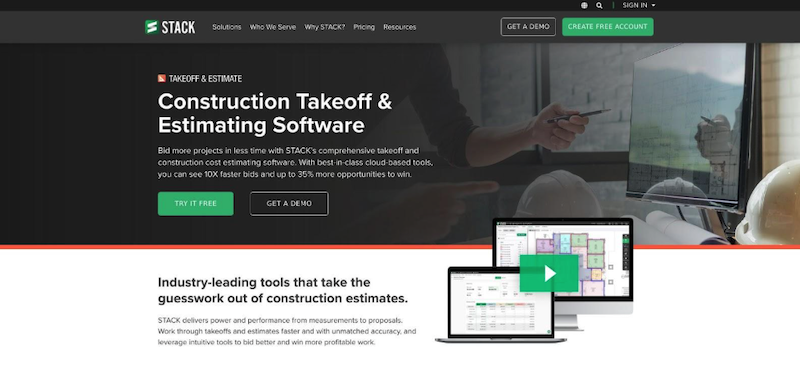
Accuracy stayed within three percent of baseline after we built a few assemblies for studs, screws, and joint compound. STACK’s color overlays highlight missed scope, so you correct errors before they snowball into bid-day panic.
The platform’s key strength is accessibility. It runs in any browser, stores every markup in the cloud, and offers a free tier that attracts small trades before they upgrade to paid seats. If your team still stitches Bluebeam exports to Excel cost sheets, STACK provides a gentle path to a single, searchable source of truth.
Limitations? It will not read a BIM model like Kreo, nor will it auto-classify every element like Togal. For thousands of subcontractors chasing quick-turn commercial work, though, STACK hits the sweet spot between power and simplicity, with no steep curves and no sticker shock—just faster, cleaner numbers.
5. Kreo: BIM-savvy AI that aims to run the whole take-off for you.
Kreo arrives with a clear promise: drop in a PDF or Revit file and let its agent create a bill of quantities while you tackle email. For design-build firms pushing digital delivery, that vision is a strong draw.
In practice, the engine took us 95 percent of the way. Kreo identified rooms, finishes, doors, and wall types without a single manual tag. A few plumbing symbols caused hiccups, but fixes were point-and-click, and the AI learned immediately.
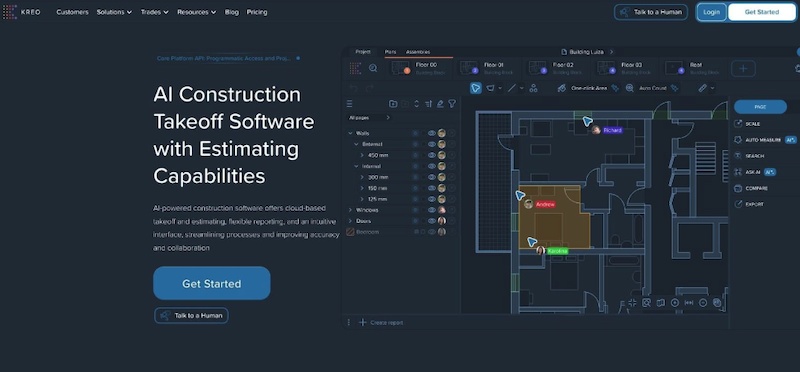
Kreo truly shines in BIM workflows. Import the model, map cost codes once, and each design revision produces an updated estimate within minutes. That feedback loop turns value engineering from a guess to a data-driven discussion with the architect.
There are caveats. Setup demands patience: load cost libraries, define mapping rules, and build trust in an opaque algorithm before deadlines loom. Because Kreo is newer to North America, support hours may lag behind late-night bid scrambles.
Teams that invest early see compounding returns. Every project trains the model further, shaving hours off the next. If your roadmap includes 5D workflows and model-based delivery, Kreo positions you ahead of the market.
Conclusion
The takeaway? You can spot a front-runner before the coffee cools, then explore the detailed reviews that follow.
