
• Skip to primary navigation
  • Skip to main content
  • Skip to primary sidebar
  • Skip to secondary sidebar
  • About
    • Contact
    • Privacy
    • Terms of use
  • Shop
    • Cart
    • Checkout
    • My Account
  • Advertise
    • Advertising
      • Buy ad space
    • Case studies
    • Design
    • Email marketing
    • Features list
    • Lead generation
    • Magazine
    • Press releases
    • Publishing
    • Sponsor an article
    • Webcasting
    • Webinars
    • White papers
    • Writing
  • Subscribe to Newsletter

Robotics & Automation News

Where Innovation Meets Imagination

  • Home
  • News
  • Features
  • Editorial Sections A-Z
    • Agriculture
    • Aircraft
    • Artificial Intelligence
    • Automation
    • Autonomous Vehicles
    • Business
    • Computing
    • Construction
    • Culture
    • Design
    • Drones
    • Economy
    • Energy
    • Engineering
    • Environment
    • Health
    • Humanoids
    • Industrial robots
    • Industry
    • Infrastructure
    • Investments
    • Logistics
    • Manufacturing
    • Marine
    • Material handling
    • Materials
    • Mining
    • Promoted
    • Research
    • Robotics
    • Science
    • Sensors
    • Service robots
    • Software
    • Space
    • Technology
    • Transportation
    • Warehouse robots
    • Wearables
  • Press releases
  • Events

IEA says renewables will become ‘world’s largest electricity source by end of this year’

December 2, 2025 by David Edwards

Renewable energy is on track to become the largest source of global electricity generation by the end of 2025, overtaking coal for the first time in modern energy history, according to new analysis from the International Energy Agency.

The projection appears in the IEA’s Renewables 2025 report, published in early October, which outlines how solar and wind power are accelerating despite policy uncertainty, supply chain pressure and downward revisions in several key markets.

The report forecasts that renewable electricity generation will grow from 9,900 TWh in 2024 to 16,200 TWh in 2030 – a 60 percent increase.

Solar PV alone accounts for more than half of the expected growth, followed by wind at around 30 percent. By contrast, coal generation is projected to stagnate or decline across most regions.

The IEA’s scenario suggests that renewables will surpass coal at the end of 2025, or by mid-2026 at the latest, depending on hydropower availability. Hydropower remains sensitive to regional weather patterns and drought conditions, which have significantly affected output in recent years.
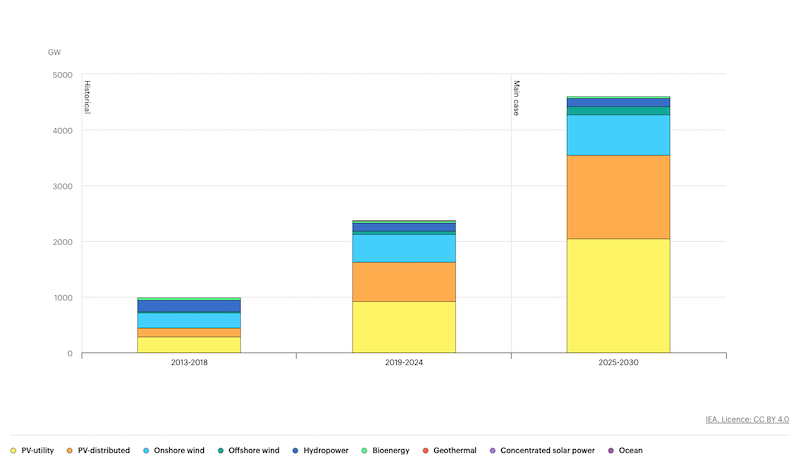
Solar and wind lead a record wave of global capacity additions

Between 2025 and 2030, the world is expected to add almost 4,600 GW of new renewable generating capacity – equivalent to the combined installed capacity of China, the European Union and Japan. This represents double the amount installed globally between 2019 and 2024.

Solar PV is the primary driver. Utility-scale solar and distributed rooftop systems together represent nearly 80 percent of the global expansion expected through 2030. Distributed solar (residential, commercial, industrial and off-grid systems) accounts for 42 percent of total PV growth.

The IEA notes that higher retail electricity prices following the energy crisis, as well as improved incentives and simplified permitting processes in some regions, continue to support strong adoption of behind-the-meter solar systems.

In countries with unstable grids, such as South Africa and Pakistan, commercial and off-grid PV installations paired with battery storage are expanding rapidly.

Wind growth is also recovering, despite recent turbulence in supply chains and financing. The report estimates that cumulative onshore wind additions will rise 45 percent over 2025-2030 compared with the previous five years, reaching 732 GW.

Annual additions are set to increase not only in Europe and India, but across Africa, the Middle East, ASEAN countries and Latin America.

Renewable electricity capacity growth by technology segment, 2013-2030

Offshore wind is expected to add 140 GW during the forecast period. China drives almost half of this growth, with Europe expected to reach 14.6 GW of annual additions by 2030.

However, macroeconomic pressures, higher project costs and several undersubscribed auctions have caused the IEA to revise the global offshore wind forecast 27 percent downward from last year.

Regional changes: US forecast drops sharply while India and the Middle East rise

One of the report’s most significant revisions concerns the United States. Renewable capacity forecasts for the US have been adjusted downward by almost 50 percent across all technologies except geothermal.

The change reflects the phase-out of key investment and production tax credits, as well as new regulatory restrictions on solar and wind development on federal land.

China’s outlook has also been reduced, though only by 5 percent. The introduction of competitive auctions and contract-for-difference schemes is expected to slightly lower investor profitability but support better long-term market integration.

By contrast, several regions show upward revisions:

Countries with expanding solar and wind sectors

  • India – almost 10 percent upgrade due to record auction capacity, new rooftop PV schemes and improved permitting for pumped-storage hydropower.
  • ASEAN countries – faster implementation of large hydropower projects and more ambitious renewable policy targets.
  • Middle East and North Africa – 23 percent upgrade, led by faster-than-expected solar development in Saudi Arabia.
  • European Union – slight upward revision for utility-scale solar PV in Germany, Spain, Italy and Poland.

Curtailment, auctions and market reforms reshape the next phase of renewable growth

As variable renewable energy expands, curtailment is becoming a structural issue in many markets. Countries such as China, Australia, Chile, Germany and Spain have already seen periods where solar and wind power must be curtailed due to grid congestion or system balancing limits.

At the same time, competitive auctions have become the dominant procurement mechanism worldwide. Auctions now account for nearly 60 percent of expected utility-scale renewable capacity growth between 2025 and 2030, compared with less than 25 percent in last year’s forecast.

The rise of market-based procurement – including merchant projects and corporate power purchase agreements – is also notable, now representing 28 percent of future additions.

Strong growth, but still short of global pledges

Despite rapid expansion, the IEA warns that current trends remain short of the COP28 ambition to triple global renewable capacity by 2030. Under the main case, global renewables reach 9,530 GW in 2030, a 2.6-times increase from 2022. Even the accelerated scenario, which assumes faster progress on permitting, grids and financing, does not fully close the gap.

Nevertheless, the near-term milestone is clear: renewables are on track to overtake coal as the largest source of global electricity by the end of 2025, marking a historic pivot in the world’s energy system.

Print Friendly, PDF & Email

Share this:

  • Print (Opens in new window) Print
  • Share on Facebook (Opens in new window) Facebook
  • Share on LinkedIn (Opens in new window) LinkedIn
  • Share on Reddit (Opens in new window) Reddit
  • Share on X (Opens in new window) X
  • Share on Tumblr (Opens in new window) Tumblr
  • Share on Pinterest (Opens in new window) Pinterest
  • Share on WhatsApp (Opens in new window) WhatsApp
  • Share on Telegram (Opens in new window) Telegram

Related stories you might also like…

Filed Under: Energy, Features Tagged With: automation news, coal decline, energy transition, global electricity generation, iea renewables 2025, robotics and automation, robotics and automation news, robotics news, solar pv growth, wind power expansion

Primary Sidebar

Search this website

Latest articles

  • The Hardware Powering the Hybrid Industrial Workforce
  • How to Choose a Robot Vacuum and Mop That Actually Fits Your Home
  • How Modern Software Helps Construction Companies in Qatar Work Smarter and Safer
  • Antivirus vs malware: Why antivirus alone is no longer enough
  • X Square Robot builds a full-stack approach to embodied AI and general-purpose robotics
  • AGIBOT debuts A3 humanoid robot in Europe and launches UK Robot-as-a-Service model
  • What Are the Biggest Challenges in Modern Electronics Manufacturing?
  • What Are the Best AI Tools for Creating Content Faster in 2026?
  • Why Does Quality Wiring Matter More Than Ever in Modern Electronic Devices?
  • Why Are Custom Harness Solutions Essential for Next Generation Technology?

Secondary Sidebar

Latest news

  • The Hardware Powering the Hybrid Industrial Workforce
  • How to Choose a Robot Vacuum and Mop That Actually Fits Your Home
  • How Modern Software Helps Construction Companies in Qatar Work Smarter and Safer
  • Antivirus vs malware: Why antivirus alone is no longer enough
  • X Square Robot builds a full-stack approach to embodied AI and general-purpose robotics
  • AGIBOT debuts A3 humanoid robot in Europe and launches UK Robot-as-a-Service model
  • What Are the Biggest Challenges in Modern Electronics Manufacturing?
  • What Are the Best AI Tools for Creating Content Faster in 2026?
  • Why Does Quality Wiring Matter More Than Ever in Modern Electronic Devices?
  • Why Are Custom Harness Solutions Essential for Next Generation Technology?

Copyright © 2026 · News Pro on Genesis Framework · WordPress · Log in

We use cookies on our website to give you the most relevant experience by remembering your preferences and repeat visits. By clicking “Accept”, you consent to the use of ALL the cookies.
Do not sell my personal information.
Cookie SettingsAccept
Manage consent

Privacy Overview

This website uses cookies to improve your experience while you navigate through the website. Out of these, the cookies that are categorized as necessary are stored on your browser as they are essential for the working of basic functionalities of the website. We also use third-party cookies that help us analyze and understand how you use this website. These cookies will be stored in your browser only with your consent. You also have the option to opt-out of these cookies. But opting out of some of these cookies may affect your browsing experience.
Necessary
Always Enabled
Necessary cookies are absolutely essential for the website to function properly. These cookies ensure basic functionalities and security features of the website, anonymously.
CookieDurationDescription
cookielawinfo-checkbox-analytics11 monthsThis cookie is set by GDPR Cookie Consent plugin. The cookie is used to store the user consent for the cookies in the category "Analytics".
cookielawinfo-checkbox-functional11 monthsThe cookie is set by GDPR cookie consent to record the user consent for the cookies in the category "Functional".
cookielawinfo-checkbox-necessary11 monthsThis cookie is set by GDPR Cookie Consent plugin. The cookies is used to store the user consent for the cookies in the category "Necessary".
cookielawinfo-checkbox-others11 monthsThis cookie is set by GDPR Cookie Consent plugin. The cookie is used to store the user consent for the cookies in the category "Other.
cookielawinfo-checkbox-performance11 monthsThis cookie is set by GDPR Cookie Consent plugin. The cookie is used to store the user consent for the cookies in the category "Performance".
viewed_cookie_policy11 monthsThe cookie is set by the GDPR Cookie Consent plugin and is used to store whether or not user has consented to the use of cookies. It does not store any personal data.
Functional
Functional cookies help to perform certain functionalities like sharing the content of the website on social media platforms, collect feedbacks, and other third-party features.
Performance
Performance cookies are used to understand and analyze the key performance indexes of the website which helps in delivering a better user experience for the visitors.
Analytics
Analytical cookies are used to understand how visitors interact with the website. These cookies help provide information on metrics the number of visitors, bounce rate, traffic source, etc.
Advertisement
Advertisement cookies are used to provide visitors with relevant ads and marketing campaigns. These cookies track visitors across websites and collect information to provide customized ads.
Others
Other uncategorized cookies are those that are being analyzed and have not been classified into a category as yet.
SAVE & ACCEPT