• Skip to primary navigation
  • Skip to main content
  • Skip to primary sidebar
  • Skip to secondary sidebar
  • About
    • Contact
    • Privacy
    • Terms of use
  • Shop
    • Cart
    • Checkout
    • My Account
  • Advertise
    • Advertising
      • Buy ad space
    • Case studies
    • Design
    • Email marketing
    • Features list
    • Lead generation
    • Magazine
    • Press releases
    • Publishing
    • Sponsor an article
    • Webcasting
    • Webinars
    • White papers
    • Writing
  • Subscribe to Newsletter

Robotics & Automation News

Where Innovation Meets Imagination

  • Home
  • News
  • Features
  • Editorial Sections A-Z
    • Agriculture
    • Aircraft
    • Artificial Intelligence
    • Automation
    • Autonomous Vehicles
    • Business
    • Computing
    • Construction
    • Culture
    • Design
    • Drones
    • Economy
    • Energy
    • Engineering
    • Environment
    • Health
    • Humanoids
    • Industrial robots
    • Industry
    • Infrastructure
    • Investments
    • Logistics
    • Manufacturing
    • Marine
    • Material handling
    • Materials
    • Mining
    • Promoted
    • Research
    • Robotics
    • Science
    • Sensors
    • Service robots
    • Software
    • Space
    • Technology
    • Transportation
    • Warehouse robots
    • Wearables
  • Press releases
  • Events

Opinion: Robotics expert ranks ‘world’s top most advanced robots’ in study

November 17, 2025 by David Edwards

Robots are reshaping industries, homes, and daily routines at an accelerating pace. From warehouse floors to living rooms, these machines are moving beyond repetitive tasks into roles that demand real-world adaptability and intelligence. But which robots truly represent the cutting edge of innovation?

Frans Tollenaar, CEO of Teqram, a provider of vision-guided robotic systems for industrial applications, explains: “The robotics industry has reached a turning point where we’re seeing humanoid and mobile robots that can navigate complex environments, manipulate objects with precision, and operate autonomously. These are no longer laboratory prototypes, but production models being deployed in real-world settings.”

To identify the most advanced robots currently operating, Teqram analyzed mobile, autonomous robots launched between 2020 and 2025.

The study evaluated each robot across five key performance factors:

  1. navigation;
  2. manipulation;
  3. degrees of freedom;
  4. speed; and
  5. strength.

Only robots capable of independent movement were included, excluding stationary communication-focused models.

‘World’s top 5 most advanced robots’
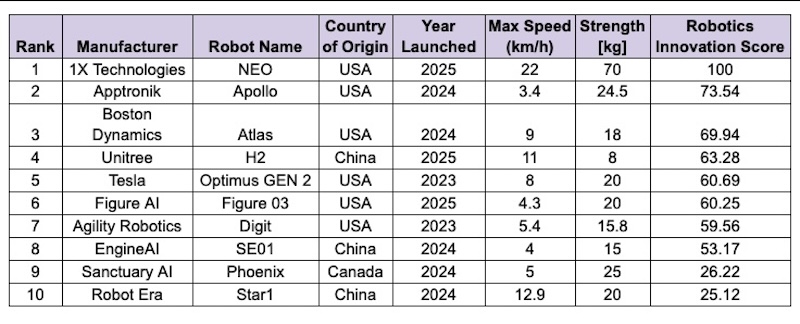
The full dataset includes a list of the top 15 “most advanced robots”, and is available on request from Teqram, along with the methodology.

1. NEO by 1X Technologies – Score: 100

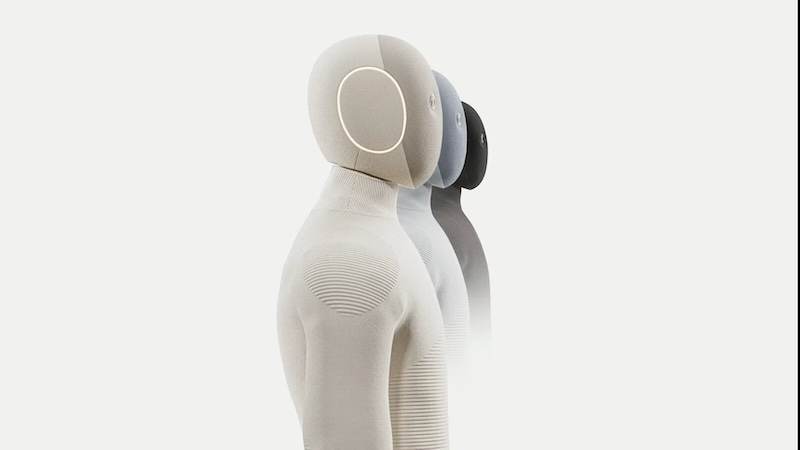
NEO (main image) achieves “a perfect innovation score of 100”, according to this study, establishing itself as “the most advanced consumer-focused humanoid robot currently available”.

Designed specifically for home environments, NEO uses AI and tendon-driven actuation to handle household chores and provide personalized assistance.

The humanoid can fold laundry, organize shelves, and respond to voice commands, bringing what once seemed like science fiction into everyday living.

NEO’s technical specifications support its versatility. With a top speed of 22 km/h and strength capacity of 70 kg, it significantly outperforms competitors in mobility and lifting power.

The robot’s 75 degrees of freedom allow for fluid, natural movement that closely mimics human motion, making it capable of performing complex domestic tasks.

“NEO represents a major shift toward robots designed for everyday home environments,” says Tollenaar. “The combination of speed, strength, and articulation makes this a practical tool that can genuinely assist with daily tasks rather than serving as a novelty.”

2. Apollo by Apptronik – Score: 73.54

Apollo ranks second with a score of 73.54, positioning itself as a human-sized industrial humanoid built specifically for logistics and warehousing.

Standing approximately 5’8″ tall and weighing around 160 pounds, this humanoid is designed to operate safely alongside human workers, addressing labor shortages in industrial environments.

Apollo can lift up to 24.5 kg (approximately 55 pounds) and features 71 degrees of freedom that provide the dexterity needed for material handling tasks.

The humanoid’s maximum speed of 3.4 km/h reflects its design priorities. In warehouse settings where precision and safety matter more than speed, Apollo’s controlled movements allow it to work in close proximity to people without posing risks.

“Apollo addresses a real-world problem: labor shortages in warehousing,” notes Tollenaar. “Its human-scale design allows it to work in spaces built for people, without requiring facility redesigns.”

3. Atlas by Boston Dynamics – Score: 69.94

Atlas scores 69.94, maintaining its reputation as the world’s most dynamic humanoid robot. This fully electric humanoid is engineered for advanced mobility and manipulation, capable of walking, running, jumping, and using both hands to push the boundaries of what a robot body can do.

With a speed of 9 km/h, lifting capacity of 18 kg, and 50 degrees of freedom, Atlas demonstrates exceptional whole-body coordination.

The humanoid excels at both navigation and manipulation, scoring the maximum 3 rating in each category. This dual mastery makes Atlas exceptionally versatile, able to tackle tasks across different environments and applications.

“Atlas shows what’s possible when you prioritize dynamic movement,” Tollenaar explains. “Rather than optimizing for a single application, it demonstrates the full range of motion a humanoid body can achieve.”

4. Unitree H2 – Score: 63.28

China’s Unitree H2 ranks fourth with 63.28, presenting a full-sized humanoid robot that stands approximately 180 cm tall and weighs 70 kg.

The humanoid features 31 degrees of freedom that enable high agility and lifelike motion. Its advanced hands are designed for dexterous tasks, making the H2 suitable for versatile performance in both research and commercial applications.

The robot reaches speeds of 11 km/h while maintaining precise control. Though its strength rating of 8 kg is lower than top competitors, the H2’s sophisticated hand design and exceptional degree of freedom count, relative to its size, allow it to perform nuanced manipulation tasks that many stronger robots cannot.

5. Tesla Optimus GEN 2 – Score: 60.69

Tesla’s Optimus GEN 2 completes the top five with 60.69, representing a next-generation humanoid robot built for general-purpose work.

This humanoid combines advanced actuators with improved mobility, achieving a walking speed of 8 km/h. With a strength capacity of 20 kg, 22 degrees of freedom, and fingertip sensors for tactile feedback, Optimus GEN 2 is designed to handle repetitive, dangerous, or mundane tasks with increasing autonomy.

The humanoid represents Tesla’s ambition to bring robotics into manufacturing and eventually consumer markets at scale, focusing on practical applications where robots can take over tasks that are hazardous or tedious for human workers.

“What separates the top performers is their ability to combine multiple capabilities effectively,” Tollenaar observes. “Success comes from integrating navigation, manipulation, and autonomy into a system that can adapt to real-world unpredictability.”

Common thread

Frans Tollenaar, CEO of Teqram, says: “These rankings reveal how rapidly humanoid robotics is maturing from research projects into deployable systems.

“The top performers share a common thread: they balance technical specifications with real-world usability. High degrees of freedom matter, but only when paired with robust navigation and manipulation capabilities.”

“Looking ahead, we’re entering an era where humanoid robots will become commonplace in settings we never imagined a decade ago.

“Manufacturing floors will see more collaborative humanoid systems working alongside people. Homes may welcome humanoid assistants for daily tasks.

“The technology is reaching a point where the question shifts from ‘can robots do this?’ to ‘how do we integrate them responsibly?’ As these systems become more capable, the focus will turn to ensuring they’re safe, accessible, and genuinely beneficial to the people they’re designed to serve.”

Credit: Article contributed by Teqram, a supplier fully autonomous, vision-guided robotic systems. Sources include Humanoid.Guide.

Print Friendly, PDF & Email

Share this:

  • Print (Opens in new window) Print
  • Share on Facebook (Opens in new window) Facebook
  • Share on LinkedIn (Opens in new window) LinkedIn
  • Share on Reddit (Opens in new window) Reddit
  • Share on X (Opens in new window) X
  • Share on Tumblr (Opens in new window) Tumblr
  • Share on Pinterest (Opens in new window) Pinterest
  • Share on WhatsApp (Opens in new window) WhatsApp
  • Share on Telegram (Opens in new window) Telegram

Related stories you might also like…

Filed Under: Features, Robotics Tagged With: 1x neo robot, advanced humanoid robots, apptronik apollo ranking, automation news, boston dynamics atlas, robotics and automation, robotics and automation news, robotics expert rankings, robotics news, Tesla Optimus Gen 2, unitree h2 analysis

Primary Sidebar

Search this website

Latest articles

  • Waabi says its AI driver transferred to Volvo autonomous truck without retraining
  • Ambi Robotics and Pickle Robot integrate AI-powered robots to automate inbound warehouse logistics
  • UK startup Humanoid launches reinforcement learning system to improve robot manipulation
  • Apptronik launches Robot Park to train Apollo humanoid robots with Google DeepMind
  • University of Rhode Island opens advanced Ocean Robotics Laboratory for autonomous marine research
  • Oak Ridge National Lab reveals ‘hidden workforce’ behind AI-powered research facilities
  • The Hardware Powering the Hybrid Industrial Workforce
  • How to Choose a Robot Vacuum and Mop That Actually Fits Your Home
  • How Modern Software Helps Construction Companies in Qatar Work Smarter and Safer
  • Antivirus vs malware: Why antivirus alone is no longer enough

Secondary Sidebar

Latest news

  • Waabi says its AI driver transferred to Volvo autonomous truck without retraining
  • Ambi Robotics and Pickle Robot integrate AI-powered robots to automate inbound warehouse logistics
  • UK startup Humanoid launches reinforcement learning system to improve robot manipulation
  • Apptronik launches Robot Park to train Apollo humanoid robots with Google DeepMind
  • University of Rhode Island opens advanced Ocean Robotics Laboratory for autonomous marine research
  • Oak Ridge National Lab reveals ‘hidden workforce’ behind AI-powered research facilities
  • The Hardware Powering the Hybrid Industrial Workforce
  • How to Choose a Robot Vacuum and Mop That Actually Fits Your Home
  • How Modern Software Helps Construction Companies in Qatar Work Smarter and Safer
  • Antivirus vs malware: Why antivirus alone is no longer enough

Copyright © 2026 · News Pro on Genesis Framework · WordPress · Log in

We use cookies on our website to give you the most relevant experience by remembering your preferences and repeat visits. By clicking “Accept”, you consent to the use of ALL the cookies.
Do not sell my personal information.
Cookie SettingsAccept
Manage consent

Privacy Overview

This website uses cookies to improve your experience while you navigate through the website. Out of these, the cookies that are categorized as necessary are stored on your browser as they are essential for the working of basic functionalities of the website. We also use third-party cookies that help us analyze and understand how you use this website. These cookies will be stored in your browser only with your consent. You also have the option to opt-out of these cookies. But opting out of some of these cookies may affect your browsing experience.
Necessary
Always Enabled
Necessary cookies are absolutely essential for the website to function properly. These cookies ensure basic functionalities and security features of the website, anonymously.
CookieDurationDescription
cookielawinfo-checkbox-analytics11 monthsThis cookie is set by GDPR Cookie Consent plugin. The cookie is used to store the user consent for the cookies in the category "Analytics".
cookielawinfo-checkbox-functional11 monthsThe cookie is set by GDPR cookie consent to record the user consent for the cookies in the category "Functional".
cookielawinfo-checkbox-necessary11 monthsThis cookie is set by GDPR Cookie Consent plugin. The cookies is used to store the user consent for the cookies in the category "Necessary".
cookielawinfo-checkbox-others11 monthsThis cookie is set by GDPR Cookie Consent plugin. The cookie is used to store the user consent for the cookies in the category "Other.
cookielawinfo-checkbox-performance11 monthsThis cookie is set by GDPR Cookie Consent plugin. The cookie is used to store the user consent for the cookies in the category "Performance".
viewed_cookie_policy11 monthsThe cookie is set by the GDPR Cookie Consent plugin and is used to store whether or not user has consented to the use of cookies. It does not store any personal data.
Functional
Functional cookies help to perform certain functionalities like sharing the content of the website on social media platforms, collect feedbacks, and other third-party features.
Performance
Performance cookies are used to understand and analyze the key performance indexes of the website which helps in delivering a better user experience for the visitors.
Analytics
Analytical cookies are used to understand how visitors interact with the website. These cookies help provide information on metrics the number of visitors, bounce rate, traffic source, etc.
Advertisement
Advertisement cookies are used to provide visitors with relevant ads and marketing campaigns. These cookies track visitors across websites and collect information to provide customized ads.
Others
Other uncategorized cookies are those that are being analyzed and have not been classified into a category as yet.
SAVE & ACCEPT