• Skip to primary navigation
  • Skip to main content
  • Skip to primary sidebar
  • Skip to secondary sidebar
  • About
    • Contact
    • Privacy
    • Terms of use
  • Shop
    • Cart
    • Checkout
    • My Account
  • Advertise
    • Advertising
      • Buy ad space
    • Case studies
    • Design
    • Email marketing
    • Features list
    • Lead generation
    • Magazine
    • Press releases
    • Publishing
    • Sponsor an article
    • Webcasting
    • Webinars
    • White papers
    • Writing
  • Subscribe to Newsletter

Robotics & Automation News

Where Innovation Meets Imagination

  • Home
  • News
  • Features
  • Editorial Sections A-Z
    • Agriculture
    • Aircraft
    • Artificial Intelligence
    • Automation
    • Autonomous Vehicles
    • Business
    • Computing
    • Construction
    • Culture
    • Design
    • Drones
    • Economy
    • Energy
    • Engineering
    • Environment
    • Health
    • Humanoids
    • Industrial robots
    • Industry
    • Infrastructure
    • Investments
    • Logistics
    • Manufacturing
    • Marine
    • Material handling
    • Materials
    • Mining
    • Promoted
    • Research
    • Robotics
    • Science
    • Sensors
    • Service robots
    • Software
    • Space
    • Technology
    • Transportation
    • Warehouse robots
    • Wearables
  • Press releases
  • Events

The Nordics: A global case study in sustainable data centre growth

November 14, 2025 by David Edwards

How Northern Europe’s long-term approach to energy, planning and balance became the industry’s quiet success story

As power-constrained markets in Europe grapple with permitting pauses and grid restrictions, the Nordics – Denmark, Finland, Sweden, Norway and Iceland – have quietly demonstrated what sustainable growth looks like in practice.

The lesson from the region is straightforward but profound. By aligning infrastructure planning with renewable energy capacity and public cooperation, the Nordics have created a foundation for data centre development that is both commercially and environmentally durable.

“The Nordic markets prove that sustainability and scalability can coexist when policy, power and planning move together,” says Charlie Enright, senior analyst at DC Byte. “Their approach shows that growth and responsibility can be complementary rather than conflicting forces.”

The foundations of sustainability

Sustainability in the Nordics is a structural feature of how the region has developed its power systems and industrial planning. The region’s advantage stems from long-term coordination between governments, utilities and local authorities, which has made clean, reliable energy available at scale.
Finland illustrates this approach well. The country’s investment in nuclear and wind generation has created one of the most stable and low-carbon power systems in Europe, with 95 percent of its electricity now produced from CO₂-neutral sources.

This mix allows operators to expand their facility footprint, knowing the availability of clean energy sources. This benefits operators seeking scalable campuses, to service AI workloads, for example, by overcoming the power bottleneck and ensuring that expansion remains sustainable.

Across the region, sustainability works because it is embedded in the system. Power, planning and policy are aligned. This predictability has allowed operators to invest for the long term rather than chase short-term capacity gains, giving the Nordics a reputation for dependability that extends beyond their borders.

Predictable power, measured growth

The stability of the Nordic energy system has allowed the region to scale its data centre capacity without the volatility seen in more constrained European hubs. Instead of racing to capture demand, operators have built steadily, guided by transparent regulation and reliable access to renewable power.

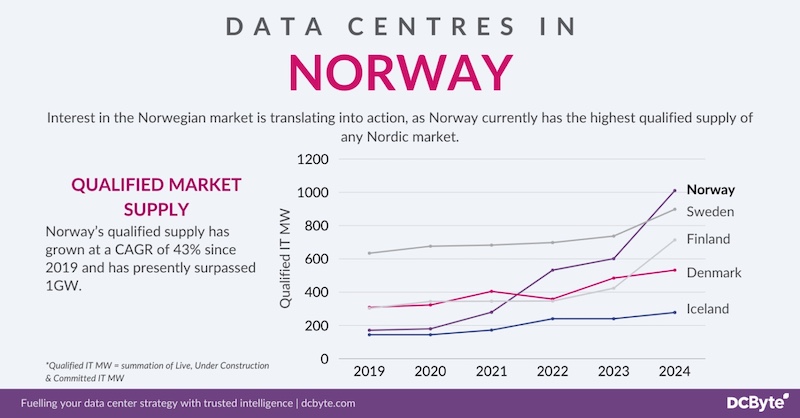
Norway’s qualified supply has grown at a 43 percent five-year CAGR since 2019 and now exceeds one gigawatt. Finland added more than 1400 MW of total IT load in 2023 and 2024, reflecting consistent confidence from both cloud providers and colocation developers.

Sweden continues to anchor regional hyperscale growth through long-term self-build projects north and west of Stockholm, supported by power availability and strong fibre infrastructure to Northern Europe via the capital city.

This steady pace contrasts sharply with the stop-start pattern in other European markets, such as Dublin, Amsterdam and Frankfurt, where permitting pauses and grid shortages have delayed deployment of capacity.

In the Nordics, predictable power translates into predictable progress. Governments and utilities coordinate closely to align new builds with available generation, preventing over-extension while maintaining room for expansion.

Balance in the ecosystem: Colocation and scale

The Nordics’ maturity lies not just in their renewable advantage but in the balance between large-scale self-build campuses and high-connectivity urban colocation markets.

While hyperscalers have expanded into unconstrained regions with abundant land and power, metro hubs such as Copenhagen, Helsinki and Stockholm continue to serve enterprise demand through dense networks of colocation facilities.

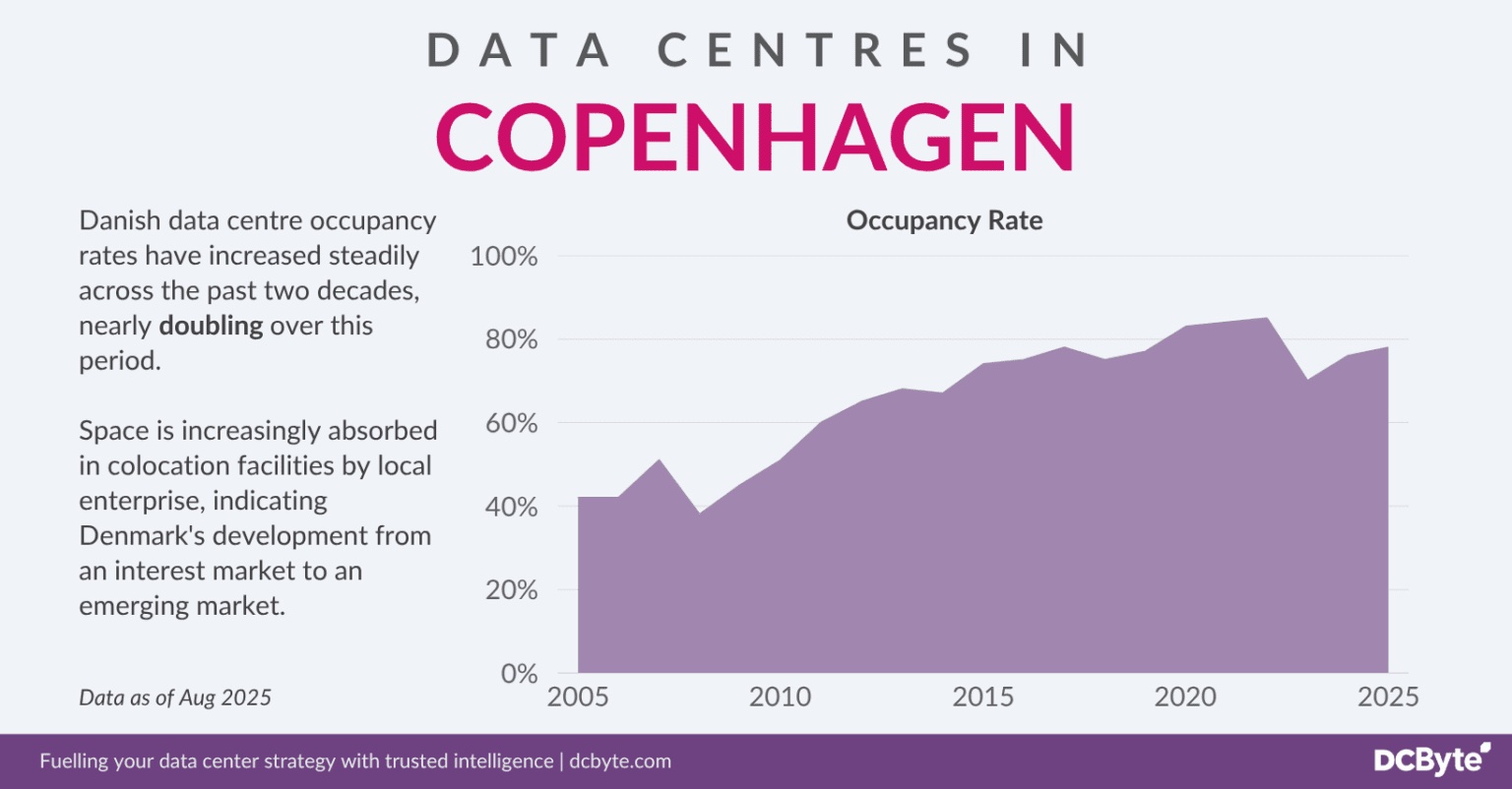
Copenhagen illustrates this dual structure. The city hosts 30 of Denmark’s 56 data centre schemes yet accounts for only 25 percent of the nation’s total IT load.

This shows that its role is shaped by connectivity and service density rather than scale alone. Similar dynamics play out across Helsinki and Stockholm, where proximity to business users and access to renewable power sustain steady absorption.

Together, these layers form a resilient ecosystem. Hyperscale self-builds meet global capacity demand, while capital-city colocation markets keep digital infrastructure close to enterprises and communities.

It is a practical balance; global scale supported by local reach, that allows the region to grow inclusively without compromising efficiency or reliability.
Lessons for the global industry

Grid stability and clear permitting guidelines drive investment confidence in data centres, as illustrated across the Nordics. In Norway, long-term hydropower capacity provides resilience to short-term energy shocks.

Finland’s uniform power pricing allows expansion close to population centres without premium costs. Sweden’s mature self-build ecosystem has continued to expand even as earlier tax incentives have been phased out, reflecting investor trust in the market’s fundamentals.

These lessons extend beyond Northern Europe. Consistent grid policy, open collaboration between utilities and operators, and integration with community systems provide a pathway for other markets seeking to balance energy, regulation and demand.

Sustainable growth does not depend on one-time incentives or isolated projects but on the alignment of planning and power.

Planning, people and power

Renewable energy, mature grids and coordinated planning have created conditions for growth that align with future infrastructure needs. Operators expand with an eye on continuity, governments focus on power security, and communities benefit from projects designed to endure.

The Nordic markets show that sustainability and stability work best when development is built around shared objectives. Progress here is steady because it is intentional, and that focus on long-term alignment ensures the region’s continued resilience.

For DC Byte, tracking these dynamics means understanding how power, planning and people come together to define the next chapter of global digital infrastructure.

Print Friendly, PDF & Email

Share this:

  • Print (Opens in new window) Print
  • Share on Facebook (Opens in new window) Facebook
  • Share on LinkedIn (Opens in new window) LinkedIn
  • Share on Reddit (Opens in new window) Reddit
  • Share on X (Opens in new window) X
  • Share on Tumblr (Opens in new window) Tumblr
  • Share on Pinterest (Opens in new window) Pinterest
  • Share on WhatsApp (Opens in new window) WhatsApp
  • Share on Telegram (Opens in new window) Telegram

Related stories you might also like…

Filed Under: Computing, Features, Infrastructure Tagged With: automation news, colocation markets, data centre planning, european power systems, hyperscale growth, long term infrastructure strategy, nordic digital infrastructure, renewable energy grids, robotics and automation, robotics and automation news, robotics news, sustainable data centres

Primary Sidebar

Search this website

Latest articles

  • Waabi says its AI driver transferred to Volvo autonomous truck without retraining
  • Ambi Robotics and Pickle Robot integrate AI-powered robots to automate inbound warehouse logistics
  • UK startup Humanoid launches reinforcement learning system to improve robot manipulation
  • Apptronik launches Robot Park to train Apollo humanoid robots with Google DeepMind
  • University of Rhode Island opens advanced Ocean Robotics Laboratory for autonomous marine research
  • Oak Ridge National Lab reveals ‘hidden workforce’ behind AI-powered research facilities
  • The Hardware Powering the Hybrid Industrial Workforce
  • How to Choose a Robot Vacuum and Mop That Actually Fits Your Home
  • How Modern Software Helps Construction Companies in Qatar Work Smarter and Safer
  • Antivirus vs malware: Why antivirus alone is no longer enough

Secondary Sidebar

Latest news

  • Waabi says its AI driver transferred to Volvo autonomous truck without retraining
  • Ambi Robotics and Pickle Robot integrate AI-powered robots to automate inbound warehouse logistics
  • UK startup Humanoid launches reinforcement learning system to improve robot manipulation
  • Apptronik launches Robot Park to train Apollo humanoid robots with Google DeepMind
  • University of Rhode Island opens advanced Ocean Robotics Laboratory for autonomous marine research
  • Oak Ridge National Lab reveals ‘hidden workforce’ behind AI-powered research facilities
  • The Hardware Powering the Hybrid Industrial Workforce
  • How to Choose a Robot Vacuum and Mop That Actually Fits Your Home
  • How Modern Software Helps Construction Companies in Qatar Work Smarter and Safer
  • Antivirus vs malware: Why antivirus alone is no longer enough

Copyright © 2026 · News Pro on Genesis Framework · WordPress · Log in

We use cookies on our website to give you the most relevant experience by remembering your preferences and repeat visits. By clicking “Accept”, you consent to the use of ALL the cookies.
Do not sell my personal information.
Cookie SettingsAccept
Manage consent

Privacy Overview

This website uses cookies to improve your experience while you navigate through the website. Out of these, the cookies that are categorized as necessary are stored on your browser as they are essential for the working of basic functionalities of the website. We also use third-party cookies that help us analyze and understand how you use this website. These cookies will be stored in your browser only with your consent. You also have the option to opt-out of these cookies. But opting out of some of these cookies may affect your browsing experience.
Necessary
Always Enabled
Necessary cookies are absolutely essential for the website to function properly. These cookies ensure basic functionalities and security features of the website, anonymously.
CookieDurationDescription
cookielawinfo-checkbox-analytics11 monthsThis cookie is set by GDPR Cookie Consent plugin. The cookie is used to store the user consent for the cookies in the category "Analytics".
cookielawinfo-checkbox-functional11 monthsThe cookie is set by GDPR cookie consent to record the user consent for the cookies in the category "Functional".
cookielawinfo-checkbox-necessary11 monthsThis cookie is set by GDPR Cookie Consent plugin. The cookies is used to store the user consent for the cookies in the category "Necessary".
cookielawinfo-checkbox-others11 monthsThis cookie is set by GDPR Cookie Consent plugin. The cookie is used to store the user consent for the cookies in the category "Other.
cookielawinfo-checkbox-performance11 monthsThis cookie is set by GDPR Cookie Consent plugin. The cookie is used to store the user consent for the cookies in the category "Performance".
viewed_cookie_policy11 monthsThe cookie is set by the GDPR Cookie Consent plugin and is used to store whether or not user has consented to the use of cookies. It does not store any personal data.
Functional
Functional cookies help to perform certain functionalities like sharing the content of the website on social media platforms, collect feedbacks, and other third-party features.
Performance
Performance cookies are used to understand and analyze the key performance indexes of the website which helps in delivering a better user experience for the visitors.
Analytics
Analytical cookies are used to understand how visitors interact with the website. These cookies help provide information on metrics the number of visitors, bounce rate, traffic source, etc.
Advertisement
Advertisement cookies are used to provide visitors with relevant ads and marketing campaigns. These cookies track visitors across websites and collect information to provide customized ads.
Others
Other uncategorized cookies are those that are being analyzed and have not been classified into a category as yet.
SAVE & ACCEPT