• Skip to primary navigation
  • Skip to main content
  • Skip to primary sidebar
  • Skip to secondary sidebar
  • About
    • Contact
    • Privacy
    • Terms of use
  • Shop
    • Cart
    • Checkout
    • My Account
  • Advertise
    • Advertising
      • Buy ad space
    • Case studies
    • Design
    • Email marketing
    • Features list
    • Lead generation
    • Magazine
    • Press releases
    • Publishing
    • Sponsor an article
    • Webcasting
    • Webinars
    • White papers
    • Writing
  • Subscribe to Newsletter

Robotics & Automation News

Where Innovation Meets Imagination

  • Home
  • News
  • Features
  • Editorial Sections A-Z
    • Agriculture
    • Aircraft
    • Artificial Intelligence
    • Automation
    • Autonomous Vehicles
    • Business
    • Computing
    • Construction
    • Culture
    • Design
    • Drones
    • Economy
    • Energy
    • Engineering
    • Environment
    • Health
    • Humanoids
    • Industrial robots
    • Industry
    • Infrastructure
    • Investments
    • Logistics
    • Manufacturing
    • Marine
    • Material handling
    • Materials
    • Mining
    • Promoted
    • Research
    • Robotics
    • Science
    • Sensors
    • Service robots
    • Software
    • Space
    • Technology
    • Transportation
    • Warehouse robots
    • Wearables
  • Press releases
  • Events

ETH researchers develop novel artificial muscles that ‘move with sound’

October 31, 2025 by Sam Francis

Researchers at ETH Zurich have developed artificial muscles that contain microbubbles and can be controlled with ultrasound. In the future, these muscles could be deployed in technical and medical settings as gripper arms, tissue patches, targeted drug delivery, or robots. (See video below.)

It might look like a simple material experiment at first glance, as a brief ultrasound stimulation induces a thin strip of silicone to start bending and arching.

But that’s just the beginning. A team led by Daniel Ahmed, Professor of Acoustic Robotics for Life Sciences and Healthcare, has developed a new class of artificial muscles: flexible membranes that respond to ultrasound with the help of thousands of microbubbles.

Microbubble patterns facilitate flexible movement

The researchers created the artificial muscles using a casting mould with a defined microstructure. The silicone membrane produced in this mould has tiny pores on its underside, each around 100 micrometres in depth and diameter – around the width of a human hair. When the researchers submerge the membrane in water, tiny microbubbles become trapped in these pores.

When subjected to sound waves, these microbubbles begin to oscillate and produce a directed flow that moves the muscle. The size, shape and positioning of these microbubbles can be precisely controlled, which makes it possible to produce movements ranging from uniform curving to wave-like patterns. The muscles respond within milliseconds and can be controlled wirelessly.
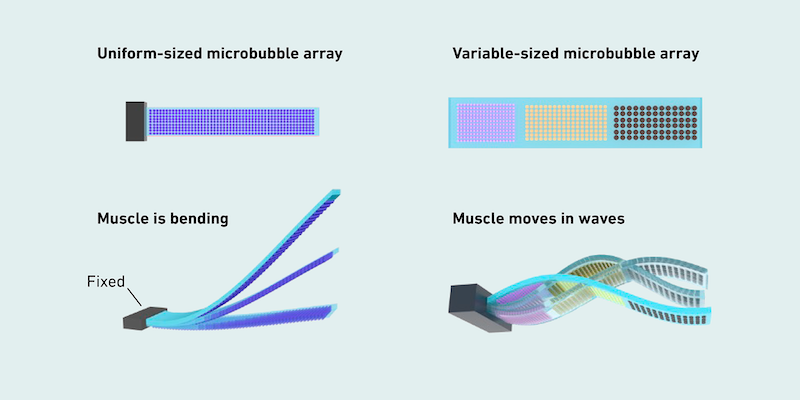
If all the bubbles are the same size, the membrane bends in response to the signal amplitude. If the bubbles are different sizes, they respond at different frequencies, which produces an undulatory movement. (Image: Shi Z et al. Nature 2025, edited)

Gentle gripping and smooth movement

The researchers have demonstrated several applications for these artificial muscles, one of which is a soft, miniature gripper arm. In an experiment, they were able to gently trap a zebrafish larva in water and then release it again.

“It was fascinating to see just how precisely yet gently the gripper functioned; the larva swam away afterwards unharmed,” recalls Zhiyuan Zhang, a former doctoral student under Ahmed and one of the lead authors of the external pagestudy, which has been published in Nature.

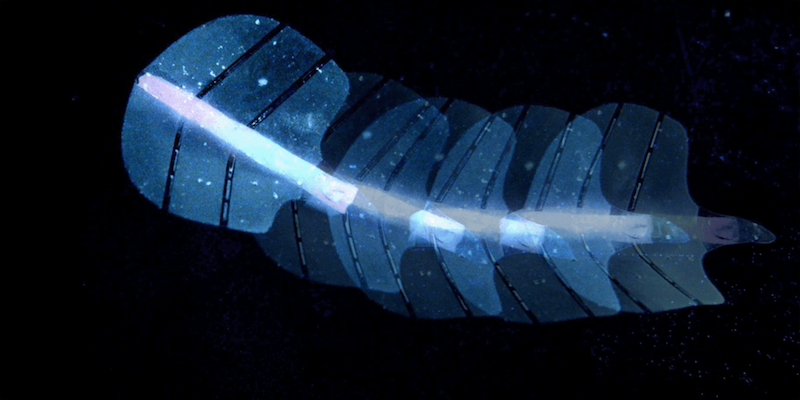
The researchers also constructed a robot that resembles a tiny stingray to demonstrate undulatory movements. It is about four centimetres wide. Two artificial muscles mimic the function of pectoral fins.

When the researchers apply ultrasound stimulation, it induces undulatory motion in the muscle, enabling the miniature robot to glide through water without any cabling.

“Undulatory locomotion was a real highlight for us,” says Ahmed. “It shows that we can use the microbubbles to achieve not only simple movements but also complex patterns, like in a living organism.”

Long-term prospects for these devices – dubbed “stingraybots” by the researchers – include deployment in the gastrointestinal tract, possibly to release medication with absolute precision or support minimally invasive procedures.

In fact, the researchers have already considered how a stingraybot could be transported into the stomach: they propose rolling the robot up and placing it in a specially developed capsule that could be swallowed before dissolving in the patient’s stomach.
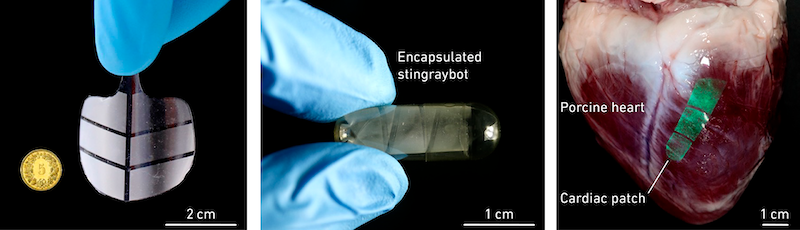
The stingraybot is approx. 4 centimetres wide (left) and can be rolled up so that it fits into a capsule that patients could swallow in the future (centre). The novel muscles can also be attached to a heart as a plaster (right). (Images: Shi Z et al. Nature 2025)

Suitable for confined spaces and sensitive surfaces

The researchers also produced a small, wheel-like silicone structure, featuring microbubbles of different sizes, which can also be driven using ultrasound. In experiments with a porcine intestine, the researchers demonstrated their ability to navigate through intestinal convolutions by sequentially stimulating microbubbles of different sizes.

“The intestine is a particularly complex environment because it is narrow, curved and irregular,” explains Zhan Shi, a former doctoral student under Ahmed and the study’s other lead author. “It was, therefore, particularly impressive that our wheel robot was actually able to move in there.”

The researchers have also developed medical patches that, through ultrasound activation, are capable of adhering to curved structures.

These patches can be specifically tailored to different tissue types and release medication in precise locations, such as to treat scars or tumours. In lab experiments, the team has already successfully delivered dye to a specific location in a tissue model.

Soft muscles with potential medical applications

“We started by conducting fundamental research before demonstrating the versatility of these artificial muscles, with applications ranging from drug delivery to locomotion in the gastrointestinal tract to cardiac patches,” summarises Ahmed.

While the technology remains limited to laboratory trials for now, it holds vast potential for future medical and technical applications. In the long term, these soft artificial muscles could help to administer medication more precisely and make procedures less invasive.

By combining biocompatibility with flexibility and wireless control, they represent a promising tool for medical applications. For the researchers, the journey toward acoustically controlled muscles is only at its beginning.

Main image: A stingraybot made from microbubble array artificial muscles, directed using ultrasound and capable, for example, of transporting medication to the right location. (Image: Shi Z et al. Nature 2025)

Print Friendly, PDF & Email

Share this:

  • Print (Opens in new window) Print
  • Share on Facebook (Opens in new window) Facebook
  • Share on LinkedIn (Opens in new window) LinkedIn
  • Share on Reddit (Opens in new window) Reddit
  • Share on X (Opens in new window) X
  • Share on Tumblr (Opens in new window) Tumblr
  • Share on Pinterest (Opens in new window) Pinterest
  • Share on WhatsApp (Opens in new window) WhatsApp
  • Share on Telegram (Opens in new window) Telegram

Related stories you might also like…

Filed Under: Features, Science Tagged With: artificial muscles, automation news, bioinspired robotics, drug delivery robots, eth zurich research, medical robotics technology, microbubble actuators, minimally invasive robotics, robotics and automation, robotics and automation news, robotics news, soft actuator development, soft robotics innovation, ultrasound powered robots

Primary Sidebar

Search this website

Latest articles

  • The Hardware Powering the Hybrid Industrial Workforce
  • How to Choose a Robot Vacuum and Mop That Actually Fits Your Home
  • How Modern Software Helps Construction Companies in Qatar Work Smarter and Safer
  • Antivirus vs malware: Why antivirus alone is no longer enough
  • X Square Robot builds a full-stack approach to embodied AI and general-purpose robotics
  • AGIBOT debuts A3 humanoid robot in Europe and launches UK Robot-as-a-Service model
  • What Are the Biggest Challenges in Modern Electronics Manufacturing?
  • What Are the Best AI Tools for Creating Content Faster in 2026?
  • Why Does Quality Wiring Matter More Than Ever in Modern Electronic Devices?
  • Why Are Custom Harness Solutions Essential for Next Generation Technology?

Secondary Sidebar

Latest news

  • The Hardware Powering the Hybrid Industrial Workforce
  • How to Choose a Robot Vacuum and Mop That Actually Fits Your Home
  • How Modern Software Helps Construction Companies in Qatar Work Smarter and Safer
  • Antivirus vs malware: Why antivirus alone is no longer enough
  • X Square Robot builds a full-stack approach to embodied AI and general-purpose robotics
  • AGIBOT debuts A3 humanoid robot in Europe and launches UK Robot-as-a-Service model
  • What Are the Biggest Challenges in Modern Electronics Manufacturing?
  • What Are the Best AI Tools for Creating Content Faster in 2026?
  • Why Does Quality Wiring Matter More Than Ever in Modern Electronic Devices?
  • Why Are Custom Harness Solutions Essential for Next Generation Technology?

Copyright © 2026 · News Pro on Genesis Framework · WordPress · Log in

We use cookies on our website to give you the most relevant experience by remembering your preferences and repeat visits. By clicking “Accept”, you consent to the use of ALL the cookies.
Do not sell my personal information.
Cookie SettingsAccept
Manage consent

Privacy Overview

This website uses cookies to improve your experience while you navigate through the website. Out of these, the cookies that are categorized as necessary are stored on your browser as they are essential for the working of basic functionalities of the website. We also use third-party cookies that help us analyze and understand how you use this website. These cookies will be stored in your browser only with your consent. You also have the option to opt-out of these cookies. But opting out of some of these cookies may affect your browsing experience.
Necessary
Always Enabled
Necessary cookies are absolutely essential for the website to function properly. These cookies ensure basic functionalities and security features of the website, anonymously.
CookieDurationDescription
cookielawinfo-checkbox-analytics11 monthsThis cookie is set by GDPR Cookie Consent plugin. The cookie is used to store the user consent for the cookies in the category "Analytics".
cookielawinfo-checkbox-functional11 monthsThe cookie is set by GDPR cookie consent to record the user consent for the cookies in the category "Functional".
cookielawinfo-checkbox-necessary11 monthsThis cookie is set by GDPR Cookie Consent plugin. The cookies is used to store the user consent for the cookies in the category "Necessary".
cookielawinfo-checkbox-others11 monthsThis cookie is set by GDPR Cookie Consent plugin. The cookie is used to store the user consent for the cookies in the category "Other.
cookielawinfo-checkbox-performance11 monthsThis cookie is set by GDPR Cookie Consent plugin. The cookie is used to store the user consent for the cookies in the category "Performance".
viewed_cookie_policy11 monthsThe cookie is set by the GDPR Cookie Consent plugin and is used to store whether or not user has consented to the use of cookies. It does not store any personal data.
Functional
Functional cookies help to perform certain functionalities like sharing the content of the website on social media platforms, collect feedbacks, and other third-party features.
Performance
Performance cookies are used to understand and analyze the key performance indexes of the website which helps in delivering a better user experience for the visitors.
Analytics
Analytical cookies are used to understand how visitors interact with the website. These cookies help provide information on metrics the number of visitors, bounce rate, traffic source, etc.
Advertisement
Advertisement cookies are used to provide visitors with relevant ads and marketing campaigns. These cookies track visitors across websites and collect information to provide customized ads.
Others
Other uncategorized cookies are those that are being analyzed and have not been classified into a category as yet.
SAVE & ACCEPT