• Skip to primary navigation
  • Skip to main content
  • Skip to primary sidebar
  • Skip to secondary sidebar
  • About
    • Contact
    • Privacy
    • Terms of use
  • Shop
    • Cart
    • Checkout
    • My Account
  • Advertise
    • Advertising
      • Buy ad space
    • Case studies
    • Design
    • Email marketing
    • Features list
    • Lead generation
    • Magazine
    • Press releases
    • Publishing
    • Sponsor an article
    • Webcasting
    • Webinars
    • White papers
    • Writing
  • Subscribe to Newsletter

Robotics & Automation News

Where Innovation Meets Imagination

  • Home
  • News
  • Features
  • Editorial Sections A-Z
    • Agriculture
    • Aircraft
    • Artificial Intelligence
    • Automation
    • Autonomous Vehicles
    • Business
    • Computing
    • Construction
    • Culture
    • Design
    • Drones
    • Economy
    • Energy
    • Engineering
    • Environment
    • Health
    • Humanoids
    • Industrial robots
    • Industry
    • Infrastructure
    • Investments
    • Logistics
    • Manufacturing
    • Marine
    • Material handling
    • Materials
    • Mining
    • Promoted
    • Research
    • Robotics
    • Science
    • Sensors
    • Service robots
    • Software
    • Space
    • Technology
    • Transportation
    • Warehouse robots
    • Wearables
  • Press releases
  • Events

University of Waterloo-led researchers develop ‘artificial muscles’ for robots

October 30, 2025 by Sam Francis

An international team led by researchers at the University of Waterloo has developed material that can be flexible “artificial muscles” to replace rigid motors and pumps in robots and allow them to move more naturally and fluidly.

Soft robots differ from hard robots in that they are pliable and flexible, making them safe for interaction with people, but the materials currently used for components enabling their movement aren’t strong enough to be effective.

The Waterloo-led research group found a way to dramatically strengthen smart, rubber-like materials by mixing liquid crystals (LCs) – commonly found in displays for electronics and sensors – into promising building blocks for soft robots known as liquid crystal elastomers (LCEs).

“What we call artificial muscles are essential for unlocking the true potential of soft robots,” says Dr. Hamed Shahsavan, a professor of chemical engineering at Waterloo, who led the research group.

“They allow robots to move flexibly, safely, and with precision. This is especially important for applications like micro-medical robots.”

A look through a microscope at a liquid crystal used to make rubber-like materials stiffer and stronger for artificial muscles in soft robots. (Picture: University of Waterloo)

LCEs are rubbers that undergo massive shape change, in a reversible and programmable manner, when they are heated. Researchers discovered that mixing small amounts of LCs with LCEs made them much stiffer and up to nine times stronger.

“To put this in perspective, fibres from the new LCEs can, when heated, lift loads up to 2,000 times their own weight,” said Shahsavan, who is also director of the Smart Materials for Advanced Robotic Technologies (SMART) Lab at Waterloo.

The LCEs provide output work of almost 24 J/kg, about three times more than the average work provided by the muscles of mammals, he added.

X-ray analysis showed that LCs disperse inside LCEs and form small pockets, like chocolate chips in cookie dough. While still in liquid form, the LC pockets surprisingly behave like solids, holding their shape and making the LCEs around them feel stiffer when pulled or stretched.

The researchers expect LCEs with these improved mechanical properties to play a significant role in the emerging field of soft robotics by enabling extremely wide ranges of motion and powerful movements for everything from delivering drugs inside the human body to working alongside humans in manufacturing plants.

“Materials with such capabilities are highly desired in robotics as they can replace old-school, bulky, heavy actuators and electromotors with light, soft, artificial muscles without sacrificing performance,” Shahsavan said. “This is the simplest yet most robust strategy to stiffen LCEs and still maintain their programmable nature.”

The international research group also included: Dr. Tizazu Mekonnen, a chemical engineering professor at Waterloo, Sahad Vasanji and Matthew Scarfo, engineering graduate students at Waterloo, Dr. M.O. Saed of the University of Cambridge, and Dr. Antal Jakli of Kent State University.

Researchers are now focused on using the new materials as 3D-printing inks to create artificial muscles at scale.

A study on the work, Stiffening Liquid Crystal Elastomers with Liquid Crystal Inclusions, was recently published in Advanced Materials.

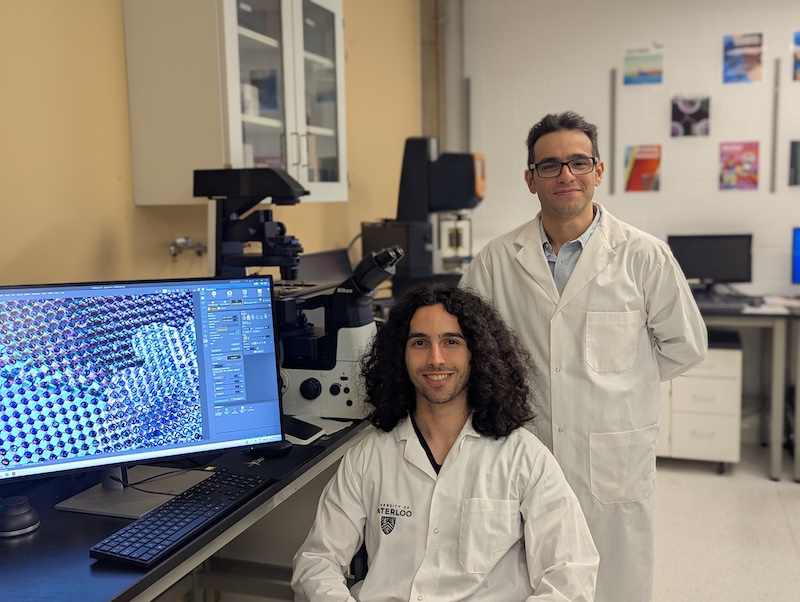
Main image: Matthew Scarfo (left), a Waterloo engineering graduate student, and Dr. Hamed Shahsavan, professor of chemical engineering, both worked on the research that developed the flexible “artificial muscles” material that could replace rigid components in robots. (University of Waterloo)

Print Friendly, PDF & Email

Share this:

  • Print (Opens in new window) Print
  • Share on Facebook (Opens in new window) Facebook
  • Share on LinkedIn (Opens in new window) LinkedIn
  • Share on Reddit (Opens in new window) Reddit
  • Share on X (Opens in new window) X
  • Share on Tumblr (Opens in new window) Tumblr
  • Share on Pinterest (Opens in new window) Pinterest
  • Share on WhatsApp (Opens in new window) WhatsApp
  • Share on Telegram (Opens in new window) Telegram

Related stories you might also like…

Filed Under: Features, Science Tagged With: advanced materials robotics, artificial muscles research, automation news, liquid crystal elastomers, liquid crystal research, medical microrobots, programmable robot movement, robotic muscle innovation, robotics and automation, robotics and automation news, robotics news, soft actuator technology, soft robotics breakthrough, university of waterloo robotics

Primary Sidebar

Search this website

Latest articles

  • How Modern Software Helps Construction Companies in Qatar Work Smarter and Safer
  • Antivirus vs malware: Why antivirus alone is no longer enough
  • X Square Robot builds a full-stack approach to embodied AI and general-purpose robotics
  • AGIBOT debuts A3 humanoid robot in Europe and launches UK Robot-as-a-Service model
  • What Are the Biggest Challenges in Modern Electronics Manufacturing?
  • What Are the Best AI Tools for Creating Content Faster in 2026?
  • Why Does Quality Wiring Matter More Than Ever in Modern Electronic Devices?
  • Why Are Custom Harness Solutions Essential for Next Generation Technology?
  • What Makes Asian Electronics Manufacturing a Smart Choice for Global Companies?
  • How Can Better Cable Management Improve Electronic Performance?

Secondary Sidebar

Latest news

  • How Modern Software Helps Construction Companies in Qatar Work Smarter and Safer
  • Antivirus vs malware: Why antivirus alone is no longer enough
  • X Square Robot builds a full-stack approach to embodied AI and general-purpose robotics
  • AGIBOT debuts A3 humanoid robot in Europe and launches UK Robot-as-a-Service model
  • What Are the Biggest Challenges in Modern Electronics Manufacturing?
  • What Are the Best AI Tools for Creating Content Faster in 2026?
  • Why Does Quality Wiring Matter More Than Ever in Modern Electronic Devices?
  • Why Are Custom Harness Solutions Essential for Next Generation Technology?
  • What Makes Asian Electronics Manufacturing a Smart Choice for Global Companies?
  • How Can Better Cable Management Improve Electronic Performance?

Copyright © 2026 · News Pro on Genesis Framework · WordPress · Log in

We use cookies on our website to give you the most relevant experience by remembering your preferences and repeat visits. By clicking “Accept”, you consent to the use of ALL the cookies.
Do not sell my personal information.
Cookie SettingsAccept
Manage consent

Privacy Overview

This website uses cookies to improve your experience while you navigate through the website. Out of these, the cookies that are categorized as necessary are stored on your browser as they are essential for the working of basic functionalities of the website. We also use third-party cookies that help us analyze and understand how you use this website. These cookies will be stored in your browser only with your consent. You also have the option to opt-out of these cookies. But opting out of some of these cookies may affect your browsing experience.
Necessary
Always Enabled
Necessary cookies are absolutely essential for the website to function properly. These cookies ensure basic functionalities and security features of the website, anonymously.
CookieDurationDescription
cookielawinfo-checkbox-analytics11 monthsThis cookie is set by GDPR Cookie Consent plugin. The cookie is used to store the user consent for the cookies in the category "Analytics".
cookielawinfo-checkbox-functional11 monthsThe cookie is set by GDPR cookie consent to record the user consent for the cookies in the category "Functional".
cookielawinfo-checkbox-necessary11 monthsThis cookie is set by GDPR Cookie Consent plugin. The cookies is used to store the user consent for the cookies in the category "Necessary".
cookielawinfo-checkbox-others11 monthsThis cookie is set by GDPR Cookie Consent plugin. The cookie is used to store the user consent for the cookies in the category "Other.
cookielawinfo-checkbox-performance11 monthsThis cookie is set by GDPR Cookie Consent plugin. The cookie is used to store the user consent for the cookies in the category "Performance".
viewed_cookie_policy11 monthsThe cookie is set by the GDPR Cookie Consent plugin and is used to store whether or not user has consented to the use of cookies. It does not store any personal data.
Functional
Functional cookies help to perform certain functionalities like sharing the content of the website on social media platforms, collect feedbacks, and other third-party features.
Performance
Performance cookies are used to understand and analyze the key performance indexes of the website which helps in delivering a better user experience for the visitors.
Analytics
Analytical cookies are used to understand how visitors interact with the website. These cookies help provide information on metrics the number of visitors, bounce rate, traffic source, etc.
Advertisement
Advertisement cookies are used to provide visitors with relevant ads and marketing campaigns. These cookies track visitors across websites and collect information to provide customized ads.
Others
Other uncategorized cookies are those that are being analyzed and have not been classified into a category as yet.
SAVE & ACCEPT