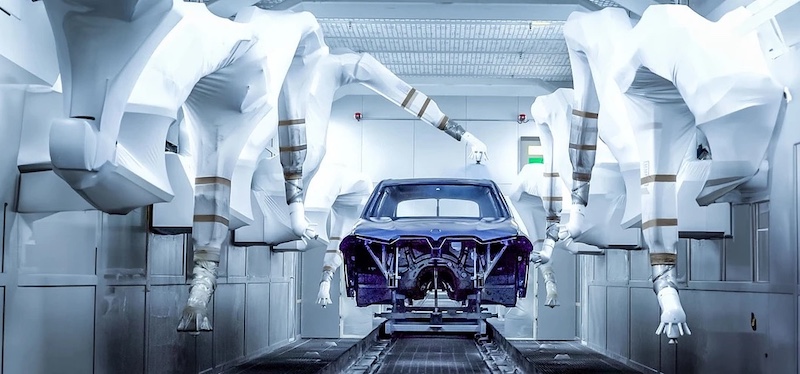
A recent Dürr financial statement sent a clear signal to the robotics world: even well-established players are not immune to the strain of slowing demand.
Dürr cut its order-intake target for 2025 (for continued operations) from its previous band of €4,300 to €4,700 million down to €3,800 to €4,100 million, citing weaker project demand.
Meanwhile, in its restructuring plan, the company announced it would eliminate roughly 500 administrative positions by end-2026, and absorb €40-50 million of restructuring provisions in H2 2025 to enable annual savings of about €50 million from 2027 onward.
Dürr also flagged a more sobering projection: its earnings before tax (EBIT) after extraordinary effects (that is, excluding gains from the planned sale of its environmental-technology unit) could fall into negative territory, between -1 percent and 0 percent.
In short: the tailwinds that once powered unabated growth in industrial robotics are showing signs of fatigue – and Dürr, at least, is bracing for turbulence ahead.
The broader robotics market: Still growing, but for whom?
On the surface, the outlook for industrial robotics remains broadly optimistic. According to Grand View Research, the global industrial robotics market was valued at $33.96 billion in 2024, and is projected to grow at a compound annual growth rate of 9.9 percent through 2030.
Other research firms, such as Technavio, suggest even more aggressive growth (19.4 percent CAGR to 2029).
And the International Federation of Robotics (IFR) reported over 4.28 million industrial robots in operation worldwide as of end-2023, with deployments climbing approximately 10 percent in 2023 alone.
Yet these macro numbers obscure several emerging weak signals. Interact Analysis recently reported that global industrial robot shipments in 2024 slipped to around 505,000 units, representing a 2.4 percent drop year-on-year.
In other words: fewer robots are being shipped globally, and average prices continue to decline.
This discrepancy suggests a disconnect: aggregate market demand might still be growing (driven by new applications, geographic expansion, and emerging sectors), but the spoils are increasingly being divided, leaving less for mid-tier or premium incumbents.
Herein lies the “grand illusion”: global growth, yes; but sustainable, high-margin growth for all players? Less certain.
An added dimension: ABB’s recent strategic decisions suggest it shares similar concerns. In April 2025, ABB moved to spin off its robotics business as a separately listed entity by 2026.
More recently, ABB agreed to sell that division to SoftBank for $5.4 billion, recasting the move as a retreat from a faltering segment suffering falling profitability and low demand.
Could ABB be exiting before the storm? It certainly hints at strategic caution at the highest level. In any case, the industrial giant has now turned to the strength it has in the electrification market and is reportedly looking to acquire Legrand, a manufacturer of electric light switches and wall sockets.
Too many robots, too many makers: A market reaching saturation?
One of the core questions behind your thesis is whether the robotics industry has become overcrowded – too many robot models, too many entrants, too much competition – and whether the market is simply saturated.
Chinese challengers: China is now the centerpiece in the global robotics race. In 2024, China accounted for about 54 percent of robot installations globally.
Chinese firms are undercutting legacy players: producing at mass scale, lowering costs, and developing integrated AI/hardware stacks that incumbents struggle to match.
Homegrown robotics giants are aggressively targeting international exports.
India’s ascent: India is also a rising force. In 2023, India posted a staggering 59 percent or so growth in robot installations – among the highest globally.
Our website, RoboticsAndAutomationNews.com, recently listed the “Top 30 Indian robotics companies”, in which we emphasized that many entrants are focusing on lower-cost arms and automation for small to medium enterprises — often with price-performance tradeoffs that undercut incumbents.
Legacy incumbents squeezed: As new entrants proliferate, established robotics companies – especially those with higher-cost hardware, longer development cycles, and significant fixed overhead – are under pressure on margins, pricing, and deal wins in price-sensitive markets.
The smaller orders become harder to win, and customization or premium features may no longer justify cost premiums.
The result: a Darwinian shake-out seems increasingly likely. Many of the new players may fail, but the survivors – likely those with cost advantage, scalable manufacturing, or niche specialization – will come out stronger. The middle – premium but not ultra-premium – could suffer most.
The cobot boom underscores this tension. The “collaborative” robot narrative once sparked speculative fervor: every robot maker pivoted toward cobots, hoping to ride the wave.
Universal Robots, for one, enjoyed outsized benefits. It is regularly credited with creating the modern cobot category and held approximately 40-50 percent market share in earlier years.
But not all players fared well: Rethink Robotics, once celebrated, failed twice and now faces financial uncertainty. Its early models are criticized for being noisy, clunky, and stylistically underwhelming – especially when compared to sleeker alternatives.
Rethink’s website still exists, but reports suggest the company is in distress. The cobot hype may have left long-lasting scars and skepticism.
In summary, global growth is still real. But for many established robotics sellers, the environment has shifted from progressive expansion to zero-sum competition. Pile ’em hig, sell ’em cheap, race to the bottom, which is the hallmark of a commodity product.
The future for Dürr: Pivot, survive or be acquired?
Dürr is not a pure-play robot arm maker. It is a systems, automation, and robotics integrator with deep engineering roots. But precisely because of its legacy and premium positioning, it now faces a strategic inflection.
Option 1: Lean, specialize and defend premium niches
In a crowded market, Dürr can lean further into its reputation for quality, precision, after-sales service, and system integration.
It may retrench from commoditized robot sales and focus on high-end applications (for example, advanced painting, surface systems, composite handling) where price pressure is lower.
Option 2: Merge or be acquired
There is precedent: German robotics and automation firms have attracted Chinese buyers (for example, Kuka’s acquisition).
If Dürr’s robotics and automation business loses viability, a sale to a well-capitalized foreign buyer is credible.
The proceeds from its planned environmental-technology divestment may strengthen its balance sheet, providing firepower to reinvent or negotiate.
Dürr itself arguably hints at that, expecting a book profit of €220-250 million (pre-tax) on the sale, which could absorb impairment or restructuring charges.
Option 3: Pivot toward software, intelligence, and AI-augmented robotics
The real frontier is less in raw mechanical arms and more in perception, autonomy, connectivity, and application-level intelligence.
A leaner Dürr might invest in data, software, diagnostics, adaptive control, and autonomous features layered on robot platforms.
If it can evolve from hardware-first to system-intelligence-first, it might sidestep the commoditization trap.
That said, timing is critical. If the market’s plateau becomes a decline, being late to pivot – or being overexposed to standard robot sales – may trigger structural decay faster than recovery is possible.
Grand illusion or a necessary reckoning?
The question the title asks is blunt but fair: is the robotics dream – perpetual growth – an illusion? Not entirely. The foundations (labor scarcity, automation demand, industry 4.0, logistics, AI) remain strong. But the era of uniform, across-the-board expansion is over.
What we are seeing may be the start of a maturation cycle: fewer pure hardware winners, more stratified segmentation, consolidation, margin pressure, and shakeouts. Not all incumbents will survive. Ambitious new entrants may disrupt, but many will fail trying.
For companies like Dürr, the challenge is whether they have the culture, capital and foresight to transition – from being robot sellers to being robotics orchestrators.
