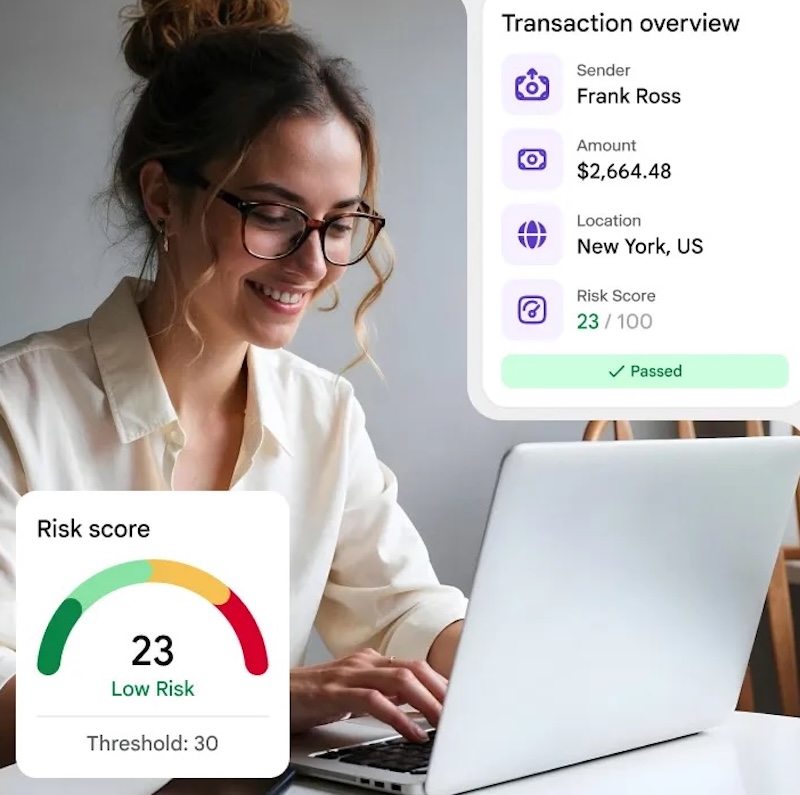
A fintech that processes a few hundred payments a day can still have someone look over them by hand. Once volumes climb into the tens of thousands, nobody can, and the monitoring has to run in software that scores each transaction and raises an alert when something looks wrong.
Transaction monitoring is the part of an anti-money laundering (AML) program that watches money after a customer has been onboarded.
It looks for activity that doesn’t fit the customer’s profile: deposits kept just under a reporting threshold, funds that arrive and leave within hours, payments to high-risk jurisdictions, or a dormant account that suddenly turns busy.
Each alert goes to an analyst, who either closes it or escalates it into a suspicious activity report.
The six tools below all automate that work, but they don’t automate the same parts of it. Some lead with machine learning and others with configurable rules, while a few bundle monitoring with identity verification so one vendor covers the customer from sign-up onwards.
Before the list, it’s worth setting out what actually separates them.
What Separates One Monitoring Tool From Another
Every vendor on this list can flag a suspicious transfer. The differences show up in how the flag is produced and in how much work it leaves for the compliance team afterwards. Five questions sort the field:
Detection logic. Explicit rules are easy to explain to an auditor, while machine-learning models can catch patterns nobody thought to write a rule for.
Timing. Real-time scoring can hold a payment before it settles. Batch review finds the problem after the money has moved.
Control over rules. Some tools let the compliance team change a threshold or add a rule directly, and others route every change through the vendor or an engineer.
Investigation. Alerts and the decisions on them should sit in one case with an audit trail, so an examiner can follow how each alert was closed.
Customer context. A system that knows who the customer is judges a transaction against that profile instead of in isolation.
The last point often decides the choice, because an alert on a large transfer means little until someone compares it with what the customer declared at onboarding, and a tool that sees only the transaction stream has to get that context through separate integration work.
1. iDenfy
iDenfy runs AML transaction monitoring on the same platform as its identity and business verification products, so the system that scores a transaction already knows who sent it.
For a fintech that onboards customers through iDenfy, monitoring needs no second vendor and no separate data feed to supply that context.
The rule engine accepts custom SQL conditions. A compliance team can write the exact logic it needs, such as an amount threshold on a specific pair of countries, without being limited to a fixed library of templates.
Sliding-window velocity rules sit on top and flag aggregate patterns, for example total volume or transaction count per customer over a rolling period. Each rule produces a risk score from 0 to 100, and the team sets the thresholds for review and escalation.
Every transaction is also screened against sanctions, politically exposed person (PEP) and adverse media lists, and onboarded customers are rescanned on an ongoing basis. When a customer’s status changes, a webhook fires and a new monitoring alert opens automatically.
Alerts then move through a tiered L1 to L3 review queue, with alerts on the same transaction grouped together, an audit trail on every case, and a suspicious activity report that the team can export for filing.
The approach is rule-led. Teams decide what the system looks for and can show an examiner exactly why each alert fired.
2. ComplyAdvantage
ComplyAdvantage built its reputation on risk data. It maintains its own database of sanctions lists and adverse media, and its transaction monitoring draws on that data alongside customer screening and payment screening modules.
Rules can be configured by the compliance team, and machine-learning scoring helps rank alerts by risk.
The pairing works best for a firm that wants screening and monitoring from the same data source. A fintech that already screens customers with another provider gets less from that link.
Identity document verification also sits outside its core products, so onboarding still needs a separate vendor.
3. Unit21
Unit21 is built around a no-code rule builder. Analysts can write detection logic and test it against historical data before it goes live, without waiting for an engineering sprint, and the platform covers both fraud and AML cases in one investigation workspace.
It’s aimed at fintechs and payment companies that change their products often and need their rules to keep up.
The tool rewards teams that use that flexibility. A startup without an analyst who has time to design and maintain rules will find that much of the platform’s value sits in work nobody is doing yet.
4. Hawk
Hawk, previously known as Hawk AI, combines rules with machine-learning models and puts its emphasis on explaining model output. Each alert comes with the factors that drove the score, which answers the usual objection to black-box detection.
The platform also covers customer screening and fraud prevention, and the company has added an AI investigation agent that prepares alert reviews for analysts.
Its customer base leans toward banks and larger payment firms. Implementation and contracts are sized for that market, which can be more than an early-stage fintech needs in its first years.
5. Flagright
Flagright positions itself as an AML and fraud platform for fintechs, with real-time monitoring, a no-code rule builder, case management and sanctions screening in one product.
It lets teams simulate a rule change against past transactions before releasing it, which shows how many extra alerts a new threshold will create before analysts have to handle them.
Flagright is younger than most vendors on this list, so its record with large regulated institutions is shorter. Identity verification comes from other providers through integrations.
6. Sardine
Sardine started in fraud prevention and still leads with it. Device intelligence and behavioral signals, such as how a user types or whether a session runs through a remote-access tool, feed into risk scores that it also applies to AML transaction monitoring and sanctions screening.
Its customers include fintech and crypto companies that see fraud and money laundering arrive through the same accounts.
The product’s center of gravity is fraud. A compliance team buying it for AML alone pays for detection capabilities that make the most sense when a fraud team shares the tool.
Matching the Tool to the Stage of the Business
For a fintech launching its first monitoring program, speed of setup and a clear audit trail count for more than model sophistication.
A platform that already holds the customer’s onboarding data also removes the integration project that would otherwise have to come first.
Later, the priorities shift. Transaction volume grows and alert queues start to outpace analyst headcount, and that is the point where rule simulation and alert prioritization begin to earn their cost.
Before signing with any vendor, run its tool against a sample of your own historical transactions, because the number of alerts it produces on real data, and the time an analyst needs to clear each one, will predict the running cost far better than a feature list.
Ownership of the rules deserves a direct question too. If changing a threshold requires a ticket to the vendor, the compliance team can’t respond quickly when a new fraud pattern appears or an examiner raises a finding.
Choosing for the Next Stage of Growth
Transaction monitoring is the part of an AML program whose workload grows with the business, so it’s the part where an early tooling decision has the longest life. Every tool above can score a transaction and raise an alert.
A fintech that chooses on what the system knows about the customer behind each payment, and on how much control its own team keeps over the logic, won’t need to replace its monitoring the first time its volumes double.
