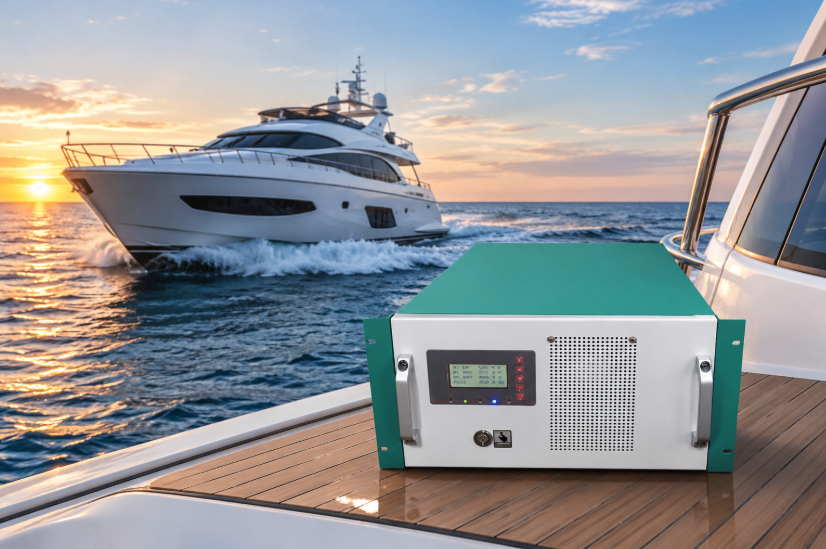
Marine inverters convert the DC power from your battery bank to provide AC power. This means you can have air-conditioning, kitchen appliances and entertainment devices operating on-board without being connected to shore-side power.
To select the correct Marine inverter for your application you must consider several factors. These include the voltage of your battery bank, the AC voltage required and inrush current of your loads. This guide will walk through each consideration, and the power rating and battery bank voltage for each option.
What is a Marine Inverter and How Does it Work?
Marine Inverters allow direct current (DC) energy from a battery bank to be converted into alternating current (AC), meaning that you can use standard AC equipment on your vessel. This is useful on vessels that are not located in a marina or place with external power sources.
Air Conditioning, Kitchen Appliances, Refrigeration, Lighting and Entertainment equipment can be powered using Marine Inverters. Pumps, computers, instrumentation and communications can also be powered from Marine Inverters. The equipment that can be powered depends on the power of the inverter and energy available in the battery bank.
Marine Inverters do not produce energy, nor charge the battery bank. The inverter simply converts the energy in the battery from DC to AC. The battery can be charged from an engine, generator, solar and external power sources, depending on the set-up of electrical systems on the vessel.

Therefore, it is important to choose a Marine Inverter of suitable specification based on the battery bank, loads and applications on your vessel.
Why Marine Inverters Are Important for Boats
Many vessels cannot connect to mains electricity. Without suitable electrical equipment on board, it can be difficult to use standard AC equipment. Marine Inverters allow energy from the vessel’s battery bank to be converted to AC to allow this equipment to be used.
On pleasure vessels, this may be kitchen appliances, air conditioning, cooling systems and entertainment. On commercial vessels, pumps, refrigeration, computers and communication equipment may need AC power. Choosing a Marine Inverter of suitable size means that these loads can be powered on vessels in locations away from land.
Consideration must be given to the total electrical system. Based on the battery size, and inverter size, you will be able to know how much energy can be supplied in AC form. This is important in creating a reliable electrical system on board.
Pure Sine Wave Output and Electrical Performance
The type of AC produced by the marine inverter can be important. Pure sine wave produces smooth AC electricity, meaning it can be used to power a variety of standard equipment and sensitive electronics. This can be useful for computers, instrumentation and communication equipment.
Marine Inverters produce pure sine wave electricity. With less than 3% distortion on linear loads, the inverter produces clean AC electricity. The units also contain an isolation transformer meaning galvanic isolation is provided between AC and DC.
These features make the inverter suitable to power a variety of equipment. However, the equipment must still be compatible with the specifications of the inverter and have suitable power available from the inverter.
Marine Inverter Display, Enclosure and Protection Features
Marine Inverters should have useful features to make installation and operation easier. Marine Inverters have an LCD display to allow information about the inverter to be viewed. An optional RS485 port is included for communications.
Metal enclosures are used in these inverters and have IP20 protection. This means the inverters are designed to be installed in dry environments, and should not be directly exposed to water or sea spray. Therefore, care must be taken to install in dry, well ventilated areas.
Protection features may also be considered. The 3000W model has protection against reverse polarity, under-voltage, over-voltage, overcurrent on the output, short circuit and overheating. The protection features may differ between models, therefore check the specification sheet for the exact model you are looking at.
How Marine Inverters Support Everyday Life and Marine Operations
Whilst a boat has a battery system for DC electricity, the majority of items require AC electricity. Marine inverters convert DC electricity from either lithium or lead acid batteries into AC electricity, similar to that from the land’s electricity supply. This allows items such as air-con, appliances and TV’s etc to be used on a boat, without access to a land electricity supply or generator.
People can therefore maintain a pleasant cabin environment, cook and relax on a yacht, catamaran or houseboat, even when anchored, and not just within a marina. As there is no engine on an inverter it is also both a quieter and zero emissions alternative to a generator.
Again, marine inverters are used to convert electricity so that items can continue to function. Fishing and aquaculture boats utilise them to enable fridges, pumps, exterior lighting and tools to work. Survey, research, rescue and patrol boats use inverters to allow computers, measuring instruments and communications devices to operate.
Ferries and tour boats use them to enable cabin facilities, ticket and passenger systems to function. Floating hotels, restaurants and platforms use inverters to allow kitchen appliances, refrigeration and guest areas to work. Electricity is further purified by using a pure sine wave (with under 3% harmonic distortion for linear items) and an isolation transformer for the AC/DC side.
Many inverters (for example the 3000W inverter) also have gentle starting modes allowing motors to start easily. Furthermore, they are fitted with over-voltage, over-current, short-circuit and temperature protection. An LCD and LED screen are also provided to illustrate the device’s condition.
Unlike generators, inverters do not produce electricity. However, they do transform it. Which items can be powered by an inverter will depend on both the capacity of a boat’s battery system and the inverter’s rating. The battery system is itself charged via a boat’s engine, generator, solar panels or land electricity supply. Therefore, the electrical requirements of a boat, together with the number of items in use at any one time, will determine what size of inverter is required.
Marine Inverter Applications Across Different Vessels
Yachts, Catamarans and Houseboats
Yachts, catamarans and houseboats may have similar electrical requirements to domestic environments. Air conditioning, cooking equipment, lighting and entertainment may be required to be powered from the battery system. Depending on the number and size of these loads, the inverter size required will vary.
List all appliances within each cabin and communal areas. This includes cooking equipment, climate control and other equipment. Note the running power of each appliance, and add them together to calculate the total electrical demand. If multiple appliances may be running simultaneously, ensure that the inverter selected can supply sufficient power to meet this demand without exceeding its continuous power capacity.
Consider appliances which may require an increased power demand at startup. Compressors in air conditioners, and motorised equipment may require increased power.
Passenger and Working Vessels
Passenger vessels, ferries and sightseeing vessels may have increased electrical requirements beyond just lighting and appliances. Within passenger cabins, ticketing systems, passenger services and other electrical loads may be required to be in operation. Choosing a suitable inverter ensures that AC power can be supplied to these systems from the vessel’s batteries.
Fishing, aquaculture and working vessels will have different electrical requirements. Refrigeration equipment will be required to help preserve supplies. Pumps, deck lighting and electrical tools will be required to assist with day to day operations. Consider both continuous and increased power requirements for starting equipment.
Survey, research, rescue and patrol vessels may require computers, communication systems and instrumentation. Suitable AC power must be provided to allow these systems to function properly.
Floating Hotels, Restaurants and Platforms
Electrical requirements on floating hotels, restaurants and platforms can be similar to that of land based buildings. Cooking equipment, refrigeration, lighting and electrical equipment in customer areas may be required. Where these facilities are not connected to a mains supply, the battery and inverter systems must be able to support equipment in use.
List all AC circuits, and note the running power of equipment in each. Add together the total power requirements for equipment which may be in operation simultaneously. Add approximately 20-30% to give a more realistic indication of the required continuous power rating.
Consider starting requirements. Refrigeration compressors, pumps and motorised equipment may require increased power.
How to Size a Marine Inverter for Your Boat
To choose the correct inverter for your boat, consideration must be given to the total combined power demand. The inverter selected must be able to cope with simultaneous equipment in operation. It must also have DC inputs to match the battery bank and AC outputs to suit equipment.
To calculate the required inverter size:
- List all AC equipment. Note the running power for all appliances, tools and electrical equipment which may be in operation simultaneously.
- Add together the running power of all equipment to be in operation simultaneously. This is the minimum continuous power requirement.
- Add approximately 20-30% to the total running power. This allows for a more appropriate inverter to be selected to avoid continuous operation at maximum capacity.
- Consider starting power requirements. Pumps, fans, compressors and other motorised equipment may require increased starting power. Ensure the battery bank voltage matches. Depending on the model selected, battery bank voltages vary between 96V and 240V.
- Ensure the correct AC output is selected. Ensure the voltage and frequency of the equipment matches. Single phase outputs of 110V, 120V, 220V, 230V and 240V are available at 50Hz or 60Hz.
- If new equipment is added to the vessel, re-calculate the total load. The number of appliances in operation may affect the inverter size. If the existing battery bank does not match the standard DC voltage options, contact the manufacturer to see if alternative input voltages are available.
Marine Inverter Sizing Examples
Where the continuous onboard power requirement is 2400W and a 25% contingency is included then a 3000W inverter should be selected. This is powered by a 96V DC battery. It can supply 4.5kW of power for 5 seconds. Again, if there are any start up requirements then these should also not exceed the inverter power. The battery voltage must also be correct for the inverter.
Where the continuous onboard power requirement is 3200W and a 25% contingency is included then a 4000W inverter should be selected. This is powered by a 120V DC battery. It can supply 6kW of power for 5 seconds. As above, the battery voltage must be correct and the combined continuous and start up power should not exceed the inverter power.
Clearly both continuous and start up power need to be analysed. Should the power requirement for the vessel sit between two inverter sizes then the larger of these should be selected, provided that it is suitable for the vessel (for example, correct DC voltage and electrical characteristics).
Installation and Care Tips
These inverters have an IP20 rating, and should be installed in dry, well ventilated areas. They should be protected from bilge water, water spray and heat sources. As they are air cooled, ensure they have enough space around them. Inverters can operate in conditions between -25 oC and +55 oC.
They can operate in conditions with up to 90% relative humidity, provided there is no condensation. Ensure that you know the dimensions of the inverter. The 3kW inverter has dimensions (rack mount) of 435 x 605 x 267mm. The 8kW inverter has dimensions (rack mount) of 460 x 680 x 340mm. Both are also available as floor standing.
Ensure that DC wiring between the battery and inverter is kept short and secured well to avoid loosening due to vibration. A fuse should be included in the positive cable close to the battery. As high currents are transported through the DC wiring, care must be taken during installation. If you are unsure, have a marine electrician install the inverter. Correct installation will make maintenance easier in the future.
Whilst the inverter is in use, you can monitor the status using the LCD screen and LED warning lights. Warning lights will illuminate if there is an issue with the inverter such as too high voltage/current, short circuit or overheating. Periodically check that connections are secure, and ensure the inverter is clean (including air vents).
If a short circuit occurs, the protection activates meaning that the inverter will not automatically turn on. Once the fault has been resolved, the inverter must be manually turned on. If an optional RS485 connection is added, remote monitoring is possible.
Common Mistakes to Avoid
Many errors occur. Firstly, inverters may be chosen without considering the starting current. Many devices, such as air con, cooling and pumps, draw a much higher current on start up. For 5 seconds, these inverters can provide 150% of their rated power.
Be sure to include all devices which have high starting currents, and ensure that the total does not exceed this limit. If the total is near to this limit, delay turning the devices on so that they do not all draw the high currents at once. For example, the 3kW inverter can provide 4.5kW for a short period of time.
Another error often made is not considering the voltage of the battery bank. The inverter has a fixed DC input voltage. For example, the 3kW inverter requires a 96V input, whereas the 10kW requires 240V. If the inverter does not match the battery bank voltage, it cannot be used.
Be sure to check that the voltage is correct. If your battery bank is operating at a different voltage, you can request different input voltages from your supplier.
It is common for these inverters to be installed in damp or exposed places. As they have an IP20 rating they must be installed inside, in dry, well ventilated conditions. If air vents are blocked, or if installed near a heat source, the inverter may overheat and activate protection.
Finally, many people forget to match the output voltage and frequency to devices. Choose between 110V, 120V, 220V, 230V and 240V and 50Hz/60Hz. Check the nameplates on each device to ensure compatibility. If the voltage/frequency does not match, devices may not function correctly.
FAQs
What does an Marine inverter do on a boat?
Converts DC power from batteries to AC power, allowing equipment such as air conditioning, kitchen appliances and entertainment to operate on board without using shore side power.
What kind of waveform do these inverters produce?
A pure sine wave. On linear loads, distortion is less than 3%, meaning it is similar to shore side power.
Which power ratings are available?
3kW, 4kW, 5kW, 6kW, 8kW, 10kW. Each inverter can provide 150% of rated power for 5 seconds.
Which output voltages and frequencies can I choose?
110V, 120V, 220V, 230V and 240V. 50Hz and 60Hz. Single phase.
How do we match the Marine inverter to my battery bank?
Match the DC voltage to the inverter. 3kW = 96V, 4kW = 120V, 5kW= 144V, 6kW= 192V, 8kW= 216V, 10kW= 240V. If you need a different voltage, it is available on request.
Final Words
Selecting the correct inverter ensures a reliable supply of AC power on your boat. Inverters can be used in yachts, passenger vessels, working vessels and vessels in general. Selecting an inverter with the correct capacity, surge capability, battery voltage and AC output will ensure the correct inverter is selected for the required equipment.
High quality marine inverters will give sufficient power to support equipment. Comparing different inverters and selecting an inverter with the appropriate capacity will help to prevent problems with insufficient power and compatibility.
