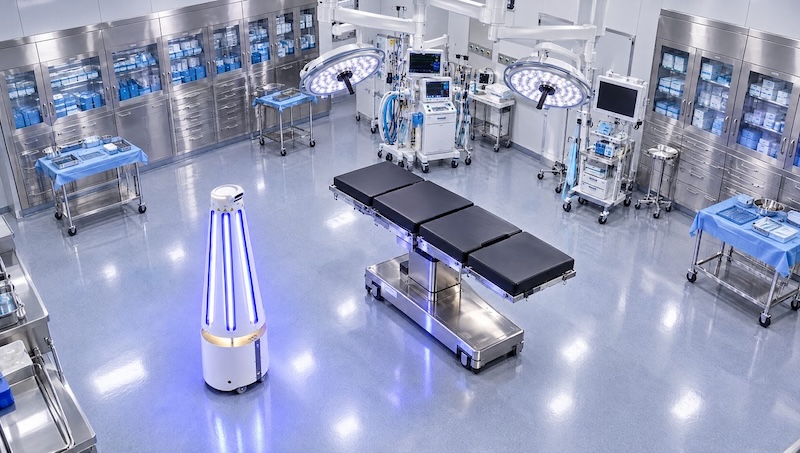
An autonomous UV-C disinfection robot developed by Ryberg Healthcare has met international disinfection standards, according to a study by researchers at Leiden University.
The Omnia robot was evaluated by researchers at the university’s Institute of Biology Leiden in a furnished laboratory designed to emulate a hospital environment.
Published in the peer-reviewed journal Infection Prevention in Practice, the study found that the autonomously moving robot met acceptance criteria requiring a log reduction of at least 5.
Researchers tested Omnia against several indicator bacteria and reported reductions of more than 7 log for Escherichia coli and more than 5 log for Pseudomonas putida, used as a model for the hospital pathogen P. aeruginosa.
On Omnia’s “Deep” setting, Bacillus subtilis, a model for Gram-positive bacteria, was reduced by more than 7 log.
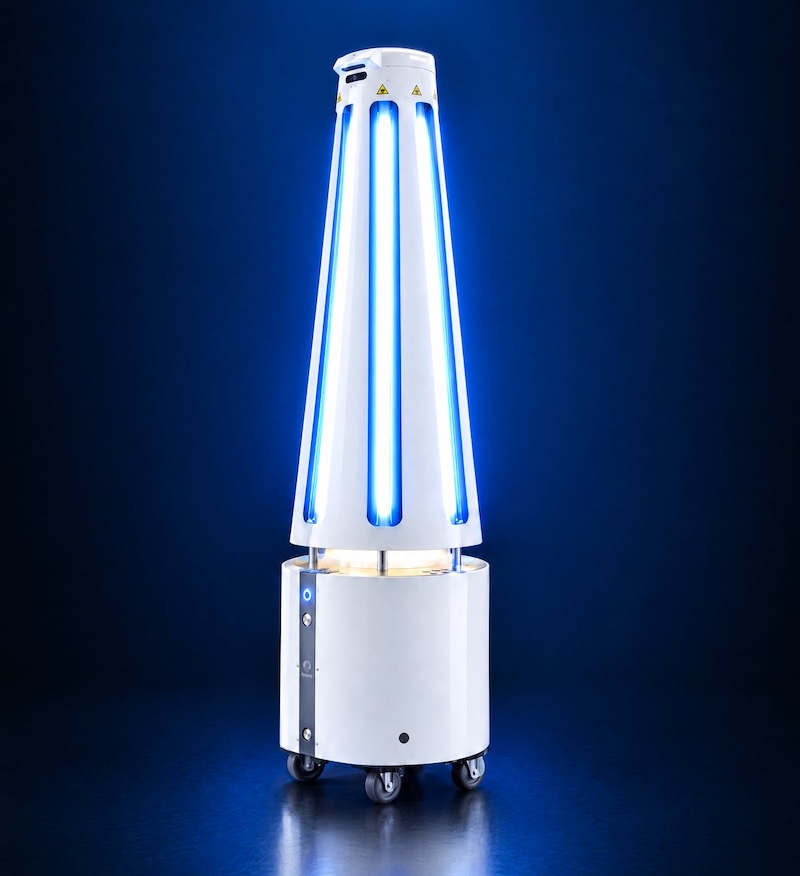
Researchers also compared autonomous and static UV-C disinfection. They found that autonomous operation was more effective than a static device for the same disinfection duration and light intensity, particularly in partially shadowed areas.
In a static test conducted according to British standard BS 8628:2022, the robot achieved a 4.0 log reduction for E. coli, below the required 5 log threshold. With the robot moving autonomously, the reduction exceeded 7 log.
The authors conclude: “This study demonstrates that the robot is capable of achieving log reductions higher than currently used disinfection methods, and the disinfection reports generated provide an indication for actual microbial log reductions achieved.”
They also conclude that “UV-C disinfection with an autonomous robot is more effective than using a static device for the same disinfection duration and light intensity.”
The researchers stressed that autonomous UV-C disinfection is intended to supplement rather than replace manual cleaning.
Nikolaj van Veen, CEO of Ryberg Healthcare, said: “Hospitals and their teams work on infection prevention every single day. With this peer-reviewed study from Leiden University, they now have concrete data on what autonomous UV-C disinfection can add as an extra layer of safety alongside their existing cleaning and disinfection processes. We look forward to talking with hospitals about a demonstration or an on-site trial.”
The researchers noted that the study was conducted in a furnished laboratory rather than a hospital and did not simulate a patient bed or bathroom. Further research is planned involving additional pathogens and shadowed areas.
