Warehouse automation is advancing quickly. Autonomous mobile robots, automated storage and retrieval systems, robotic picking cells, autonomous forklifts, conveyors, vision systems and increasingly sophisticated warehouse software are changing how products move through distribution centers and manufacturing facilities.
The goal behind most of these investments is straightforward: move more material with greater consistency, accuracy and efficiency.
But greater automation also changes the consequences of equipment downtime.
In a largely manual operation, one disabled forklift or pallet truck may slow a particular workflow. In a highly connected warehouse, the same failure can interrupt a process that depends on multiple systems working together.
If material does not reach an automated cell on time, the robot may have nothing to process. If a lift truck cannot replenish a storage zone, downstream picking activity can eventually slow.
If an automated vehicle is unavailable, software may be forced to reroute work through less efficient paths.
Automation can reduce many forms of operational friction, but it does not eliminate the need for reliable equipment. In many cases, it makes uptime even more important.
Automation Creates Connected Workflows
Modern warehouse technology increasingly operates as an ecosystem rather than as a collection of independent machines.
Warehouse management systems determine where inventory should go. Warehouse execution systems coordinate tasks across people and equipment. Autonomous mobile robots transport materials between work areas.
Robotic arms pick, palletize or depalletize products. Forklifts and other material handling equipment continue to move loads through receiving, storage, production and shipping.
Each technology may perform a different function, but the overall operation depends on those functions remaining synchronized.
This interconnectedness creates efficiency when everything is working correctly. It can also magnify the effects of an unexpected breakdown.
Consider a manufacturing facility where automated equipment moves components from storage to production. A robot may perform the repetitive transportation work, but forklifts may still handle inbound loads, replenish storage positions and move finished products to shipping.
A problem with one part of that material flow can create congestion elsewhere. Production does not necessarily care whether the disruption was caused by a robot, forklift, conveyor or software system. From an operational perspective, material simply stopped arriving when it was needed.
That makes uptime a system-level concern.
The Most Advanced Warehouse Still Relies on Physical Equipment
Warehouse automation discussions naturally focus on software, robotics and artificial intelligence. Those technologies deserve attention, but physical equipment remains the foundation of most material handling operations.
Forklifts, pallet trucks, reach trucks, order pickers and other vehicles continue to perform tasks that automation may not yet handle efficiently or economically.
Even highly automated facilities frequently operate mixed fleets that combine conventional equipment with autonomous systems.
That creates an important operational reality: adding automation does not necessarily reduce the importance of maintaining traditional equipment. Instead, managers must maintain a broader and increasingly diverse equipment environment.
A single facility may now need to monitor conventional lift trucks, automated vehicles, batteries and charging systems, safety technologies, sensors and software-connected assets.
Reliability therefore becomes part mechanical discipline and part data management.
Preventive Maintenance Becomes More Important, Not Less
As warehouse workflows become more interconnected, reactive maintenance becomes increasingly risky.
Waiting until equipment fails can create cascading delays that reach far beyond the disabled machine.
Preventive maintenance offers a different approach. Inspections, scheduled service, fluid and filter changes, wear-part replacement and early identification of developing problems help maintenance teams address issues before they become operational emergencies.
The objective is not simply to avoid repair costs. It is to protect the flow of the operation.
That distinction becomes more important in automated environments because high throughput often depends on predictable equipment availability.
For facilities examining how maintenance, emergency service, rental capacity, training and fleet technology can work together to protect operations, Black Equipment provides an example of an uptime strategy that looks beyond individual repairs and considers the broader material handling environment.
This type of approach becomes increasingly valuable as warehouse systems grow more complex.
Data Can Turn Maintenance into an Operational Tool
Connected equipment also creates opportunities to manage uptime more intelligently.
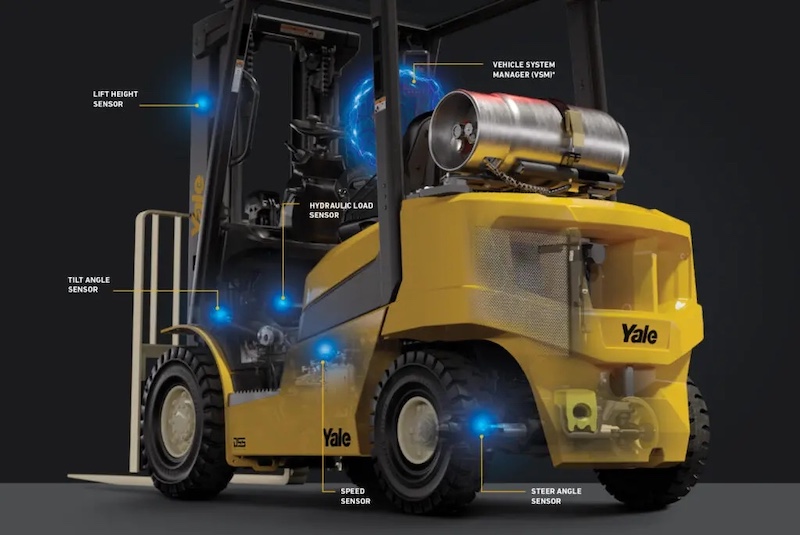
Telematics systems can provide visibility into utilization, fault codes, operating hours, impacts and maintenance activity. Instead of relying entirely on fixed service intervals or waiting for an operator to report a problem, managers can use equipment data to identify patterns.
A truck accumulating substantially more hours than the rest of the fleet may require a different maintenance schedule.
Repeated fault codes may reveal a mechanical issue before a complete failure occurs.
Utilization data may also show that certain vehicles are being overworked while others remain underused.
This information allows companies to make maintenance decisions based on actual operating conditions rather than assumptions.
The same principle increasingly applies to automated equipment. Robots, autonomous vehicles and warehouse software generate enormous amounts of operational data. The companies that use this information effectively can move from reacting to failures toward identifying the conditions that often precede them.
Predictive maintenance is ultimately another form of automation: using data to determine when intervention is necessary before productivity is affected.
Redundancy Should Be Part of Automation Planning
No equipment system can guarantee perfect uptime.
Machines eventually require service. Batteries need charging. Components wear out. Unexpected failures happen.
For that reason, warehouse automation planning should include redundancy.
That may mean maintaining additional material handling capacity, having rental equipment available, stocking commonly needed parts or creating alternative workflows that can keep material moving when a primary system is unavailable.
The goal is not necessarily to duplicate every piece of equipment. That would be expensive and inefficient.
Instead, operations teams should identify the assets that would create the greatest disruption if they failed and determine how work would continue without them.
As warehouses become more automated, contingency planning should extend across both conventional and robotic equipment.
A highly automated operation without a fallback strategy can still be vulnerable to a surprisingly small mechanical problem.
Operators Remain Part of the Uptime Equation
Human operators also play an important role in equipment reliability.
Pre-shift inspections can reveal tire damage, leaks, unusual sounds or other warning signs before they become major failures. Proper equipment operation reduces unnecessary wear. Early reporting gives maintenance teams an opportunity to investigate problems while they are still manageable.
Automation changes the type of work performed by people, but it does not remove the value of trained employees who understand how equipment should behave.
In mixed environments, employees may also become responsible for interacting with several types of technology. Training therefore needs to evolve alongside the equipment itself.
The most reliable warehouse is not simply the one with the most advanced technology. It is the one where technology, equipment, maintenance processes and people work together effectively.
Uptime is Becoming Part of Automation Strategy
Warehouse automation will continue expanding as companies pursue greater throughput, flexibility and resilience.
The next stage of that evolution will involve more than installing additional robots.
Companies will need to consider how automated systems interact with existing equipment, how maintenance data feeds operational decisions and how quickly workflows can recover when something fails.
The warehouses that perform best will likely be those that view uptime as part of their automation architecture rather than as a maintenance department metric.
Automation can transform how materials move.
But regardless of how intelligent the software becomes or how autonomous the equipment gets, one fundamental requirement remains unchanged: the operation only delivers value when the equipment is available to work.
