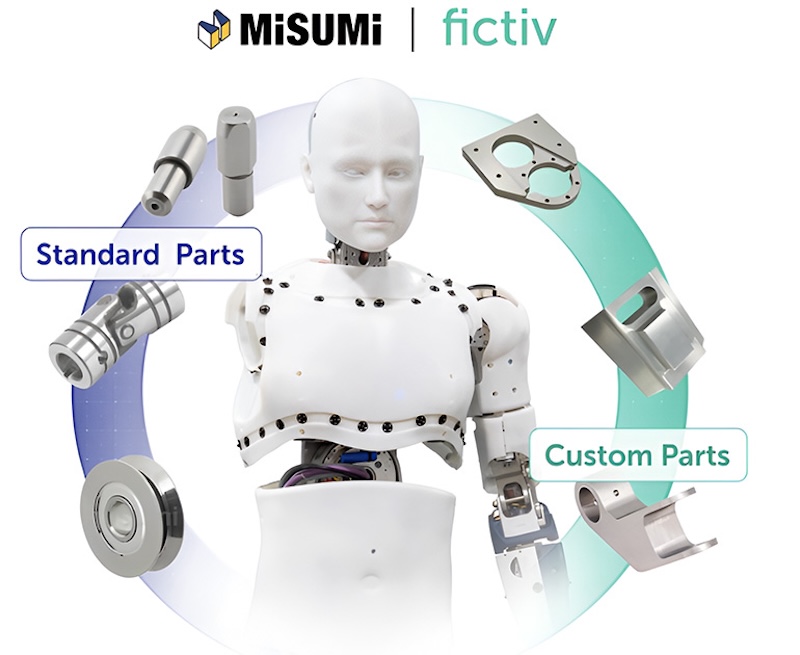
As humanoid robot developers race to move their machines from demonstrations and pilot projects into factories and other working environments, another challenge is rapidly coming into focus: how to manufacture these highly complex machines at scale.
Building a handful of working humanoids is one thing. Producing hundreds or eventually thousands of robots with consistent quality, predictable costs and reliable supply chains presents a very different engineering problem.
Humanoids contain dozens of actuators alongside motors, precision gears, bearings, sensors and machined components, while many of their designs are still evolving rapidly as manufacturers learn from real-world deployments.
That creates an unusual manufacturing challenge in which companies may need to increase production while continuing to modify the product itself.
The issue is becoming increasingly important as investment in humanoid robotics grows and companies including Boston Dynamics, Figure, Agility Robotics and several major automotive manufacturers prepare for larger-scale deployments.
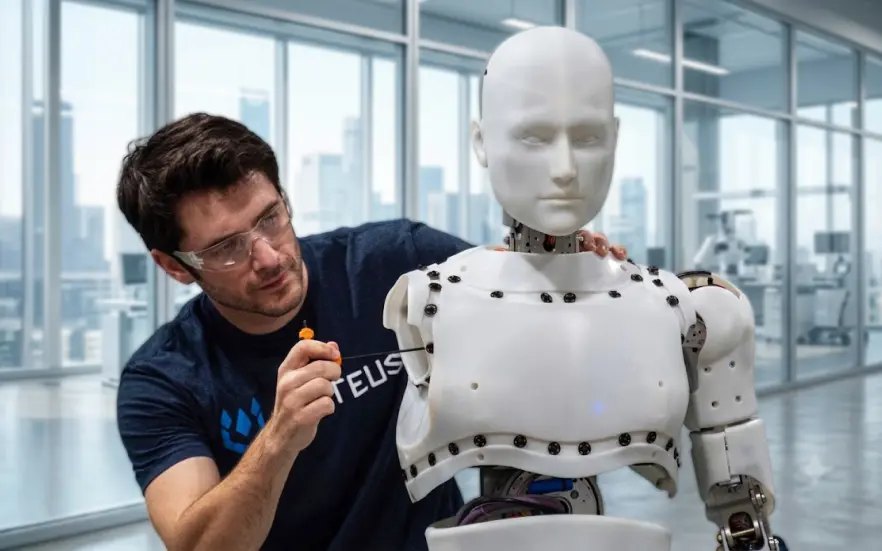
In this Q&A, Steve Ricketts, SVP of business development at Misumi Americas, a major supplier of mechanical components and industrial automation parts to manufacturers and machine builders, and digital manufacturing and supply-chain company Fictiv, discusses what happens when humanoid developers make the transition from prototype to production, where manufacturing bottlenecks are likely to emerge, how costs could be brought down, and whether the industry will eventually converge around standardized components and manufacturing processes.
Interview with Steve Ricketts

Robotics & Automation News: Humanoid robotics companies are demonstrating increasingly capable prototypes, but how different is the engineering challenge of building one or 10 successful robots from manufacturing hundreds or thousands of them reliably and economically?
Steve Ricketts: It’s a fundamentally different problem. A prototype proves the concept works. Production proves you can repeat it. At one to ten units, engineers can hand-fit parts, tweak tolerances, and work around quirks.
At hundreds or thousands, every one of those workarounds becomes a source of variation, cost, and delay. Success depends on design for manufacturability, tolerance stack-ups that hold across batches, consistent supplier quality, and assembly processes that don’t depend on a few skilled people.
The teams that scale fastest treat manufacturing as a design input from the start, not a hurdle to clear after the design is done.
R&AN: When robotics startups make the transition from prototype to production, where do you most commonly see problems emerge?
SR: Most often it’s designs that were never created with volume manufacturing in mind, and nearly every other problem traces back to that.
Parts that were CNC-machined from solid stock for a prototype may need to become castings or molded components, which changes tolerances, tooling lead times, and cost.
We also see tolerances specified tighter than the function requires, assembly sequences that are difficult to repeat, and single-source components that become risks at volume.
Quality control is another gap, because inspection methods that work for ten parts rarely scale to a thousand. Catching these issues early is far cheaper than redesigning later.
R&AN: Humanoid robots contain unusually large numbers of actuators, motors, gears, bearings, sensors and precision-machined components. Are there particular components or manufacturing processes that you expect to become bottlenecks as humanoid production volumes increase?
SR: Actuators are the most likely pressure point. Each humanoid needs dozens of them, and each actuator combines motors, precision gears, bearings, encoders, and housings.
High-precision gearing, such as harmonic drives and planetary reducers, and the machining behind them are capacity-constrained today. Rare-earth magnets for motors are another supply-chain concern, as are specialized bearings and sensors.
On the process side, five-axis machining, precision grinding, and tight-tolerance inspection will strain existing capacity. Expect a shift toward more automated production and in-line metrology to keep quality consistent as volumes climb.
R&AN: Traditional product development tends to move from prototype to design freeze and then volume manufacturing, but humanoid companies are still changing their hardware rapidly as they learn from deployments. How do you manufacture at scale when the product itself may continue changing from one production batch to the next?
SR: You need a manufacturing approach built for change. That means using flexible processes, such as CNC machining, 3D printing, and soft or bridge tooling, for as long as the design is still evolving, and committing to hard tooling only for stable subassemblies.
Modular architectures help, because you can update a forearm or a hand without redesigning the whole robot.
Strong revision control, clear communication with suppliers, and digital manufacturing platforms that can quote and produce updated parts quickly all keep iteration from turning into chaos. The goal is to scale production in stages rather than waiting for a perfect design.
R&AN: There is considerable discussion about eventually bringing the cost of humanoid robots down to tens of thousands of dollars. From a manufacturing perspective, where are the biggest opportunities to reduce costs?
SR: It will take several levers working together. Design simplification is the biggest: fewer parts, fewer unique fasteners, and fewer tight tolerances where they aren’t needed.
Component standardization comes next, since reusing actuator designs across joints concentrates volume and lowers unit cost.
Moving from machined parts to castings, stampings, and injection-molded components makes a big difference once volumes justify tooling. Volume itself drives down supplier pricing, and material choices matter too.
Vertical integration can help with the most critical subsystems, but most companies will still rely on a strong supplier ecosystem to get there.
R&AN: Some of the largest companies entering humanoid robotics have substantial manufacturing resources of their own, while startups are much more dependent on external suppliers and manufacturing partners. Does that give established automotive and industrial companies a significant advantage as the sector moves from prototypes toward mass production?
SR: Established manufacturers do have real advantages: supply chain leverage, production expertise, capital, and experience with quality systems at scale.
But startups aren’t without strengths. They move faster, take design risks that larger organizations avoid, and can build new architectures without legacy constraints.
Access to manufacturing capability is also becoming less of a barrier, because on-demand manufacturing partners and digital platforms give smaller teams access to capabilities that once required owning a factory.
I expect the winners to be whoever pairs great hardware design with disciplined manufacturing execution, regardless of company size.
R&AN: If humanoid robots eventually reach automotive-style production volumes, how different will the robots themselves need to become from the machines we’re seeing today? Do you expect the industry ultimately to converge around more standardized components, architectures and manufacturing processes, or will humanoid hardware remain highly proprietary?
SR: Today’s robots will look quite different from the volume versions. Expect fewer parts, more integrated subassemblies, and designs optimized for casting, molding, and automated assembly rather than machining. I think we’ll see partial convergence.
Commodity elements like motors, bearings, sensors, and fasteners will standardize, and actuators may follow as the market matures, much as the auto industry standardized many components.
Differentiation will likely stay proprietary in areas like software, hand design, and overall system architecture. The industry will probably end up with a shared supply base supporting distinct products.
