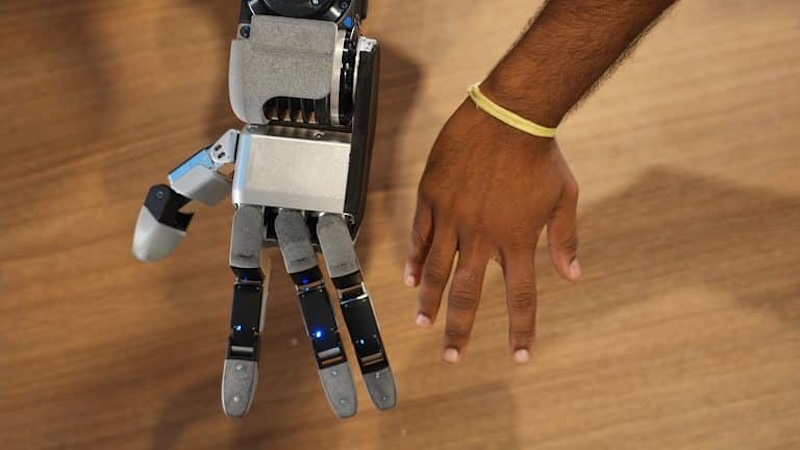
Boston Dynamics has unveiled a new four-finger hand for its Atlas humanoid robot, designed to combine the dexterity needed for complex manipulation and tool use with the strength and durability required for industrial work.
The new hand has 13 degrees of freedom (DOF), including a four-DOF opposable thumb, and uses direct actuation together with dense tactile pressure sensors across the fingertips and palm.
Boston Dynamics says the design enables Atlas to perform complex manipulation tasks including in-hand object reorientation, pinch and tripodal grasps, recovery from slipping objects, and operation of tools such as drills, power torque drivers, grinders, nail guns and welding torches.
The company deliberately chose four fingers rather than attempting to reproduce the five-finger human hand, arguing that eliminating the pinky reduces cost, size, actuator count and potential failure points without significantly reducing functionality.
From grasping to manipulation
Atlas’ previous seven-DOF hands were primarily designed to grasp a wide range of objects. Boston Dynamics says the new generation has been developed to manipulate them.
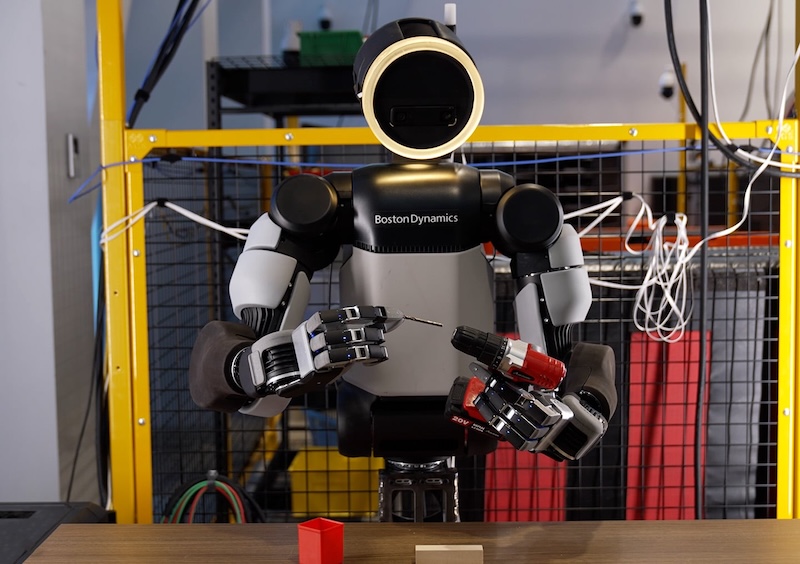
Each of the three fingers has three degrees of freedom, while the opposable thumb has four. The thumb can slide along both the length and width of the other fingers, allowing Atlas to form different pinch and tool-holding configurations.
The hand is approximately the size of a large human hand, partly because Atlas is intended to operate in environments, spaces and workstations originally designed for people.
Despite the increased dexterity, Boston Dynamics says the new hand maintains similar strength to its previous design. The company has previously demonstrated Atlas carrying a loaded minifridge weighing more than 100 lb.
The actuators are encapsulated and use a single actuator type, with no cables crossing the joints. Boston Dynamics says this architecture is intended to improve ruggedness, manufacturability and repairability as humanoid robots move toward larger-scale production.
Why Atlas only has four fingers
Boston Dynamics says the decision to omit the fifth finger followed internal experimentation over whether a pinky provided enough additional functionality to justify the added complexity.
During development, chief technology officer Zack Jackowski asked members of the team to tape their pinky and ring fingers together for a day and report which tasks they could no longer perform.
The experiment helped convince the development team that four fingers were sufficient for the capabilities it was targeting.
Adding another finger would require three additional actuators, increasing the hand’s cost, volume and number of potential failure points.
The resulting four-finger architecture can still perform in-hand reorientation, recover from slipping grasps and hold tools while operating their triggers.
Tactile sensing for industrial work
The hand incorporates dense pressure tactile sensors covering its fingertips and palm, complementing the proprioceptive sensing provided through its actuators.
Boston Dynamics says this allows Atlas to detect small contact signals while interacting with objects and provides the feedback required for more delicate manipulation.
Backdrivability and actuator transparency are also central to the design, enabling the robot to use proprioception for agile manipulation and force regulation.
Tool use is a particular focus.
Rather than attempting to create a hand capable of performing every task directly, Boston Dynamics sees tools as a way of extending the capabilities of humanoid robots in much the same way they extend human capabilities.
The company argues that this will become increasingly important as humanoids move beyond conventional pick-and-place operations into tasks involving assembly, cables, tools and objects presented in less structured environments.
Designed for reinforcement learning and simulation
The hand has also been designed specifically with simulation and reinforcement learning in mind.
Boston Dynamics says its rigid-drive actuation, backdrivable transmission and control systems allow the physical behavior of the hand to be reproduced with high fidelity in simulation.
This enables reinforcement learning systems to train manipulation policies while varying factors including motor torque, surface friction, object geometry and disturbances before transferring those behaviors to the physical robot.
The company says it has already achieved initial sim-to-real results in dynamic manipulation tasks, with behaviors trained entirely in simulation and then deployed on Atlas hardware using high-rate actuator proprioception for feedback.
Boston Dynamics sees reinforcement learning as an important complement to human demonstration data. Human demonstrations can provide large amounts of information about how objects are manipulated, while simulated reinforcement learning can train the high-speed control and force regulation required to execute those movements reliably on a robot.
The hand has been developed as a companion to the latest generation of Atlas, Boston Dynamics’ fully electric humanoid robot, which the company is developing for industrial applications and eventual large-scale manufacturing.
Boston Dynamics says dexterous tool use will be a core capability if humanoid robots are to become flexible machines capable of performing a broad range of real-world industrial tasks.
