By Pramod Ghadge, co-founder and CEO, Unbox Robotics
Global ecommerce has spent the better part of a decade optimising how goods move forward, from warehouse to doorstep.
As online shopping keeps growing worldwide, so does the volume of goods coming back, and most warehouses were never built with the physical infrastructure or the intelligence to handle it.
A global survey of 491 executives across ten manufacturing-centric industries, conducted by Bain & Company, the World Economic Forum and the University of Cambridge, found that 79 percent consider circularity crucial to their business today, yet only 20 percent believe their supply chain capabilities are actually fit for purpose.
Reverse logistics was singled out as one of the clearest reasons why: costly, complex, and often run on weak networks and limited digital tracking.
For retailers, the gap is substantial since reverse logistics is a second supply chain running in the opposite direction. Closing this gap increasingly depends on smartly pairing AI with robotics to meet the growing volume seen today.
Why reverse logistics is uniquely hard
Forward fulfilment is comparatively predictable. Demand can be forecast, inventory can be positioned in advance, and the path from shelf to shipment is largely linear.
Returns break most of those assumptions. Volume is erratic, with a single marketing campaign, a sizing issue, or a seasonal spike capable of sending return rates climbing overnight, often with little warning for the teams who have to process it.
Conditions are just as inconsistent as returned goods arrive in every state imaginable: some damaged, some missing parts or packaging; each one requires a different decision for further processing.
Compounding the above, the return process itself is fragmented, with an item typically passing through inspection, grading, restocking, refurbishment or disposal, often across different teams and systems that were never built to talk to one another.
Together, these factors make reverse logistics one of the most operationally demanding parts of the retail supply chain, and one of the most expensive to get wrong.
Where AI meets robotics on the warehouse floor
Solving this requires two things working together: a system that can make fast, accurate decisions about what to do with a returned item, and a physical system that can act on those decisions at scale.
This is where AI and robotics increasingly meet. Computer vision and machine learning models can assess a returned item, check its condition, cross-reference it against inventory and sales data, and recommend a next step within seconds, rather than leaving that judgement to a manual, item-by-item review.
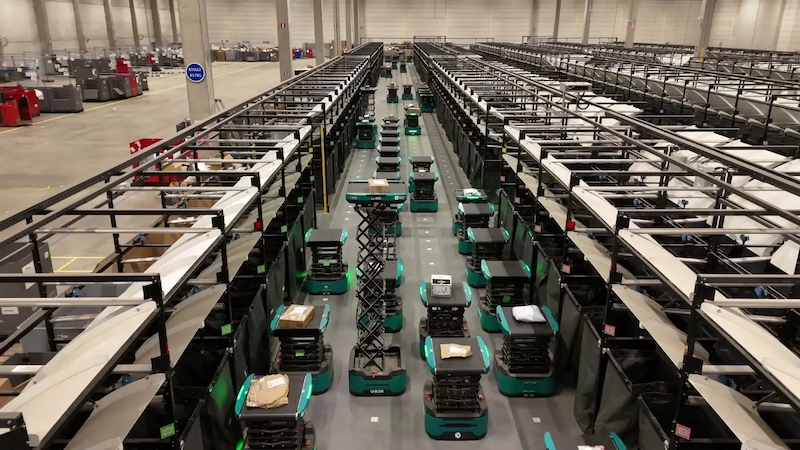
But a decision is only useful if it can be executed quickly. That is the role mobile robots (AGV or AMR) play, moving items to the right sorting, grading or restocking location without waiting on manual handling at every stage.
Many of these systems now rely on decentralised coordination among robots (aka swarm intelligence) rather than a single central controller, allowing a fleet to adapt in real time as volumes spike or shift, rather than grinding to a halt at the first bottleneck.
Gartner research points to this trend, projecting that by 2030 half of new warehouses built in developed markets globally will be designed with robotic fleets forming the operational backbone.
Space is the other constraint reverse logistics runs into quickly. Returns processing competes for the same square footage as forward fulfilment, and few retailers want to expand their footprint just to handle returned products.
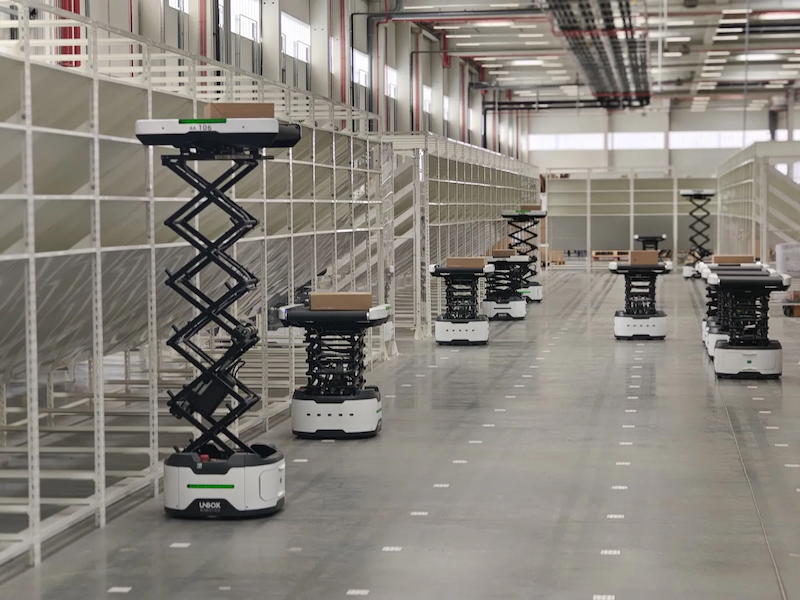
Robotic systems that operate vertically – using a warehouse’s height rather than only its floor space – allow returns capacity to be added during peak seasons without a facility expansion, a meaningful advantage wherever warehouse space is constrained and costly to add.
What this combination delivers
Put together, AI-driven decisioning and robotic execution change what is possible in reverse logistics. Sorting and grading become faster and more consistent, since AI models can classify items and route them accordingly instead of relying on manual inspection at every step, cutting the time between a return arriving and a decision being made.
Most importantly, returns become measurable, with real-time dashboards integrated into existing WMS or ERP systems giving operations teams visibility into return volumes, rejection reasons and processing throughput, turning reverse logistics into a function that can be tracked and improved rather than simply endured.
The role of people doesn’t disappear, it shifts
None of these upgrades points to warehouses without people, but to people doing different work. As AI takes on classification and robots take on movement, the tasks left for human teams change shape: fewer hours spent manually inspecting every returned item, and more time spent handling the cases that genuinely need judgement; that is, an item with ambiguous damage, a product that doesn’t fit any standard grading rule, a customer dispute that needs resolving before a return can be processed.
Gartner describes this as human-optional facilities: not the absence of people, but operations in which human involvement is reserved for exceptions rather than treated as the default.
For retailers, this shift matters as much as any efficiency gain, since it changes what returns teams are hired and trained to do.
Building resilient reverse logistics
One thing remains unchanged: returns will continue to be unpredictable, and no single system removes that entirely.
But the combination of AI decisioning and flexible robotic execution gives retailers something they haven’t had before: a way to treat reverse logistics as a manageable, even improvable, part of the business rather than a cost centre to be tolerated.
As return volumes keep climbing globally and expectations around sustainable, efficient returns keep rising, retailers who build this intelligence and flexibility into their reverse logistics now will be the ones who turn a persistent operational headache into a source of resilience and competitive advantage.

About the author: Pramod Ghadge is the co-founder and CEO of Unbox Robotics, a global warehouse automation company that designs and deploys intelligent robotic systems for parcel sortation and order consolidation.
