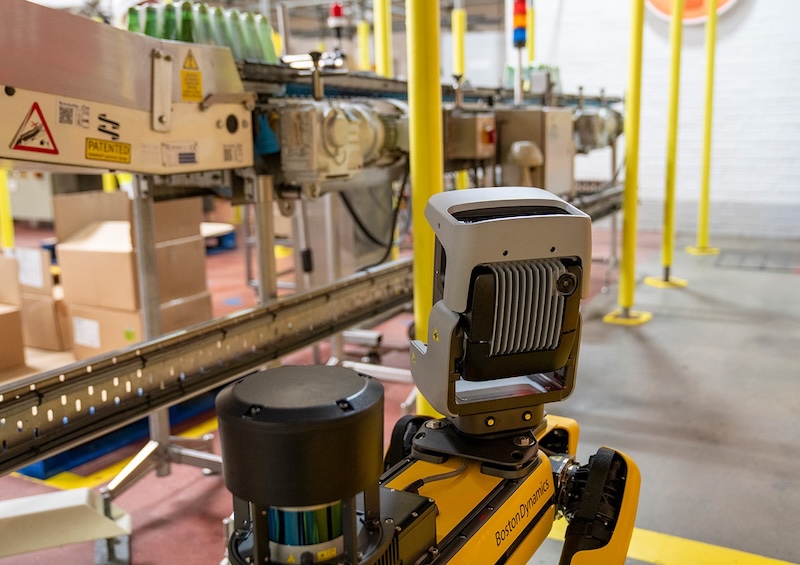
Boston Dynamics has released Spot 5.2, a major software update designed to connect its quadruped robots more closely with enterprise systems and enable AI agents to trigger autonomous inspections and other actions on the factory floor.
The release expands the capabilities of both the company’s Spot robot and Orbit fleet management software, with new integrations intended to connect data from robots, industrial sensors, cameras and enterprise platforms.
Boston Dynamics says the aim is to move beyond isolated AI and automation systems by enabling information from different parts of an industrial facility to trigger actions by Spot.
The update also expands Spot’s inspection capabilities through Google Gemini-powered visual intelligence, video inspections, site-wide monitoring and new predictive maintenance tools.
Connecting Spot with enterprise systems
A central part of Spot 5.2 is a redesign of Boston Dynamics’ Orbit software around industrial assets rather than individual inspections.
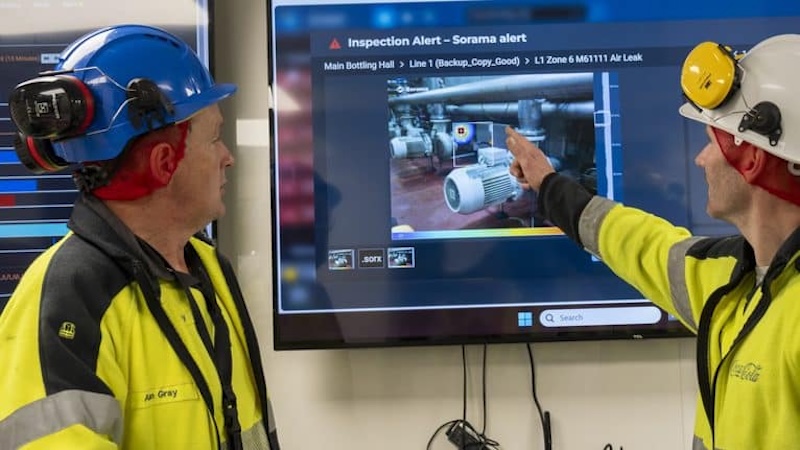
Orbit can now import asset hierarchies and associated metadata and link individual assets to inspections performed by Spot.
The approach more closely reflects the way equipment is organized in systems such as computerized maintenance management systems (CMMS), manufacturing execution systems (MES) and enterprise asset management (EAM) platforms.
Users can add information including an asset’s location, type, criticality, manufacturer and model.
The additional metadata enables more targeted alerts and allows operators to examine equipment performance at different levels.
For example, engineers responsible for pumps could receive alerts specifically relating to pump anomalies. Plant managers could also use Orbit’s asset dashboard to examine trends across an entire facility, a particular class of equipment or machines within a specific production area.
AI agents can dispatch Spot
Boston Dynamics is also opening Orbit to more external data sources through expanded API capabilities.
Inputs can come from systems including programmable logic controllers, fixed sensors and security cameras rather than exclusively from Spot.
The company says this provides the foundation for a new Model Context Protocol (MCP) layer through which AI agents can autonomously deploy Spot when predefined business conditions are met.
In a predictive maintenance application, for example, an alert from a fixed sensor could trigger Spot to travel to the affected machine and collect additional information.
A robot could alternatively be instructed to perform an inspection only while a particular piece of equipment is operating.
Similar workflows can be applied to security operations. Spot could be dispatched to investigate an area after a CCTV system or third-party sensor detects movement.
The result is intended to turn Orbit into a connection between physical robotic operations and the wider enterprise software environment.
Google Gemini expands Spot’s visual inspections
Spot 5.2 also expands the robot’s visual inspection capabilities using Google Gemini.
Boston Dynamics previously announced that its AIVI visual inspection system would use Gemini models trained on industrial data.
The system is designed to perform specialized inspections involving equipment such as 5S boards, sight glasses, pallets and gauges.
The new release extends these capabilities to video inspections through AIVI-Learning.
Video allows Spot to identify conditions that may be difficult to detect from individual images. Potential applications include detecting water dripping from pumps and motors, identifying slipping conveyor lines and recognizing equipment warning lights.
Water leaks could indicate conditions likely to cause corrosion or hazardous puddles, while conveyor movement abnormalities could provide early warning of equipment problems and potential downtime.
Spot can continuously scan facilities for risks
Boston Dynamics has also introduced Site Scans, which enable Spot to look for temporary or unexpected conditions while moving through a facility.
Unlike conventional robotic inspections associated with a predetermined asset or location, Site Scans use the AIVI-Learning model to analyze Site View 360-degree images for potential risks.
These could include spills, people entering restricted areas or unattended objects such as suspicious backpacks.
Site Scans monitor the entire facility by default, although operators can configure particular zones and time periods for monitoring.
The capability broadens Spot’s role from carrying out scheduled equipment inspections to continuously observing changing conditions across industrial sites.
New predictive maintenance capabilities
Spot 5.2 introduces three additional predictive maintenance capabilities: gas sensing, visual vibration analysis and partial discharge detection.
Integration with the MFE Spot Connected Gas Detection Solution enables the robot to autonomously monitor more than 20 types of gas in real time.
Atmospheric measurements collected during routine autonomous missions can be streamed directly into Orbit alongside other inspection information.
Visual vibration analysis provides another method of monitoring machinery. Using Spot Cam, the system amplifies movement that is too small to be easily detected by the human eye, potentially revealing changes in equipment behavior.
Partial discharge monitoring uses the Sorama L642 acoustic camera to inspect high-voltage equipment including cables, bushings and transformers.
The technology is designed to identify early indications of insulation problems before they develop into more serious equipment failures.
From AI analysis to physical action
The update reflects a broader effort to connect AI software with machines capable of acting on information in the physical world.
Industrial companies increasingly have data distributed across fixed sensors, cameras, maintenance platforms, enterprise software and robotic systems. Connecting those systems could allow an anomaly detected by one device or software platform to automatically initiate further investigation by a mobile robot.
With Spot 5.2, Boston Dynamics is positioning Spot and Orbit as part of that connective infrastructure, enabling AI-generated insights to lead directly to autonomous inspections and other physical actions inside industrial facilities.
