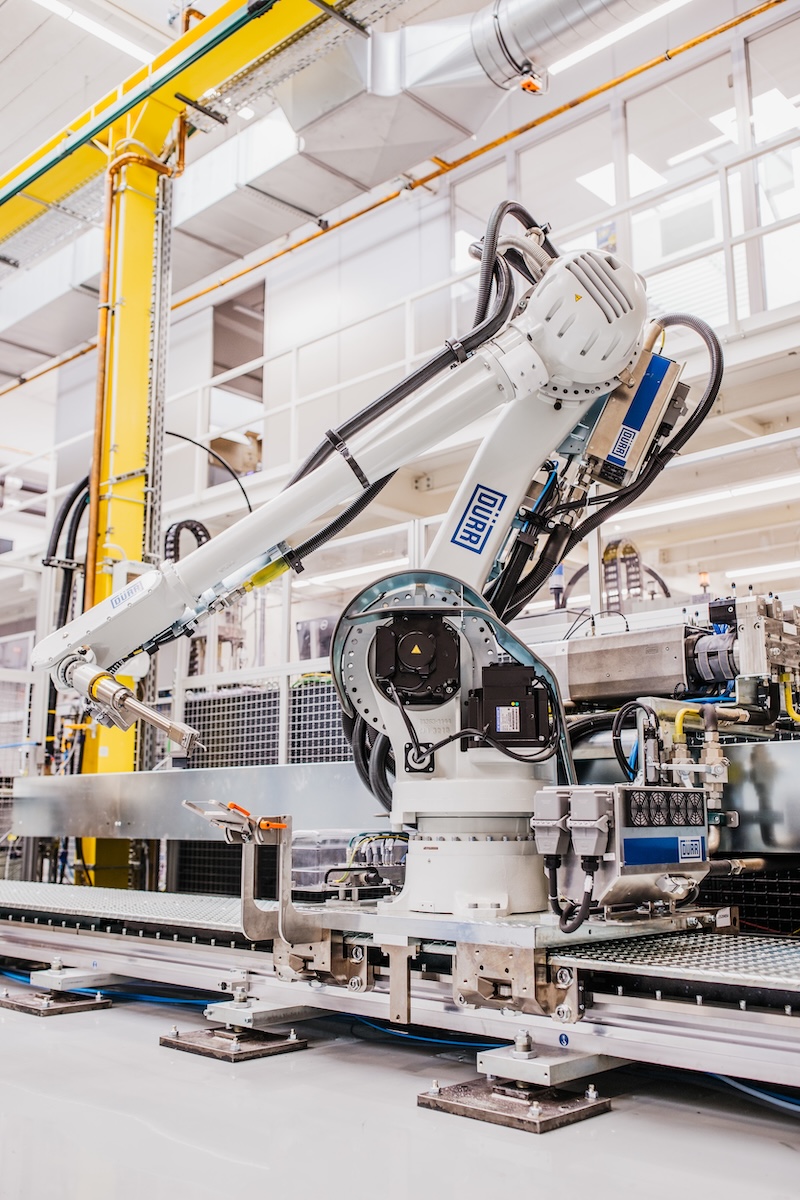
Dürr has launched four new industrial robots for automotive paint shops, covering payloads from 20 kg to 150 kg and applications including sealing, cleaning and material handling.
The new EcoRS Generation 2 range provides reach of up to 3,100 mm and is designed to replace multiple application-specific configurations with a standardized robot platform.
Dürr says the common architecture should simplify the planning of paint-shop automation as well as maintenance, spare parts management and servicing over the lifetime of the equipment.
Martin Wurst, product manager at Dürr, says: “With the new EcoRS generation, we are establishing a standardised platform for sealing applications. Customers benefit from high process quality, maximum availability, and significantly reduced complexity throughout the entire lifecycle.”
Robots designed specifically for paint shops
Rather than adapting general-purpose industrial robots for automotive finishing applications, Dürr says it has designed the EcoRS range specifically around paint-shop processes.
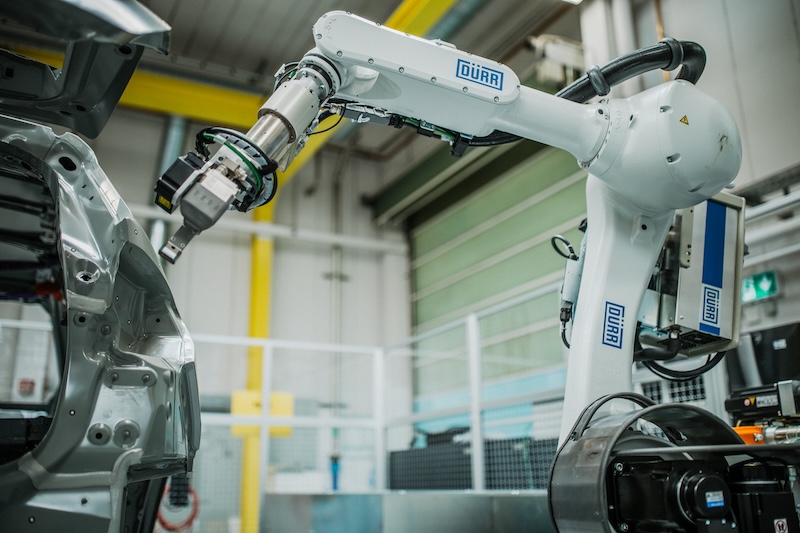
The company has integrated the robot mechanics, control system and application technology to improve path accuracy and consistency during material application.
Sealing is a particular focus. The robots are designed for fine-seam applications where manufacturers require consistent visible and functional seams across vehicle bodies.
Dürr has also enlarged the robots’ working envelope to accommodate different vehicle models and give manufacturers greater flexibility when introducing future vehicle programs.
Internal motors and cabling reduce robot footprint
One of the main changes in the second-generation EcoRS platform is the relocation of more components inside the robot.
Motors for axes three through six are now internally mounted, while cabling has also been routed internally.
The changes reduce the robot’s interference contour, giving it more room to operate around vehicles, equipment and other automation within the paint shop.
Dürr says the redesign also makes the robots easier to clean while reducing their overall space requirements and weight.
The company has developed the associated application equipment alongside the robots rather than treating it as a separate system. According to Dürr, the resulting integration between robot kinematics, controls and process technology improves repeatability and supports more reliable operation.
Common controls across painting and sealing robots
The EcoRS range uses the same control technology as Dürr’s painting robots and integrates with the company’s wider control architecture and DXQ software platform.
This gives manufacturers a common control and software environment across different areas of a painting line.
Operational and process data from different systems can therefore be analyzed together, allowing operators to identify performance problems and potential optimization opportunities across the facility.
Using a standardized control architecture should also make the robots easier to integrate into existing production environments.
Dürr targets lower maintenance costs
The four-model range is also intended to reduce the number of components manufacturers need to keep in stock.
A common platform means fewer spare-part variants as well as more standardized maintenance, troubleshooting and service procedures.
Dürr says this can reduce inventory and operating costs while improving equipment availability.
The company is positioning EcoRS Generation 2 as a single robotic platform capable of covering a broader range of paint-shop operations, reducing the need for separate robot architectures for individual sealing, cleaning and handling applications.
