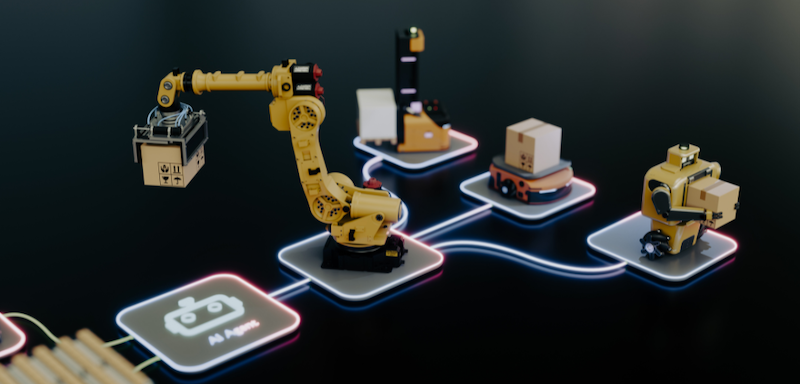
The manufacturing sector is no stranger to automation. According to the International Federation of Robotics (IFR), the global factory robot workforce has more than doubled in the last decade.
Yet, a recent UK Business Data Survey from 2026 reveals a startling gap: while many manufacturers are adopting artificial intelligence, only 12% have it fully integrated into their existing business systems.
This figure pales in comparison to the Information & Communication sector, where 39% of AI adopters have achieved full integration.
This data highlights a critical distinction: there is a significant difference between using isolated AI tools and running a truly “smart factory”.
A facility doesn’t become intelligent simply by installing a few robots or running a standalone predictive maintenance algorithm.
The real transformation – and the competitive advantage of Industry 4.0 – comes from creating a cohesive, data-driven ecosystem where AI is the central nervous system, not just a peripheral tool. So, what’s holding manufacturers back from bridging this gap?
The Difference Between an Automated Factory and a Smart Factory
For decades, the focus of industrial automation has been on replacing manual, repetitive tasks with machines. An automated factory is highly efficient at executing pre-programmed instructions on a production line.
It excels at consistency and speed but often operates in rigid, siloed workflows. If a disruption occurs, human intervention is typically required to diagnose and resolve the issue.
A smart factory, on the other hand, is a connected environment. It leverages the Industrial Internet of Things (IIoT), sensors, and cloud computing to create a continuous flow of data between physical machinery, Operational Technology (OT), and business management systems, Information Technology (IT), such as MES and ERP platforms.
In this ecosystem, AI is not just another tool; it becomes an intelligence layer that analyzes operational data and supports decisions related to production, maintenance, quality control, and resource planning.
The Unique Integration Challenges in Manufacturing
The journey from an automated facility to a smart factory is fundamentally a software and systems integration challenge. Manufacturers face several unique hurdles that make this transition far more complex than in other industries.
Legacy Systems and the OT/IT Divide
Many factories run on established, reliable legacy systems like Manufacturing Execution Systems (MES) and Enterprise Resource Planning (ERP) software. These platforms were not always designed to communicate with modern, cloud-native AI applications.
Bridging the gap between the OT world of PLCs and industrial protocols and the IT world of APIs and databases requires specialized expertise. This complexity is where many projects stall, as off-the-shelf software solutions may struggle to connect these disparate worlds.
This is a domain that calls for expert AI application development services capable of creating solutions that can process and interpret complex industrial data streams.
Data Fragmentation and Quality
In a typical factory, data is generated by numerous sources – sensors, machines, quality control stations, and manual logs. This data is often fragmented, unstructured, and stored in isolated “silos”. Before any meaningful AI analysis can occur, this data must be collected, cleaned, standardized, and contextualized.
Without a robust data architecture, AI models may be fed poor-quality information, leading to inaccurate predictions and unreliable performance. This foundational work often requires deep expertise in custom software development services to build the necessary data pipelines and integration layers.
High-Stakes Operational Environment
Unlike a software bug in a low-risk internal application, a failure in a factory’s control or monitoring system can halt production, leading to financial losses, quality issues, or safety risks.
The demand for high availability and strong security makes manufacturers understandably cautious about implementing new, insufficiently tested technologies directly into their core operations. Any new software must be rigorously tested and deployed without disrupting ongoing processes.
Building the Software Backbone for the Smart Factory
The core challenge, therefore, is not a lack of AI tools or hardware but the absence of a coherent software backbone to connect them. A smart factory needs a scalable and secure architecture that can:
- Integrate seamlessly with both legacy and modern systems.
- Collect and process vast amounts of data from diverse IIoT sources.
- Host and run AI models for tasks like predictive maintenance, quality inspection, and production scheduling.
- Provide clear, actionable insights to operators and managers through user-friendly applications.
This is where a strategic technology partner becomes invaluable. Companies with experience in industrial software, like SOFTECH, can support the development of these integrated ecosystems.
They understand the nuances of bridging the OT/IT divide and have the expertise to develop custom software that connects a factory’s existing infrastructure with the power of modern AI and cloud platforms.
By focusing on creating a solid software foundation, they help manufacturers de-risk their digital transformation journey and ensure that AI initiatives deliver measurable ROI.
From Potential to Performance: The True Value of Integrated AI
When AI is integrated into the operational fabric of a factory, its value can extend beyond a single department. It can unlock a higher level of visibility, coordination, and responsiveness.
Predictive maintenance models can analyze vibration and temperature data to support repairs before a machine fails, minimizing unplanned downtime.
AI-powered vision systems can inspect large volumes of parts and assist human teams in identifying defects, reducing waste and improving quality control.
Production schedules can also be adjusted more effectively based on new orders, resource availability, or supply chain delays.
Ultimately, the path to the smart factory is paved with smart software integration. The low 12% integration rate in manufacturing is not a sign of failure, but an indicator of the complexity of the task.
For manufacturers ready to move beyond isolated AI experiments, the focus must shift from simply acquiring technology to strategically building the connected, intelligent software ecosystem that will define the future of the industry.
