
Apple is expected to unveil its first-ever foldable iPhone on September 9, which will have to clear one of the foldable industry’s toughest hurdles: building a smartphone that can fold hundreds of thousands of times without cracking.
According to experts at femtosecond laser company Litilit, many electronics manufacturers now face a similar challenge: making durable and precise components as devices become smaller.
Foldable phones bring together several difficult materials and components, from ultra-thin glass and flexible display layers to compact printed circuit boards, ceramics and semiconductor parts.
Nikolajus Gavrilinas, CEO and co-founder of Litilit, says many components used in foldable phones and other consumer electronics need to be manufactured with extreme precision.
For example, one of Apple’s previous patents for a foldable smartphone describes locally thinned glass, down to as little as 10-50 microns at the fold, which, if it makes it into the final device on September 9, has to be manufactured without introducing cracks or heat damage.
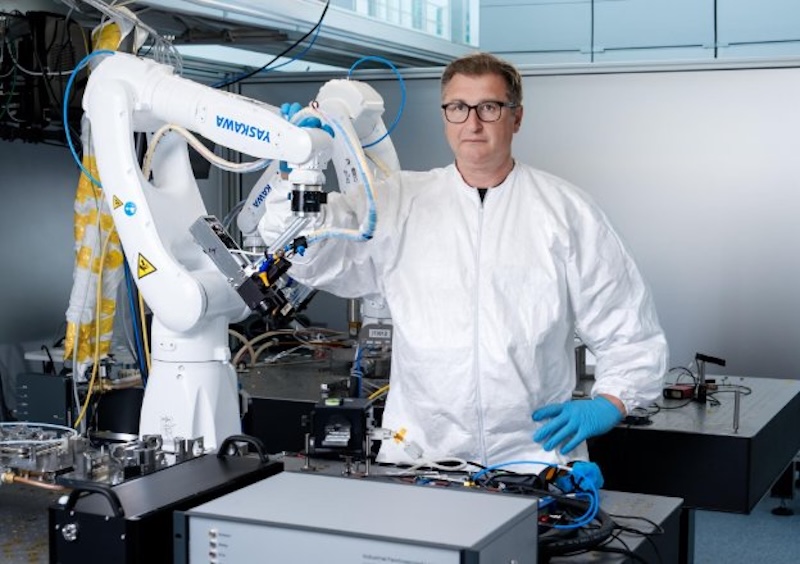
The flexible plastic layer underneath the display faces the same problem: it has to be cut to size without a rough or heat-damaged edge, because such a defect can turn into a tear after enough folds.
Gavrilinas says: “The market for electronic components keeps pushing manufacturing closer to its limits. In consumer electronics, even a tiny defect can turn into a crack that makes the whole component unusable.
“Femtosecond lasers solve these problems by using pulses so short that material evaporates before heat can spread, allowing them to process delicate components close to active circuitry without leaving heat damage or debris that could cause short circuits.”
According to Gavrilinas, femtosecond laser pulses are also well-suited for manufacturing OLED displays, used from foldable screens to smartwatches.
An OLED panel is a stack of different materials such as organic light-emitting layers, circuitry and protective layers, and even a few microns of heat damage can damage any of them. Femtosecond lasers are one of the key tools that make manufacturing OLED displays precise and reliable.
Meanwhile, manufacturing these advanced lasers is typically difficult and takes time, as femtosecond lasers rely heavily on highly skilled specialists, Gavrilinas says.
In addition, the growing demand for advanced lasers in consumer electronics, as well as other fast-moving fields such as semiconductors and manufacturing data center equipment, means supply may not keep up with rising demand.
Gavrilinas says: “To solve the scalability issue, we built them from the ground up with that in mind. Our lasers have reduced component complexity, modular design, and high-level automation, which results in faster manufacturing as well as easy integration into factories that manufacture parts for consumer electronics.”
Litilit builds lasers based on a few patented inventions, made by Litilit co-founders Kęstutis Regelskis, Nerijus Rusteika, and Gavrilinas, in close collaboration with the Center for Physical Sciences and Technology (FTMC) in Vilnius.
According to Gavrilinas, the company’s laser architecture achieves around 20 percent electrical-to-optical femtosecond efficiency, which is a strong result for this industry.
This June, Litilit started building a high-capacity femtosecond laser factory that will begin production in a few months. During the first year of production, Litilit plans to manufacture around 1000 lasers and, in a few years, reach an annual capacity of 3,000 femtosecond lasers, on track to be the highest production capacity in the industry.
The company is planning to expand production of lasers to other countries together with international partners.
